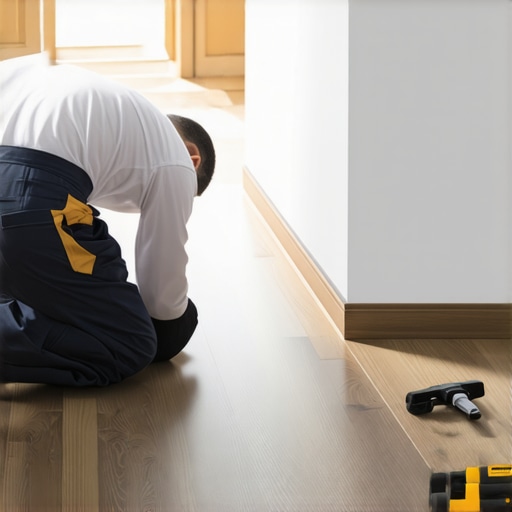

Why laminate flooring clicks when you walk on it
The physics of why a floor clicks
Laminate flooring clicks when you walk on it because the boards are moving vertically and rubbing against each other or the subfloor. This movement is usually caused by an uneven subfloor, debris trapped under the planks, or a lack of expansion gaps at the room perimeter. When the floor deflects under your weight, the locking mechanisms shift, creating friction and noise.
I spent three days grinding concrete on a job last month just so the floor would not click like a castanet. Most guys skip the leveling compound. They think the underlayment will hide the dip. It will not. I was in a basement in the humid part of the state, smelling like oak dust and WD-40, working on a slab that looked like the surface of the moon. If I had just laid the laminate over that mess, the homeowner would have heard every step for the next twenty years. A click is a cry for help from your subfloor. It means something is bending that should be flat. I have seen guys throw down a cheap foam pad and pray. Prayer does not fix a three sixteenths inch dip in a concrete slab. Only a grinder and a bag of self-leveler can do that.
The ghost in the expansion gap
The expansion gap is the space left between the edge of the flooring and the wall. It must be there. Laminate floors are floating systems, meaning they are not nailed or glued down. They expand and contract with temperature and humidity changes. If you pin the floor against the wall or under a heavy kitchen island, it has nowhere to go. The tension builds up in the locking joints. When you walk on it, that tension releases as a click or a snap. It is a structural engineering failure on a small scale. I always tell my apprentices that a floor needs to breathe. If you choke it at the edges, it will scream when you step on it. Many installers hide their mistakes with baseboards, but the noise gives them away every time. A floor is a living thing in a house. It moves. If you do not give it the half inch it needs at the perimeter, you are asking for a headache.
“A floor is only as good as the subfloor beneath it, deflection is the enemy of every joint.” – Master Flooring Axiom
Subfloor dips and the hollow sound
Subfloor flatness is the most ignored variable in modern construction. The industry standard is typically one eighth of an inch of deviation over a ten foot radius. If your floor has a valley deeper than that, the laminate planks will bridge over it. You now have an air pocket. When your foot hits that spot, the board bends down to meet the subfloor. This causes the tongue and groove to rub together. This friction is what produces the clicking sound. It is not just annoying. It is destructive. Over time, this constant bending will fatigue the locking mechanism. Eventually, the tongue will snap off entirely. Then you do not just have a click, you have a gap. I have pulled up floors where the HDF core was turned to powder because of this movement. You have to get the subfloor flat. There is no shortcut. I prefer a high quality Portland cement based leveler for concrete. For wood subfloors, you might need to sand down the high spots at the plywood seams. Do the work now or hear the click later.
The chemistry of the HDF core
Laminate is made of High-Density Fiberboard. This is basically wood fibers compressed with resin under high pressure. It is incredibly dense, but it is still wood. It reacts to moisture. When the humidity in a room spikes, the core absorbs that moisture and expands. If the boards are already tight, this expansion increases the pressure on the click-lock system. The noise you hear is the sound of wax or resin rubbing at the joints. Some manufacturers coat their joints in paraffin wax to keep them quiet. This works for a while, but it is a bandage, not a cure. If your home humidity fluctuates more than twenty percent, you are going to hear some movement. I always recommend keeping a house between thirty and fifty percent humidity. This keeps the core stable. It prevents the boards from growing so much that they bind up against each other.
Laminate performance comparison table
| Feature | Specification | Impact on Sound |
|---|---|---|
| Subfloor Tolerance | 1/8 inch over 10 feet | Reduces vertical deflection |
| Expansion Gap | 1/2 inch at perimeter | Prevents pressure clicking |
| Underlayment Density | High density 20+ lb/ft3 | Absorbs micro-vibrations |
| Wear Layer Thickness | AC3 to AC5 rating | Reduces surface impact noise |
| Moisture Content | Below 12 percent for wood | Prevents board warping |
Why your underlayment might be the problem
While most people want the thickest underlayment, too much cushion actually causes the locking mechanisms on LVP and laminate to snap under pressure. This is a contrarian point that many big box store employees get wrong. They sell you that thick, squishy foam thinking it will be soft on your feet. It is too soft. When you walk, the floor sinks too deep into the foam. This puts extreme leverage on the thin tongue of the plank. The clicking is the sound of that joint struggling to stay together. You want a high-density, thin underlayment. It should be firm. It should support the joint, not let it sag. I have seen five millimeter foam destroy a ten thousand dollar floor in two years. Use the stuff that feels like a heavy rubber mat. It dampens the sound without sacrificing the structural integrity of the floor.
“Wood flooring is a hygroscopic material, meaning it constantly gains and loses moisture to stay in equilibrium with its environment.” – Master Flooring Axiom
The precision of the locking mechanism
The tongue and groove on a modern laminate floor are cut with lasers or high-speed diamond tipped routers. The tolerances are measured in microns. If even a tiny grain of sand or a shard of drywall dust gets into that groove during installation, the joint will not seat perfectly. It might look closed, but it is not. When you walk on it, that grain of debris acts like a wedge. It grinds against the core material. This produces a gritty, clicking sound. I am obsessed with my shop vac. I vacuum the subfloor. I vacuum the grooves of the planks. I make sure the work area is surgical. If you are installing while someone is hanging drywall in the next room, you are going to have a noisy floor. The dust is your enemy. It gets into everything. It ruins the chemical and physical bond of the installation.
Installation checklist for a silent floor
- Verify subfloor flatness using a ten foot straight edge.
- Grind down high spots in concrete and fill low spots with leveler.
- Acclimate the flooring in the room for at least 48 hours.
- Vacuum the subfloor and the plank grooves before locking them.
- Maintain a consistent half inch expansion gap at all vertical obstructions.
- Use a high-density underlayment with a high compression strength.
- Install T-moldings in doorways and in rooms longer than 30 feet.
The 1/8 inch that ruins everything
Small errors compound in flooring. If you start your first row just slightly off straight, by the time you are ten rows in, the tension is immense. The boards are being forced together at an angle. This creates a permanent stress on the locking system. Every step you take near those boards will produce a click because the joint is trying to pull itself apart. I use a string line or a laser to ensure that first row is dead straight. Even if the wall is crooked, the floor must be straight. You can scribe the first row to the wall, but do not follow a bowed wall. If you follow the bow, you are building a curve into a product designed to be linear. That curve will manifest as a noise. It is basic geometry. The boards are rectangles. If you try to lay them in an arc, the joints will fail. Always trust your level and your string line over the wall of the house.
Acclimation and environmental failure
I have seen people take laminate out of a cold truck and install it immediately. That is a recipe for disaster. The material needs to reach the equilibrium moisture content of the room. If it is cold and dry from the warehouse and you put it in a warm, humid house, it will expand. If you install it tight, it will grow and peak. Peaking is when the boards push against each other and lift off the ground. When you walk on a peaked floor, it clicks as it is forced back down. It is like stepping on a bubble in a sticker. I require forty eight hours minimum for acclimation. I want those boards out of the box or at least with the ends of the boxes cut open. You have to let the air get to the core. If you skip this, you are rolling the dice with the client’s money. I do not gamble with my reputation. I wait. The sawdust under my nails tells me that patience is the only way to get a silent result. If a homeowner is in a rush, I tell them to find another installer. I do it right or I do not do it at all.