
Why Your Laminate Flooring Is Tenting in the Middle of the Hallway
The ghost in the expansion gap and why your hallway floor is rising
I once walked into a house where a five thousand dollar laminate floor was rising three inches off the subfloor in the middle of a narrow hallway. The homeowner thought the house was settling. I took one look at the baseboards and knew the truth. There was not a single millimeter of space between the edge of the planks and the drywall. The installer had wedged the floor in so tight it looked like a drum skin. When the humidity hit seventy percent that summer, the wood fibers did what they always do. They expanded. With nowhere to go against the studs, the floor had to go up. It is a classic case of physics winning over a bad installation. I spent the next four hours with a toe-kick saw cutting a perimeter gap while the homeowner watched his ‘perfectly tight’ floor finally settle back down to the earth. Most guys think they can cheat the manual. They think a tight fit is a sign of quality. In the world of floating floors, a tight fit is a death sentence for your joints.
The physics of wood fiber expansion
Laminate floors tent because of thermal expansion and humidity changes. The high-density fiberboard core contains organic wood fibers that absorb water vapor from the atmosphere. When these fibers swell, the entire footprint of the floor grows. If the floor hits a wall or a heavy object, the resulting pressure forces the planks to buckle at their weakest point. This molecular expansion is relentless. A standard laminate floor can grow by as much as one eighth of an inch for every ten feet of span. In a long hallway, that cumulative growth adds up fast. If you did not leave a gap at the ends of that hallway, you are basically building a slow-motion car crash. The resin-bound core of the laminate is designed to be stable, but it is not a rock. It is a biological product that reacts to the moisture in your home. When the relative humidity jumps from thirty percent in the winter to sixty percent in the summer, those planks are looking for space. If they do not find it at the walls, they will find it by lifting off the subfloor.
“A floor is only as good as the subfloor beneath it; deflection is the enemy of every joint.” – Master Flooring Axiom
Why hallways act like pressure cookers
Narrow corridors concentrate the forces of expansion across a smaller surface area. Hallways are often the first place tenting occurs because they are confined by walls on both sides and usually have multiple door transitions. When the floor expands widthwise in a three foot wide hallway, it hits the walls almost immediately. Because the floor is locked into a narrow channel, the force has no room to dissipate. I have seen floors tent because a single door casing was pinned too tightly against the laminate. You have to undercut your door jambs so the floor can slide underneath them freely. If you nail your transition strips or your baseboards through the laminate and into the subfloor, you have created a fixed point. A floating floor must be allowed to float. The moment you pin it down in a narrow hallway, you have created a pivot point for a buckle. The friction of the underlayment against the subfloor also plays a role. If the subfloor is rough or dirty, the floor cannot slide as it expands, leading to localized tenting.
The subfloor flatness failure
Laminate tenting is often caused by high spots in the subfloor that were never ground down. While most people worry about the floor being level, as a pro, I only care if it is flat. If you have a hump in your concrete or plywood subfloor that exceeds three sixteenths of an inch over a ten foot radius, your laminate will fail. When a floating floor passes over a high spot, it creates a bridge. As the floor expands, the pressure pushes the planks further up off that high spot, creating a hollow sound and eventually a visible tent. I spent three days grinding concrete on a job last month just so the floor would not click like a castanet. If you skip the floor leveling compound or the grinder, you are just masking a structural problem with a cosmetic band-aid. You can buy the most expensive underlayment in the world, but it will not fix a subfloor that looks like the rolling hills of Kentucky.
The role of moisture and vapor barriers
Moisture migrating from a concrete slab is a hidden driver of laminate tenting. Even if your house feels dry, concrete is a porous sponge that constantly releases water vapor. If you did not lay down a six mil polyethylene vapor barrier before the underlayment, that moisture is hitting the bottom of your laminate planks. This causes the bottom of the board to expand faster than the top, leading to a condition called cupping or crowning. This imbalance in the core density creates internal stress that manifests as a tented floor. You need to use a moisture meter to check the slab before you even open a box of flooring. If the calcium chloride test shows more than three pounds of moisture emission, you have a problem that a simple underlayment cannot fix. I have seen guys lose forty thousand dollars on commercial jobs because they ignored the RH probes in the slab. Do not be that guy.
| Material Property | HDF Core Laminate | Solid White Oak | SPC Vinyl Plank |
|---|---|---|---|
| Expansion Rate | High | Very High | Low |
| Moisture Resistance | Moderate | Low | High |
| Acclimation Time | 48-72 Hours | 7-14 Days | 0-24 Hours |
| Core Density (kg/m3) | 800-900 | 700-750 | 1900-2100 |
The heavy object lockdown effect
Placing heavy furniture or kitchen islands on top of a floating floor prevents necessary movement. Homeowners often ask why their vinyl or laminate is buckling after a kitchen remodel. Usually, it is because they locked the floor under a heavy kitchen island, killing the floor ability to breathe. If you have a heavy bookshelf or a grand piano in a hallway, it acts as an anchor. When the rest of the floor tries to expand toward that anchor, it gets stuck. The energy has to go somewhere, so it pushes the planks up in the middle of the floor. You must install heavy cabinetry and islands first, then lay the floor around them, leaving the proper expansion gap covered by a toe kick or molding. Never, under any circumstances, should you install a permanent fixture on top of a floating floor system. It violates the fundamental physics of the installation.
“Wood and wood-based products are hygroscopic; they will always seek an equilibrium with the surrounding environment.” – NWFA Technical Guidelines
The 1/8 inch that ruins everything
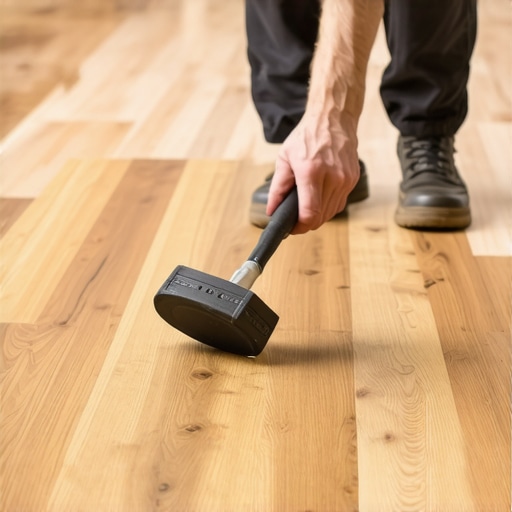
Small debris trapped in the locking mechanisms can prevent the floor from sitting flat. During installation, sawdust or small chips of the HDF core can get into the click-lock tongue and groove. If you force those planks together, the joint is not fully seated. It might look fine when you stand up, but there is a microscopic gap. As the floor undergoes its daily cycles of expansion and contraction, that stressed joint will eventually fail or pop upward. I always keep a vacuum and a stiff brush on my belt when I am clicking planks together. One tiny pebble of grit can cause a tent two rooms away. You also have to watch your tapping block. If you hit the planks too hard, you can mushroom the edge of the tongue, which prevents a snug fit. It is a game of millimeters, and the difference between a floor that lasts thirty years and one that fails in three months is often just a clean workspace.
Professional checklist for preventing floor tenting
- Verify subfloor flatness within 3/16 inch over 10 feet.
- Maintain a consistent 1/4 inch to 1/2 inch expansion gap at all vertical obstructions.
- Acclimate the flooring in the room of installation for at least 48 hours at living conditions.
- Install a 6-mil poly vapor barrier over all concrete subfloors.
- Undercut all door jambs and casings to allow for free movement under the trim.
- Never nail or screw transition strips through the flooring into the subfloor.
- Use a tapping block and pull bar to ensure joints are fully seated without damage.
Fixing a tented hallway without a full tear out
You can often resolve tenting by creating expansion space after the fact. If your floor is already rising, the first thing you do is pull up the baseboards. Look for the spots where the floor is touching the wall. You will likely find a few ‘pinch points’ where the plank is wedged against a stud or a door frame. Use a vibrating multi-tool or a specialized flooring saw to cut back the edge of the laminate by half an inch. Once the pressure is released, you might need to jump on the floor or use a heavy weight to help it settle back down. If the tenting was caused by moisture, you need to address the source of the humidity first, or the floor will just buckle again. If the joints are damaged or ‘peaked’ from the pressure, you might have to replace those specific planks, but releasing the perimeter pressure is the primary fix for a tenting hallway. Stop thinking of your floor as a static object. It is a moving, breathing entity that needs its personal space.