How to Fix a Squeaky Laminate Floor Without Pulling It Up
The sound of a laminate floor groaning under your weight is not just an annoyance. It is a structural cry for help. Most guys skip the leveling compound. They think the underlayment will hide the dip. It won’t. I spent three days grinding concrete on a job last month just so the floor wouldn’t click like a castanet because the previous installer ignored a 3/16 inch birdbath in the slab. When you hear that chirp or pop, you are listening to the sound of friction. Two pieces of high-density fiberboard are rubbing together under the pressure of your footfall because they have room to move. A floating floor should move horizontally as a single unit, but it should never move vertically. When it does, the tongue and groove locking mechanisms act like a saw, slowly grinding each other down until the joint fails completely.
The friction point inside your floor
Laminate floor squeaks usually originate from the tongue and groove locking system rubbing against adjacent planks or the subfloor. Friction is the primary culprit when boards shift vertically. If the subfloor is not perfectly flat, the laminate planks bridge over low spots. When you step on that bridge, the plank flexes downward. This movement causes the interlocking profile to slide against its neighbor, creating a high-pitched noise. To stop this without a full tear-out, you must introduce a dry lubricant or a structural stabilizer into that specific joint. Standard oils or wet lubricants are a disaster for laminate because the HDF core is essentially compressed sawdust and resin. It will soak up liquid, swell like a sponge, and ruin the floor permanently. You need materials that change the coefficient of friction without altering the moisture content of the wood fibers.
Why your subfloor is lying to you
Subfloor flatness is the most overlooked variable in residential flooring and the leading cause of post-installation noise issues. Most homeowners assume their plywood or concrete is flat enough, but the industry standard is 1/8 inch of deviation over a 10-foot radius. If you are transitioning from a carpet install to laminate, you are likely moving from a forgiving surface to an unforgiving one. Carpet hides dips and ridges that laminate will telegraph immediately. If your subfloor has a crown or a valley, the laminate cannot sit flush. Over time, the air pocket beneath the plank allows for deflection. This deflection stresses the locking mechanism. I have seen countless DIY jobs fail because the owner didn’t use a self-leveling compound or a grinder to prep the surface. They thought the padding would cushion the blow, but too much cushion is actually a death sentence for click-lock floors. It allows the joints to move too much, eventually snapping the thin plastic or wood tongues.
“A floor is only as good as the subfloor beneath it; deflection is the enemy of every joint.” – Master Flooring Axiom
The ghost in the expansion gap
A laminate floor needs a perimeter expansion gap of at least 1/4 to 3/8 of an inch to prevent binding and buckling. If your floor is squeaking near the walls, it is often because the planks are tight against the drywall or the baseboard. As humidity levels change, the HDF core expands. If it hits a wall, the pressure has nowhere to go but up. This creates tension across the entire floor system. I often find that installers have nailed the baseboards or shoe molding directly into the laminate planks rather than the wall. This pins the floor in place and causes it to scream every time the temperature shifts. You can fix this by removing the trim and checking the perimeter. If the floor is touching the wall, you can use a oscillating multi-tool to trim the edge of the laminate in place, giving it the room it needs to breathe.
The 1/8 inch that ruins everything
Precision measurement of subfloor tolerances determines whether a floor remains silent for twenty years or begins clicking within two months. When we talk about floor leveling, we are talking about the physics of load distribution. In the table below, I have outlined the technical tolerances required for different flooring types to avoid structural noise.
| Floor Type | Max Deviation (10 ft) | Underlayment Requirement | Noise Sensitivity |
|---|---|---|---|
| Laminate | 1/8 inch | High-Density Foam | Extreme |
| Solid Hardwood | 3/16 inch | 15lb Felt or Paper | Moderate |
| Engineered Wood | 1/8 inch | Acoustic Rubber | High |
| Luxury Vinyl (LVP) | 3/16 inch | Integrated Pad | Low to Moderate |
Lubricating the tongue and groove with dry agents
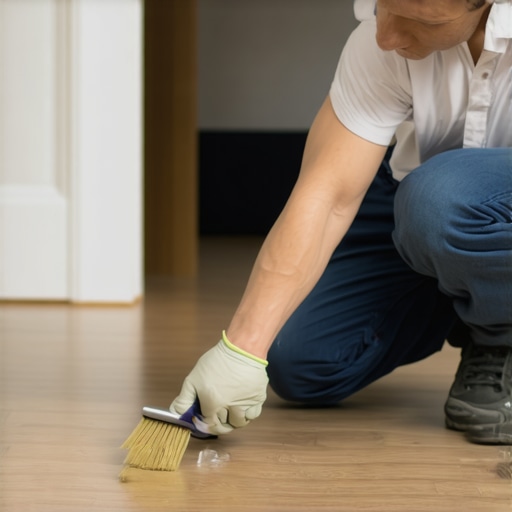
Injecting dry lubricants into the seams of a squeaky laminate floor reduces the friction that causes high-pitched chirping sounds. This is the most effective non-invasive fix. You want to use a dry PTFE (Teflon) spray or a graphite powder. Because these are dry, they do not cause the wood fibers to swell. You apply the lubricant directly into the seam where the noise is loudest and then walk on it to work the powder into the joint. Wipe away any excess immediately. Graphite is messy and black, so if you have a light-colored floor, a clear PTFE spray is a better choice. The chemical bond of the lubricant creates a microscopic film between the tongue and the groove, allowing them to slide past each other silently during vertical deflection.
Structural injections for hollow spots
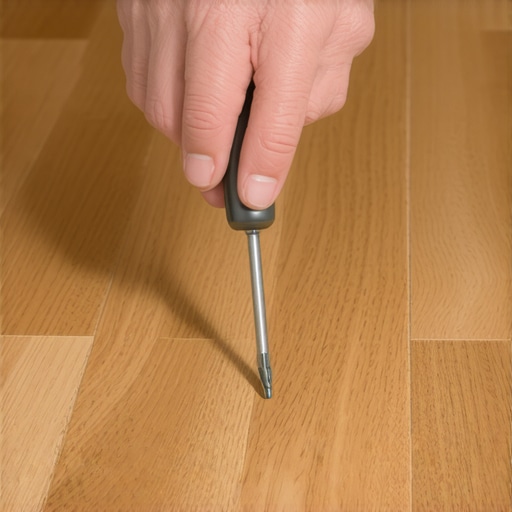
Injecting a specialized floor repair adhesive into hollow spots beneath the planks provides a permanent structural support that stops movement. When the squeak is caused by a deep subfloor dip, lubrication won’t help because the movement is too great. You need to fill the void. I use a kit that involves drilling a tiny hole (about the size of a finish nail) into the joint of the floor. You then use a syringe to pump a low-viscosity, high-strength adhesive into the space between the laminate and the subfloor. Once the adhesive cures, it acts like a custom-molded shim. It stops the plank from flexing downward. You then fill the tiny hole with a matching floor wax or putty. It is a surgical approach that saves you from ripping up the whole room. This is especially useful in areas near showers or kitchens where the subfloor might have experienced minor localized warping.
The checklist for a silent floor
Before you start drilling or spraying, follow this diagnostic sequence to identify the root cause of your floor noise.
- Check the perimeter expansion gaps by removing a piece of baseboard.
- Verify that no molding or transition strips are nailed directly into the laminate.
- Use a 6-foot level to identify the exact center of the deflection.
- Monitor the indoor humidity levels to ensure they stay between 35 and 55 percent.
- Test for subfloor moisture using a pinless meter if the floor is over concrete.
- Examine the wear layer for signs of peaking, which indicates high pressure.
Moisture chemistry and the HDF core
The chemical composition of a laminate floor core makes it highly susceptible to hygroscopic expansion and contraction. Laminate is not wood; it is a composite of wood fibers and urea-formaldehyde or melamine resins. These fibers want to reach equilibrium with the air around them. If your home is too humid, the boards swell and the joints tighten. If it is too dry, they shrink and the joints loosen. Both scenarios lead to noise. In regions with high humidity, the floor can actually lift off the subfloor, a phenomenon called crowning. Conversely, in dry climates, the tongues can partially pull out of the grooves, leading to a clicking sound. A silent floor requires a stable environment. I always tell clients that their HVAC system is a part of their flooring system. Without climate control, the floor will never be quiet.
“Moisture is the primary catalyst for structural failure in floating floor systems.” – TCNA Technical Bulletin
Final observations on floor stability
Fixing a squeaky floor without pulling it up is a game of millimeters and chemistry. You are either reducing friction or eliminating movement. If the lubricant doesn’t work, the adhesive injection will. If the adhesive injection doesn’t work, you have a subfloor that is so far out of spec that no amount of surface-level tinkering will save it. Flooring is an engineering challenge. It requires a level surface, a stable climate, and the right materials. If you treat your floor like a performance surface rather than a decorative rug, it will stay silent for decades. Stop looking at the surface and start thinking about the physics of what is happening underneath your feet. The sawdust under my nails has taught me that the subfloor always wins in the end.