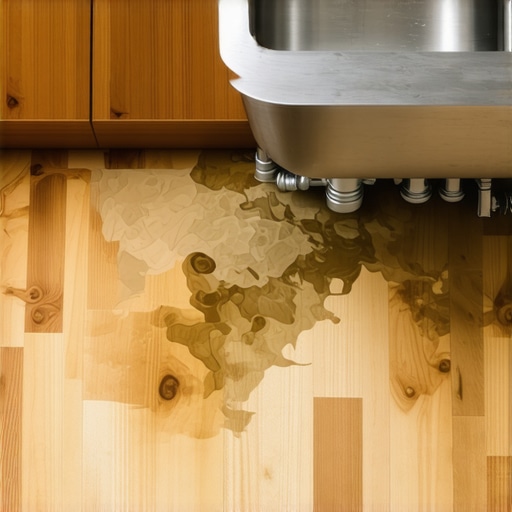
Why Your Laminate Floor Feels Spongy Near the Sink
I can still smell the mix of fresh oak dust and the sharp, metallic tang of WD-40 on my coveralls from this morning. I have spent more than twenty-five years on my knees with a moisture meter and a 10-foot straightedge, and if there is one thing I have learned, it is that a floor is a performance surface, not a piece of furniture. People treat flooring like a rug they can just toss down, but that is how you end up with a mess. I spent three days grinding concrete on a job last month just so the floor wouldn’t click like a castanet. The homeowner thought I was crazy when they saw the diamond cup wheel and the dust shroud, but I told them that if I did not get that slab flat to within 3/16 of an inch over a 10-foot radius, their expensive flooring would be trash in six months. Most guys skip the leveling compound because it is messy and slow, but that 1/8 inch of error is exactly what ruins a kitchen installation. When you walk near your sink and feel that give, that soft, sinking sensation, you are feeling the physical failure of a structural system that was either ignored during prep or sabotaged by moisture.
The ghost in the expansion gap
A laminate floor expansion gap is the necessary space between the flooring and walls that prevents buckling and sponginess. Without this 1/4 inch to 3/8 inch void, the HDF core cannot expand during humidity changes, leading to vertical deflection and a bouncy feel near heavy cabinets. Many installers make the mistake of running the laminate tight against the cabinets or the baseboards. When the humidity in the kitchen rises, often from the dishwasher or the sink, the wood fibers in the core of the laminate absorb that moisture. Wood is hygroscopic, it wants to be as wet as its environment. As those fibers swell, the entire floor needs more physical space. If it hits a wall or a heavy kitchen island, it has nowhere to go but up. This creates a bridge. When you step on that bridge, it compresses back down to the subfloor, giving you that spongy feeling. This is not just an aesthetic issue, it is a mechanical stress that will eventually snap the tongues and grooves that hold the planks together.
Water is a structural solvent
Moisture near sinks causes laminate flooring to feel spongy because the high-density fiberboard absorbs water through the seams. This triggers capillary action, swelling the wood fibers and weakening the click-lock mechanism, which results in a soft, compressible surface that no longer supports weight properly. The chemistry of a laminate plank is fascinating and terrifying. It is essentially a high-density fiberboard (HDF) sandwich. This core is made of wood fibers bonded with urea-formaldehyde or melamine resins under extreme pressure. While the top wear layer of aluminum oxide is incredibly tough, the edges where the planks click together are the Achilles heel. Once water gets past the surface tension and into the joint, it begins to break down the resin bonds. The HDF starts to look like a wet graham cracker. Once those fibers lose their density, the structural integrity of the plank is gone. You are no longer stepping on a solid board, you are stepping on a layer of compressed mulch that is slowly disintegrating.
“A floor is only as good as the subfloor beneath it; deflection is the enemy of every joint.” – Master Flooring Axiom
Your subfloor is not your friend
A subfloor dip or low spot near the kitchen sink creates a void under the laminate that manifests as a spongy or bouncy floor. If the subfloor is not perfectly flat to industry standards, the floating floor will bridge over depressions, causing the locking system to flex and eventually fail. I have seen countless DIY jobs where the homeowner thought a thick underlayment would hide a 1/4 inch dip in the plywood. It does not work that way. In fact, while most people want the thickest underlayment possible, too much cushion actually causes the locking mechanisms on laminate to snap under pressure. You want a high-density, low-compression underlayment. If the underlayment is too soft, it acts like a pillow, allowing the planks to move too much when you walk. That constant movement fatigue is what leads to the ‘sponginess’ and the eventual separation of the planks. You need to be looking at the compressive strength of your underlayment, measured in kilopascals, rather than just the thickness in millimeters.
The chemistry of swollen fibers
Swelling in laminate cores occurs when the hydrostatic pressure of moisture in the subfloor or ambient humidity exceeds the binding capacity of the HDF resins. This molecular expansion forces the locking profile out of alignment, creating a soft spot that feels like walking on foam near water sources. We have to look at the density of these boards. A premium HDF board will have a density of 850 to 950 kg/m3. A cheap, builder-grade board might only hit 600. The lower the density, the more ‘air’ is between those fibers. More air means more room for water to move in and take up residence. When you have a slow leak under a sink or a dishwasher that vents steam directly onto the floor, you are essentially feeding those fibers a constant diet of expansion fuel. Once the fibers swell, they rarely go back to their original shape. Even if the floor dries out, the damage to the resin bonds is permanent.
| Material Type | Density (kg/m3) | Water Resistance | Deflection Tolerance |
|---|---|---|---|
| Standard MDF | 600-700 | Poor | Very Low |
| Premium HDF | 850-950 | Moderate | Moderate |
| Stone Polymer (SPC) | 1900-2100 | High | High |
Measuring the deflection in your joists
Subfloor deflection is the amount of vertical movement a floor system undergoes when a load is applied, usually measured by the L/360 standard. If your kitchen floor joists are undersized or over-spanned, the laminate flooring will feel spongy regardless of how well the planks are installed. This is a structural engineering challenge. If you have a crawlspace or a basement, go down there and look at the joists under your kitchen. If you see 2x8s spanning 14 feet, you have a trampoline, not a subfloor. No amount of leveling compound will fix a floor that is physically moving because the lumber cannot support the weight. You have to stiffen the system by adding blocking or sistering the joists. The NWFA is very clear about this: the floor must be rigid. If the subfloor moves, the floating floor on top of it will move twice as much. This is often why the floor feels worst right in front of the sink, where you stand for long periods, putting a constant, concentrated load on a single point in the joist span.
“The substrate must be flat to within 1/8 inch in a 6-foot radius or 3/16 inch in a 10-foot radius to prevent mechanical failure.” – NWFA Installation Guidelines
The 1/8 inch that ruins everything
A deviation of 1/8 inch in subfloor flatness is the critical threshold where laminate locking mechanisms begin to undergo stress fractures. This minor gap creates an air pocket that feels spongy to the foot and leads to creaking and plank separation over time. I use a 10-foot magnesium straightedge to check every slab. If I can slide a nickel under that straightedge, I have work to do. You have to understand the physics of the ‘click.’ These joints are machined to tolerances of less than a tenth of a millimeter. When the board is forced to bridge a gap, the tongue is being pulled out of the groove at an angle it was never designed to handle. You are literally tearing the wood fibers apart every time you walk across that spot. Over a few months, those fibers shred, the joint loosens, and the ‘sponginess’ turns into a full-blown gap where dirt and more moisture can enter. It is a death spiral for your flooring.
- Test the subfloor for moisture using a pin-type meter or calcium chloride test.
- Verify the subfloor flatness with a long straightedge before laying underlayment.
- Maintain a consistent 3/8 inch expansion gap around the entire perimeter.
- Use a high-density underlayment with a high compressive strength rating.
- Seal the edges of the laminate near the sink with a 100% silicone sealant.
Fixing the sponge without ripping it all out
Fixing a spongy laminate floor involves identifying if the cause is localized moisture or subfloor voids, which may require injecting floor repair resins or removing the transition strips to check for binding. If the issue is a dip in the subfloor, you can sometimes use a specialized floor repair kit that involves drilling a tiny hole and injecting a fast-setting, high-density foam or resin. This fills the void and provides a solid base. However, if the sponginess is caused by water damage from the sink, you are looking at a replacement of the affected planks. You cannot ‘un-swell’ wood fibers. If you catch it early and the cause is just a lack of an expansion gap, you can sometimes remove the baseboards and use a toe-kick saw or a vibrating multi-tool to cut back the edges of the laminate, giving the floor the room it needs to lay flat. This is the difference between a total loss and a simple afternoon fix. Always check the perimeter first. It is the most common failure point and the easiest to rectify.
The final assessment of structural flooring
A floor is not just something you walk on, it is a complex assembly of chemistry, physics, and engineering. When your laminate feels spongy near the sink, it is a diagnostic signal. Your floor is telling you that the relationship between the HDF core, the subfloor flatness, and the local moisture levels has been compromised. Do not ignore it. A spongy floor is a floor in the process of failing. Whether you are dealing with a builder-grade material that cannot handle the humidity of a modern kitchen or an installation that ignored the vital expansion gaps, the solution always starts with a level and a moisture meter. Respect the standards of the NWFA and the TCNA, and stop looking for shortcuts. Your knees might hurt from the work, but your floor will stay solid for decades.