How to Salvage Carpet After a Minor Sink Overflow
I spent three days grinding concrete on a job last month just so the floor wouldn’t click like a castanet. Most guys skip the leveling compound. They think the underlayment will hide the dip. It won’t. I’ve spent twenty five years with sawdust under my nails and a moisture meter in my pocket and if there is one thing I have learned, it is that a floor is an engineered system, not a rug you just throw down. When a minor sink overflow happens, most homeowners look at the wet fibers and grab a few towels. They think the job is done once the surface feels dry to the touch. That is how you end up with a structural failure and a house that smells like a wet basement. You have to understand the physics of the subfloor and the chemistry of the adhesives if you want to save that carpet without growing a science project in your floor joists.
The 48 hour window of biological reality
Microbial growth begins the moment moisture reaches the organic material in your subfloor and carpet backing. You have exactly two days to stabilize the environment before the mold spores begin their colonization. If the water came from a clean supply line, you have a fighting chance. If it came from a clogged drain, you are dealing with grey water and the salvage rules change entirely. You are not just fighting wetness, you are fighting the chemical breakdown of the latex binder that holds the carpet together.
“A floor is only as good as the subfloor beneath it; deflection is the enemy of every joint.” – Master Flooring Axiom
When water hits a carpet, it moves through the face fibers, which are usually nylon or polyester, and hits the primary backing. Underneath that is the latex bond and the secondary backing. If that water sits for more than a few hours, the styrene-butadiene rubber latex begins to undergo hydrolysis. This is a chemical reaction where water breaks down the molecular bonds of the adhesive. Once this happens, the carpet will delaminate. You will see bubbles and ripples that no power stretcher can ever fix. You have to pull that water out of the deep structure before the chemistry fails.
The physics of the extraction vortex
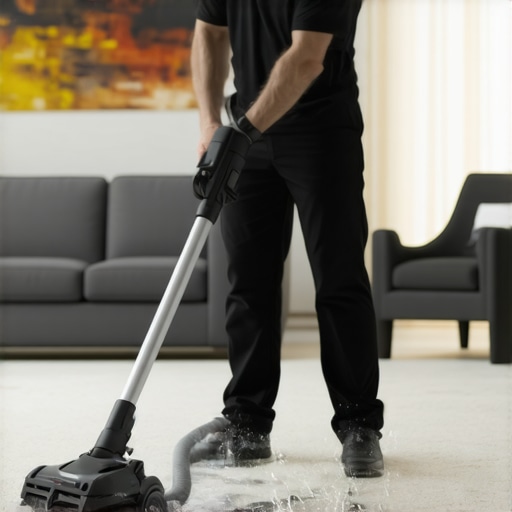
High volume water extraction requires tools that create a vacuum seal against the subfloor. A standard shop vacuum is not enough to pull moisture out of an 8 pound rebond pad. You need a tool like a water claw that uses the weight of the operator to compress the foam and suck the liquid from the very bottom of the assembly. If you leave even ten percent of the water in the pad, it will act as a reservoir, slowly feeding moisture back into the wood subfloor or concrete slab for weeks.
| Material Type | Drying Priority | Chemical Risk | Salvage Rate |
|---|---|---|---|
| Nylon 6.6 | High | Latex breakdown | 90% |
| Polyester (PET) | Medium | Minimal fiber swelling | 85% |
| Rebond Pad | Critical | Cellular retention | 20% |
| Plywood Subfloor | Immediate | Delamination | 70% |
The subfloor is where the real disaster happens. If you have a plywood or OSB subfloor, the edges of the sheets will swell when they get wet. This is called edge flare. Even if you dry the carpet, you will be left with ridges in the floor that look like topographical maps. On concrete, the moisture creates a high pH environment that can eat through the adhesives of nearby flooring types or cause the tack strips to rust and stain the carpet from the bottom up. [IMAGE_PLACEHOLDER]
Why your subfloor is lying to you
A subfloor might feel dry on the surface while maintaining a high moisture content deep within its grain. I have seen installers put carpet back down over a subfloor that looked fine, only to have the baseboards rot out six months later. You need a pin-type moisture meter to check the actual percentage of water in the wood. Anything over 16 percent moisture content is a breeding ground for wood-rotting fungi. You have to keep the fans running until the subfloor matches the rest of the house, usually around 8 to 10 percent depending on your local climate.
- Extract all surface water with a weighted vacuum tool.
- Pull the carpet back from the tack strips in the affected corner.
- Remove and discard the wet padding because it is cheaper to replace than to dry.
- Set up high velocity air movers to blow air both over and under the carpet.
- Use a LGR dehumidifier to pull the moisture out of the air.
- Check the moisture content of the subfloor every 12 hours.
The chemistry of secondary backing delamination
The secondary backing is the rough material on the bottom of your carpet. It provides the dimensional stability that allows the carpet to stay flat and tight. When water is introduced, the fibers can swell, but the latex binder is the most vulnerable part. If you walk on wet carpet, you are physically crushing those weakened chemical bonds. This is why you must stay off the floor until it is completely dry. The weight of a human body can cause the primary and secondary backings to slide against each other, leading to a permanent structural failure of the textile. This is not about aesthetics, it is about the engineering of the floor.
“Moisture migration through a slab is not a suggestion, it is a physical certainty that dictates the life of the textile.” – Structural Flooring Principles
Once the carpet and subfloor are dry, you cannot just kick the carpet back onto the tack strip with your toe. The wetting and drying process often causes the carpet to shrink slightly. You will need a power stretcher to reset the tension. If the carpet is loose, it will move when you walk on it, causing the fibers to rub together and wear out prematurely. A floor is a high friction environment and tension is what keeps it from self-destructing. The 1/8 inch of stretch you get from a professional tool is what makes the difference between a floor that lasts ten years and one that fails in two.