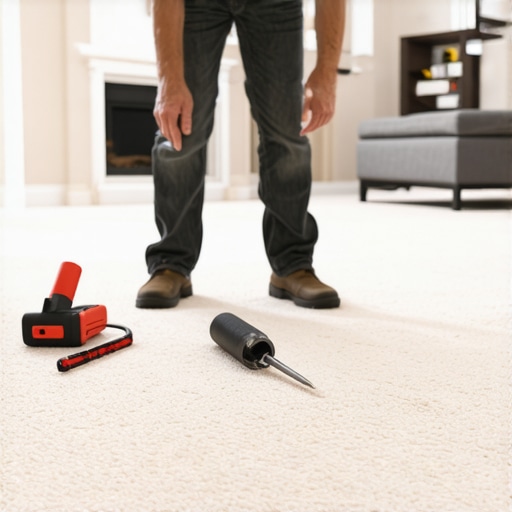
The Mechanics of Carpet Tension and Why Your Installer Failed
Most guys skip the leveling compound. They think the underlayment will hide the dip. It won’t. I spent three days grinding concrete on a job last month just so the floor wouldn’t click like a castanet. That is the reality of a real pro versus a guy with a truck and a dream. When you see a crew walk into your home with nothing but a knee kicker, you are watching the slow death of your investment. Carpet in 2026 is not just a rug. It is a complex assembly of primary and secondary backings held together by a latex bond. If that assembly is not stretched to the exact mechanical tolerances required by the manufacturer, it will fail. I have seen fifteen thousand dollar jobs ruined because an installer wanted to save twenty minutes of setup time. This is not about aesthetics, it is about structural engineering on a residential scale.
The visual ripple effect in high traffic zones
The presence of ripples or waves in a carpeted room indicates a total failure of mechanical tensioning. When an installer relies solely on a knee kicker, the carpet fibers and the secondary backing are never fully extended. This results in excess material that shifts during normal foot traffic. You will notice these waves most clearly near doorways or in the center of a large living room. The physics are simple. Foot traffic pushes the carpet forward. If the carpet is loose, the primary backing slides over the pad, creating a bubble. Over time, this bubble becomes a permanent crease because the latex bond within the carpet breaks down from the constant folding action. [IMAGE_PLACEHOLDER] This is not something you can just kick back into place. Once the delamination begins, the carpet is structurally compromised. You are looking at a permanent site-defect that requires a full restretch or, in many cases, a total replacement of the material.
Premature wear and fiber crushing near the baseboards
Carpet that pulls away from the wall or shows deep crushing near the perimeter is a direct result of improper power stretching. A power stretcher uses long poles to push against the opposite wall, ensuring even distribution of force across the entire room. Without this tool, the carpet is only tight for the first six inches near the tack strip. The rest of the floor remains in a relaxed state. When you walk on a floor that lacks tension, the fibers rub against each other with much higher friction than they would on a tight surface. This friction generates heat at a molecular level, causing the synthetic fibers to lose their resilience and lay flat. This is why you see those ugly dark paths in your hallways after only six months. It is not dirt. It is fiber damage caused by the floor moving beneath your feet. A properly stretched floor should be as tight as a drum head. If you can grab a handful of carpet in the middle of the room and pull it up more than half an inch, your installer cheated you.
“A floor is only as good as the subfloor beneath it; deflection is the enemy of every joint.” – Master Flooring Axiom
The sound of a hollow floor and adhesive failure
A hollow clicking sound when walking across a carpeted surface often points to a subfloor that was never leveled and a carpet that was never tensioned to bridge the gaps. While carpet is a soft surface, it relies on a flat substrate to maintain its internal chemistry. If there is a dip in the concrete or plywood, and the carpet is not stretched tight over that dip, the material will bounce. This bouncing action acts like a bellows, sucking dust and moisture into the pad. This is where the chemistry gets ugly. Moisture trapped under a loose carpet reacts with the latex adhesive in the backing. This leads to a smell that most people mistake for old dog or damp basement, but it is actually the smell of a failing chemical bond. In areas like kitchens or near showers, this moisture intrusion is even more aggressive. If your carpet transitions to a shower or a laminate floor, those transition points must be secured with a power stretcher to prevent the carpet from frayers and pulling out of the transition strip.
| Stretching Method | Max Tension Rating | Longevity Expectancy | Recommended Use |
|---|---|---|---|
| Knee Kicker Only | Low (15%) | 1 to 3 Years | Closets Only |
| Manual Power Stretch | High (95%) | 10 to 15 Years | All Residential Rooms |
| Hydraulic Tensioning | Maximum (100%) | 20+ Years | Commercial and Large Open Plans |
Transitions to laminate and showers
When carpet meets a hard surface like laminate or tile in a bathroom, the tension at that junction is what prevents fraying. An installer who skips the power stretch will often hide the loose edges under a bulky T-molding or a transition strip. This is a shortcut. A real pro will stretch the carpet until it is tight against the transition, then tuck it firmly into the gap. If you see the carpet pulling away from your laminate floor, it is because the internal tension of the carpet is pulling it back toward the center of the room. This happens because the installer did not set the teeth of the power stretcher deep enough into the secondary backing. In high-humidity areas like near showers, the fibers expand. Without the mechanical hold of a proper stretch, the carpet will swell and create a trip hazard right where you step out of the tub. It is a safety issue as much as a durability issue. You should always demand to see the power stretcher on the job site before the first tack strip is even nailed down.
- Check for the presence of a power stretcher with extension poles on the job site.
- Ensure the installer uses a moisture meter on the concrete slab before laying the pad.
- Verify that all subfloor dips greater than 1/8 inch are filled with leveling compound.
- Inspect the perimeter to ensure the carpet is tucked tight without visible tack strip nails.
- Confirm that the carpet acclimated to the home temperature for at least 48 hours.
“Proper tensioning requires the use of a power stretcher to ensure the secondary backing is extended to its mechanical limit.” – CRI 105 Standard Reference
The ghost in the expansion gap
The expansion gap is a structural necessity that installers often ignore when they are in a rush. If the carpet is not stretched toward the walls correctly, it cannot interact with the expansion gaps of the surrounding hard floors like laminate or hardwood. Flooring is a living system. It moves with the seasons. In the humid summers of the East Coast or the damp winters of the Pacific Northwest, the wood and the carpet fibers will expand. If the carpet is loose, it has nowhere to go but up, creating those signature ripples. A master installer understands the local climate and adjusts the tension accordingly. They know that a floor installed in the dry heat of a Phoenix summer needs to be tighter than a floor installed in a humid Houston spring. If your installer doesn’t talk to you about humidity and acclimation, they are just a carpet layer, not a flooring architect. Demand better for your home. Don’t let a lazy install turn your high-end carpet into a pile of wrinkled junk within two years.
http://Johnathan%20Carter
This article really highlights the importance of proper stretching techniques when installing carpet. I once had a similar issue in my living room where the installer relied only on a knee kicker, and the ripples appeared within a few months. It’s quite remarkable how much difference the right tools, like a power stretcher, can make. It’s interesting to see how much subtle tension affects not just the appearance but also the durability and safety of the flooring. I wonder, though, how common is it for homeowners to actually check for the presence of a power stretcher during installation? In my experience, many just assume the job was done correctly. Are there any telltale signs that an installer skipped this step that homeowners can easily identify during the process or right after it’s completed? I’d love to hear from others about their experiences or tips on what to watch out for to ensure the installation is up to standard.