The ‘Two-Finger Test’ for Checking if Your Garage Door Spring Needs Immediate Replacement
The ‘Two-Finger Test’ for Checking if Your Garage Door Spring Needs Immediate Replacement
It happens when you least expect it. You’re sipping your morning coffee in your Burlingame home, preparing for the commute, when a sound like a gunshot echoes from the garage. That unmistakable “bang” is the sound of a high-tension steel spring snapping under pressure. For many residents seeking bay area garage doors services, this is the first time they realize just how much heavy lifting those springs do every single day. However, a spring doesn’t always break with a theatrical noise; often, it dies a slow, silent death that puts immense strain on your entire system.
As an expert technician who has spent years servicing the San Francisco Peninsula, from the foggy hills of San Mateo to the coastal breeze of Burlingame, I have seen thousands of garage doors. My name is Lynn Lenardon, and I’ve made it my mission to help homeowners understand that their garage door is not just a moving wall – it is a complex mechanical system. Most homeowners don’t realize that their electric opener isn’t actually doing the heavy lifting; the springs are. When those springs weaken, your opener “muscles” through the weight until its own gears strip or the motor burns out entirely. To prevent a costly multi-component failure, I recommend every homeowner learn the “Two-Finger Test.”
Understanding the Mechanics: Torsion vs. Extension Springs
Before we dive into the test, we need to understand what we are testing. In the Bay Area, we primarily see two types of spring systems: torsion springs and extension springs. Torsion springs are located on a metal shaft directly above the door opening. They operate by twisting and storing energy. Extension springs, more common in older homes or smaller garages, run along the horizontal tracks on either side of the door and stretch as the door closes.
Regardless of the type, these springs act as a counterweight. A standard residential garage door can weigh anywhere from 150 to 400 pounds. The springs are wound or stretched to provide exactly enough force to neutralize that weight. When the system is perfectly balanced, the door should feel almost weightless. Typical torsion springs are rated for approximately 10,000 to 18,000+ cycles. A “cycle” is one full opening and closing of the door. If you use your door four times a day, a 10,000-cycle spring will last roughly seven years.
Understanding these hidden mechanics is the first step toward home safety. Just as you might use The ‘Towel’ Test for Detecting Slow Leaks Under Your Toilet to find hidden plumbing issues before they rot your subfloor, the Two-Finger test reveals hidden mechanical strain in your garage system before it leads to a total collapse.
What is the ‘Two-Finger Test’?
The Two-Finger Test is the gold standard for diagnosing door balance. It is a simple, non-invasive way to determine if you need garage door repair bay area experts to intervene. This test should be performed every six months to ensure your springs are still providing the necessary counterweight to the door’s physical mass.
Step-by-Step Instructions for the Two-Finger Test
- Close the door completely: Ensure there are no obstructions in the path of the sensors and that the door is fully seated against the garage floor.
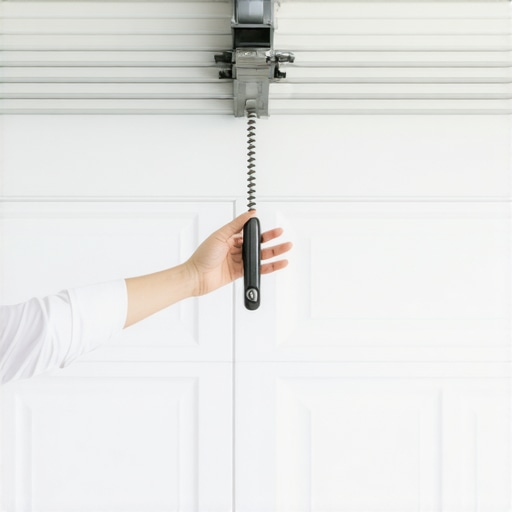
- Disconnect the opener: This is the most critical step. Pull the emergency release cord – usually a red handle hanging from the opener carriage. This “disengages” the motor from the door, allowing you to move the door manually.
- The Lift: Attempt to lift the door manually. Use the lift handle or place your hands at the bottom of the door. Here is the catch: attempt to lift it using only two fingers.
If the door is properly balanced, you should be able to lift it with the strength of just two fingers. It should glide smoothly along the tracks without excessive resistance. If you find yourself needing to use your back, legs, or both hands to heave the door upward, your springs have lost their tension. This is a clear sign you need to fix garage door components immediately.
The “Halfway” Rule
Once you have lifted the door, stop when it is about 3 to 4 feet off the ground (roughly waist-high). Let go of the door carefully. A well-balanced door should stay in place or move only a few inches. If the door crashes back to the floor, the springs are dangerously weak. Conversely, if the door “shoots” upward toward the ceiling, the springs are over-tightened, which can be just as damaging to the door’s hardware. If your door fails this balance check, it is time to seek garage door repair from a professional who understands the specific torque requirements of your door model.
Signs Your Springs are Reaching “End of Life”
While the Two-Finger Test is a functional diagnostic, visual cues can also tell you a lot about the health of your system. In our local climate, environmental factors play a massive role in hardware longevity. The salty air and humidity of the San Francisco Peninsula can accelerate the degradation of steel components.
- Visual Gaps in the Coils: If you look up at your torsion spring and see a physical gap in the coils, the spring has already snapped. It may still be on the shaft, but it is providing zero lifting power.
- Rust and Corrosion: Rust creates friction between the coils of the spring. In the Bay Area, salt air acts as a catalyst for oxidation. If your springs look “crusty” or orange, the structural integrity of the steel is compromised. You can use The ‘Flashlight’ Secret for Finding Low Spots in Concrete Floors as an inspiration for your inspection; take a high-powered LED flashlight and shine it across the length of the spring. Look for “pitting” or areas where the smooth surface of the steel has become jagged.
- Fraying Cables: The springs work in tandem with the cables. If the springs are weak, the cables often take on uneven loads. Check the bottom brackets for any signs of “polishing” or fraying on the steel braided lines. If you see this, you likely need garage door cable replacement in addition to spring work.
- Slowing Performance: If your door seems to be moving in “slow motion” or if the opener makes a straining, humming sound during the first foot of travel, the springs are failing to provide the initial burst of energy needed to overcome gravity.
Why DIY Spring Replacement is a High-Risk Move
In the age of YouTube tutorials, many homeowners are tempted to fix garage door spring issues themselves. As a professional, I cannot stress this enough: Do not attempt to replace torsion springs yourself.
Garage door springs are under an incredible amount of tension – enough force to lift a 400-pound door. To replace them, you must use professional winding bars to tension the steel. One slip of a screwdriver (which many DIYers mistakenly use instead of winding bars) can result in the spring unwinding instantly. The force released is equivalent to a small explosion.
Research into garage door accidents has documented horrific injuries, including shattered wrists, facial trauma, and even the loss of fingers. There is a documented case of a homeowner losing two fingers because they placed their hand in the wrong position while the spring was under tension. This is why emergency garage door repair exists. Professional technicians have the training and the specialized tools to manage this torque safely. When you weigh the cost of a professional service call against a trip to the emergency room, the choice is clear. If your door is stuck or won’t open, contact an urgent garage door repair service immediately.
Beyond the Springs: Openers and Cables
A failing spring is rarely an isolated problem. Because the garage door is a closed-loop system, the failure of one part puts stress on every other part. The most common victim of a bad spring is the garage door opener.
Most modern openers have a “force setting” that tells the motor how hard to pull. If the spring is weak, the motor has to pull harder. Over time, this wears down the nylon drive gears inside the opener. If you hear a grinding noise but the door isn’t moving, your gears are likely stripped. In these cases, you don’t just need a spring; you need garage door opener repair or a full unit replacement. Similarly, if the door is crooked, you may require garage door cable repair. The cables are the “muscles” that the “tendons” (springs) pull on. If one cable is longer than the other due to stretching or fraying, the door will bind in the tracks, further damaging the rollers and the track alignment.
Maintaining your garage infrastructure is as vital as your home’s foundation. If you’re also dealing with interior issues, check out our guide on How to Level a Sloping Floor Without Removing the Old Wood. Just as a sloping floor indicates a structural issue below, a heavy garage door indicates a mechanical issue above.
Commercial Considerations
While most of this advice is tailored to homeowners in San Mateo and Burlingame, business owners should be even more vigilant. If you manage a warehouse or a storefront, commercial garage door repair is a matter of liability and operational continuity. Commercial doors are often much heavier and used much more frequently than residential ones. A failed spring in a commercial setting can trap vehicles, halt deliveries, and create a significant safety hazard for employees. Regular maintenance and the Two-Finger Test (where applicable for smaller commercial doors) are essential parts of facility management.
Conclusion: Don’t Wait for a Total Collapse
The Two-Finger Test is a simple, five-minute check that can save you thousands of dollars in repair costs. By identifying a weakening spring early, you can schedule a garage door spring replacement on your own terms, rather than waiting for an emergency on a Monday morning when you’re already late for work.
If you live in Burlingame, San Mateo, or anywhere across the San Francisco Peninsula and your door fails the Two-Finger Test, don’t take the risk of a DIY fix. The combination of high-tension steel and the corrosive Bay Area air makes this a job for experts. At Floorcraft, we pride ourselves on providing the highest quality fix garage door opener and spring services in the region. We understand the specific needs of local homes and the importance of a door that operates safely and quietly.
Don’t wait for a total collapse. If your door feels heavy, makes strange noises, or fails to stay open at the halfway point, it is telling you something. Listen to it. Contact us today for expert garage door spring replacement and ensure your home remains the safe haven it’s meant to be.