How to Seal a Shower Drain Flange So It Never Leaks Again
I spent three days grinding concrete on a job last month just so the floor wouldn’t click like a castanet. Most guys skip the leveling compound. They think the underlayment will hide the dip. It won’t. I have seen fifteen thousand dollar wide plank walnut floors cup like potato chips and I have seen brand new shower installs turn into mold factories because some installer thought a bit of cheap putty was enough to fight physics. You want to seal a shower drain flange so it never leaks again. It is not about the trim. It is about the mechanical bond between the flange, the membrane, and the subfloor. If your subfloor has even a sixteenth of an inch of play, your seal will eventually snap. I smell like oak dust and WD-40 most days, and if there is one thing I know, it is that water always finds the path of least resistance. Usually, that path leads straight to your joists because you ignored the deflection ratings.
The anatomy of a structural drain failure
To seal a shower drain flange effectively, you must use 100 percent RTV silicone or a specialized MS polymer sealant applied to a clean, debris-free flange surface. Mechanical compression from the clamping ring must be tight enough to displace the sealant into every microscopic ridge of the PVC or ABS plastic. The drain is the most stressed part of the entire floor system. While a carpet install involves tensioning a textile over a pad, a shower floor involves managing hydrostatic pressure and structural movement simultaneously. Most leaks do not happen because the pipe broke. They happen because the seal between the flange and the waterproofing layer failed. This failure is often rooted in the floor leveling process. If the mortar bed or the concrete slab is not perfectly flat around the drain perimeter, the flange will sit at a slight tilt. When you step near that drain, the subfloor flexes. That flex pulls the sealant away from the plastic. One drop of water gets in. Then ten. Then the subfloor is gone.
“A floor is only as good as the subfloor beneath it, deflection is the enemy of every joint.” – Master Flooring Axiom
The chemistry of the bond and why putty fails
Plumber’s putty is a relic of the past that has no place in a modern high-performance shower installation because it eventually dries out, becomes brittle, and shrinks. Modern shower flanges require flexible sealants that can maintain an airtight bond during the natural thermal expansion and contraction of the plumbing. Putty is basically oil and clay. It works for a while, but it cannot handle the movement of a house settling. When I talk about laminate flooring, I talk about expansion gaps. Showers need that same logic applied to the chemistry of their joints. I use 100 percent silicone because it remains elastomeric. It stretches. It moves with the house. If you are working on a slab, you need to ensure the concrete is dry. A moisture meter is your best friend. If the slab is pushing out vapor, your silicone will not stick. It is like trying to tape a wet box. It just won’t happen. You need to verify that the pH of the concrete is neutral before you even think about the final seal.
The ritual of the compression nut
Properly tightening the compression nut on a shower drain requires a balance of force that creates a watertight gasket seal without cracking the plastic housing. You should hand tighten the nut and then apply exactly one quarter turn with a specialized internal drain wrench to ensure the gasket is fully seated. Over-tightening is a common rookie mistake. I have seen guys use a massive pipe wrench and crack the flange right down the middle. Now you have a hairline fracture that only leaks when the shower gets hot and the plastic expands. It is a nightmare to find. You have to think about the floor leveling again. If the drain pipe is not perfectly vertical because the subfloor is sloped, the compression nut will cross-thread. This is why I spend so much time with a grinder and a level before the plumbing even starts. A flat floor is the foundation of a dry house. There are no shortcuts. If you see a dip, you fill it. If you see a hump, you grind it down.
The 1/8 inch that ruins everything
Precision in the rough-in phase is the only way to guarantee a leak-proof shower because a drain pipe that is 1/8 inch off-center creates uneven pressure on the flange gaskets. This misalignment leads to localized compression failure where the rubber gasket eventually deforms and allows water to bypass the primary seal. In the world of carpet install, an eighth of an inch is nothing. In the world of showers and subfloors, an eighth of an inch is a disaster. I treat every drain like a structural engineering project. The flange must sit flush. If the subfloor is plywood, I ensure it is a double layer of three quarter inch CDX or better. I do not trust thin subfloors. They bounce. Bouncing floors lead to cracked grout and leaking drains. You need to check the Janka rating of any wood involved, though in a wet zone, we are usually looking at the ply density and the adhesive used in the wood itself.
| Material Type | Recommended Sealant | Cure Time | Movement Capability |
|---|---|---|---|
| PVC Flange | 100% Silicone | 24 Hours | High |
| ABS Flange | ABS Solvent/Silicone | 24 Hours | Medium |
| Cast Iron | Epoxy Gasket/Silicone | 48 Hours | Low |
| Stainless Steel | MS Polymer | 24 Hours | High |
Why your subfloor is lying to you
Subfloors often appear flat to the naked eye but contain subtle waves and dips that will compromise the structural integrity of your shower pan and drain seal. You must use a ten foot straight edge to identify these deviations and correct them with high-compressive strength self-leveling underlayment before installing the flange. I have walked onto jobs where the homeowner said the floor was perfect. I put a level on it and it looked like the rolling hills of Kentucky. If you put a shower pan on that, the drain is under constant stress. It is like trying to balance a chair on two legs. Eventually, something gives. Usually, it is the seal. I use a specific floor leveling compound that has a fiber-reinforced matrix. It does not crack under the weight of a full shower. If you are doing a laminate job nearby, you can use the same prep. It makes the whole house feel solid. A solid floor is a quiet floor. A quiet floor is a floor that was installed by someone who knows how to use a grinder.
“Subfloor deflection limits for tile and stone are twice as stringent as those for wood to prevent catastrophic joint failure.” – TCNA Standards Handbook
The checklist for a permanent seal
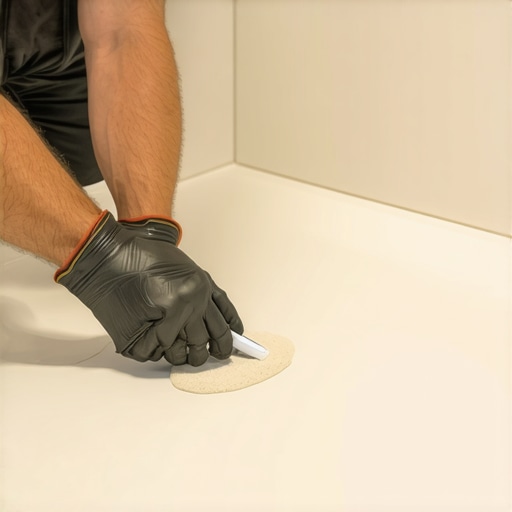
- Clean the flange and the pipe with denatured alcohol to remove all oils and dust.
- Apply a continuous 1/4 inch bead of silicone around the underside of the flange.
- Verify that the subfloor is within 1/8 inch of level across the entire shower footprint.
- Tighten the clamping ring until the sealant begins to squeeze out evenly.
- Let the sealant cure for a full 24 hours before performing a flood test.
- Check the moisture content of the subfloor to ensure it is below 12 percent.
The ghost in the expansion gap
Expansion gaps are not just for hardwood and laminate floors but are vital for shower drains to allow for the movement of the house without putting stress on the plumbing joints. A drain that is hard-piped into a rigid subfloor without any room for movement will eventually shear the seal during seasonal humidity shifts. In the winter, the wood in your house shrinks. In the summer, it swells. This movement is powerful enough to snap a plastic drain if it is pinned too tightly. I always leave a tiny bit of breathing room around the pipe where it passes through the subfloor. I fill that gap with a flexible fire-stop or a specialized foam. This keeps the drain floating just enough to survive the seasons. If you treat your house like a static object, you are going to have a bad time. A house is a living, moving thing. You have to build with that movement in mind. Whether it is a carpet install or a custom walk-in shower, the principles of structural movement remain the same. Respect the movement and the house will stay dry. Ignore it and you will be calling me to rip out your moldy subfloor in five years.