How to Remove Dark Coffee Stains from Light-Colored Berber Carpet
The physics of the Berber loop
Berber carpet fibers and looped pile structures create a unique challenge because the capillary action of the tight weave traps tannins and liquid acids deep within the carpet backing. Unlike cut pile, the loops act as a reservoir for dark coffee stains. I spent three days grinding concrete on a job last month just so the floor wouldn’t click like a castanet, and that same level of detail is required for carpet. I once walked into a house where a homeowner had tried to scrub a coffee spot out of a light cream olefin Berber. They used a stiff brush and a bottle of high-pH dish soap. By the time I arrived, the friction had melted the tips of the synthetic fibers, creating a permanent grey haze that looked worse than the coffee. The liquid had traveled down the fiber and into the secondary backing, then wicked back up as it dried. They didn’t understand that carpet is a three dimensional filter. It is not a flat surface. You are dealing with moisture migration and chemical bonds. If you treat it like a countertop, you lose. I smell like industrial extraction solvent and worn out knee pads because I know that a floor is a structural system. Coffee is a biological dye. It contains oils, acids, and pigments that want to become part of the polymer chain of your floor. To save the carpet, you must understand the molecular tension of the spill.
The hidden chemistry of the coffee spill
Coffee tannins and organic acids require a pH balanced extraction method to prevent the synthetic fibers from taking on a permanent yellowish brown hue. When coffee hits light colored Berber, the temperature of the liquid matters. Hot coffee expands the polypropylene or nylon molecules, allowing the stain to penetrate deeper into the fiber core. Most people reach for a chemical under the sink that is way too alkaline. High alkalinity on a protein stain or a tannin stain can set the color permanently. You need a neutralizing agent.
“A floor is only as good as the subfloor beneath it; deflection is the enemy of every joint, just as residue is the enemy of every fiber.” – Master Flooring Axiom
The science of surfactants is what we are talking about here. A surfactant lowers the surface tension of the water, allowing it to get under the coffee oils. But if you use too much, you leave a sticky residue. That residue is a magnet for atmospheric soil. Three months later, the coffee stain is gone, but a black oily circle appears in its place. That is re-soiling. You must be precise. You must be clinical. This is not about cleaning. This is about molecular displacement.
The tools for professional carpet restoration
Microfiber towels, high volume extraction vacuums, and pH neutral detergents are the essential components for removing dark liquids from dense carpet loops without causing fiber blooming. If you use a standard household vacuum, you are failing. You need something that can pull air through the subfloor padding.
- White cotton or microfiber towels for blotting
- Cold distilled water to prevent heat setting
- A shop vac with a narrow crevice tool for maximum suction
- White vinegar for a mild acidic rinse
- A weighted object for the final drying phase
Most guys skip the leveling compound on a hard floor, and most homeowners skip the extraction phase on a carpet. They think the towel gets it all. It does not. The padding underneath the Berber acts like a sponge. If you leave organic matter in the pad, it will grow microbial colonies. I have pulled up carpets where the subfloor was black with mold because someone spilled a venti latte and just ‘dabbed it.’ You have to get the liquid out of the primary backing and the latex adhesive that holds the loops together. This is a structural engineering challenge. You are managing a fluid dynamic event inside a textile matrix.
The comparison of carpet fiber performance
Olefin fibers, nylon 6,6, and wool blends each react differently to stain removal agents and mechanical agitation during the cleaning process. You have to know what you are standing on before you apply a solvent.
| Fiber Type | Stain Resistance | Heat Sensitivity | Absorbency Rate |
|---|---|---|---|
| Olefin (Polypropylene) | High (Chemical) | Very High | Low |
| Nylon | Medium (Treated) | Medium | High |
| Wool | Low | Low | Very High |
| Polyester | High | High | Low |
If you have wool Berber, you cannot use bleaching agents. You will dissolve the protein bonds of the hair. If it is olefin, which is common in builder grade carpet, it is basically plastic. It loves oil. Coffee has oils. Therefore, the olefin loop will hold onto the coffee oils even if the tannin color is gone. This is why the 1/8 inch that ruins everything is often the depth of the pile height. If you do not reach the bottom of the loop, the stain remains.
“Moisture is the primary vector for flooring failure, whether in a concrete slab or a wool rug.” – Master Flooring Axiom
Always check the moisture content of the floor after you think you are done. If it is still wet to the touch after six hours, you have failed the evaporation protocol.
The extraction protocol for deep coffee removal
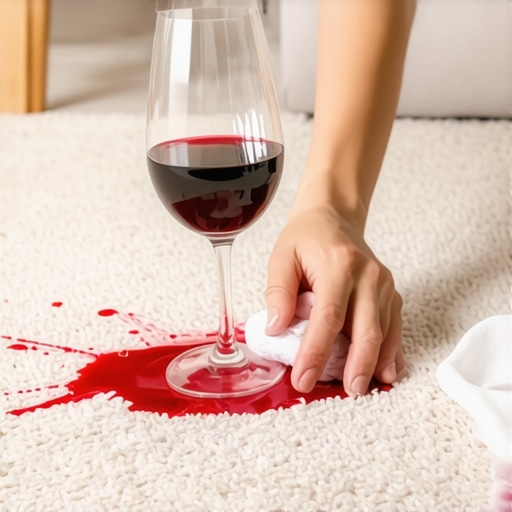
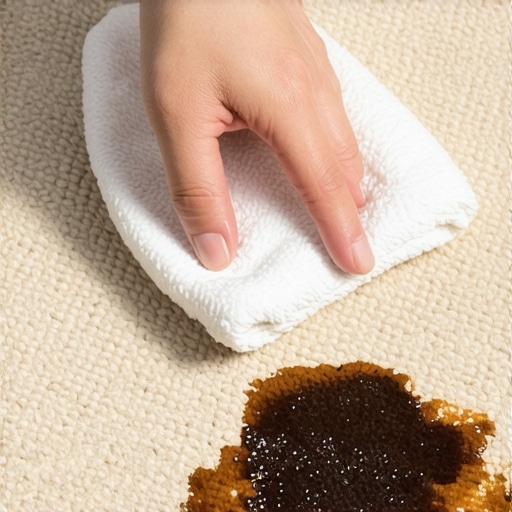
Blotting, neutralizing, and extraction must be performed in a specific sequence to prevent wicking and fiber distortion in light colored textiles. First, you blot. Do not scrub. Scrubbing is for people who want to buy new carpet. Scrubbing untwists the yarn bundles. Once those loops bloom, they reflect light differently, and the carpet looks dirty even when it is clean. That is called permanent pile distortion. Use cold water. Cold water keeps the tannins from bonding. If you use hot water, you are essentially dyeing the carpet. Apply your pH neutral solution and let it dwell for five minutes. This dwell time allows the surfactants to surround the coffee particles. Then, use your extraction tool. Press down hard. You want to create a seal against the subfloor. Pull the moisture out. After the liquid is gone, mist the area with a one to one ratio of white vinegar and water. This acidic rinse neutralizes any leftover detergent alkalinity. It also helps stabilize the dye sites in the fiber. Finally, lay a thick stack of white towels over the spot and put a heavy book on top. This uses capillary action to pull any remaining deep moisture into the towels rather than letting it wick to the surface of the Berber loops. It will buckle if you leave it too wet. It will smell if you leave it dirty. Precision is the only way out.
The ghost in the expansion gap
Subfloor wicking occurs when residual moisture in the carpet pad or plywood underlayment migrates back to the surface fibers during the drying cycle. This is the most common reason a dark coffee stain reappears. You think you won, then you wake up the next morning and the spot is back. It is not magic. It is physics. As the water evaporates from the top of the fiber, it creates a vacuum effect that pulls the dirty water from the bottom of the pad. To stop this, you must dry the floor from the bottom up. Use a high velocity air mover. If you do not have one, a floor fan is better than nothing. You need laminar airflow across the surface. This increases the evaporation rate and breaks the surface tension of the air. While most people want the thickest underlayment, too much cushion actually causes the locking mechanisms on LVP to snap under pressure, and in carpet, it just holds more contaminants. If you have a slab foundation, the moisture has nowhere to go but up. If you have a crawlspace, you better hope your vapor barrier is intact or the ambient humidity will slow your drying time to a crawl, leading to browning. This is cellulosic browning, a chemical reaction where the jute backing of the carpet releases lignin. Now you have two stains. The coffee and the carpet itself. Don’t be the guy who ignores the hygrometer. Know your relative humidity.