How to Fix a Bulging Carpet Seam in Your Main Hallway
I spent three days grinding concrete on a job last month just so the floor wouldn’t click like a castanet. Most guys skip the leveling compound. They think the underlayment will hide the dip. It won’t. When I walked into that hallway, the customer was complaining about a carpet bulge that looked like a buried electrical conduit. They thought it was a manufacturing defect. I knew better. I knelt down, the smell of WD-40 and oak dust still clinging to my work pants, and felt the subfloor. There was a 1/4 inch valley right under the seam. Every time they stepped on it, the seam flexed until the adhesive failed. That is the reality of flooring. It is a performance surface where physics always wins over aesthetics. If you do not respect the subfloor, the subfloor will humiliate your carpet install.
The tension failure in your hallway
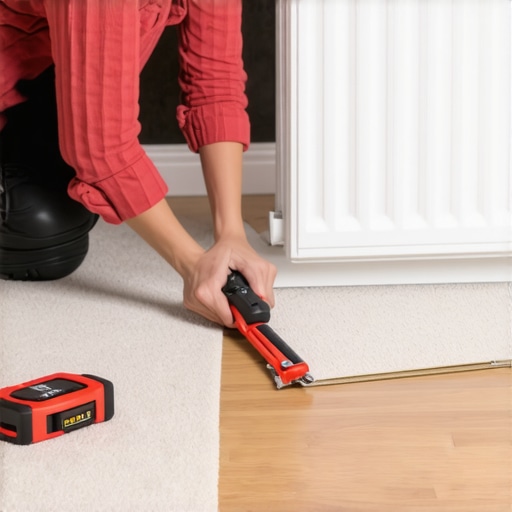
Fixing a bulging carpet seam requires a total release of the existing tension followed by a chemical re-bonding of the secondary backing to the seam tape. You must use a power stretcher to redistribute the localized stress that caused the peak or the bubble. A knee kicker is insufficient for hallway lengths exceeding twelve feet because it lacks the mechanical leverage to stabilize the lateral force. The primary reason a seam fails in a high-traffic area is the loss of structural integrity in the thermoplastic adhesive. When the seam iron is not held at the correct temperature, the glue only coats the tips of the fibers rather than penetrating the backing. Over time, the constant friction from foot traffic shears these weak bonds. This creates a pocket of loose material that moves independently of the pad, resulting in a visible bulge.
“A floor is only as good as the subfloor beneath it; deflection is the enemy of every joint.” – Master Flooring Axiom
Why your subfloor is lying to you
Subfloor flatness is the single most ignored variable in carpet maintenance and installation across the residential sector. Even though carpet is flexible, it acts as a topographical map of whatever sits beneath it. If your plywood or concrete slab has a dip greater than 3/16 of an inch over a ten foot span, the carpet will eventually bridge that gap. This creates a trampoline effect. Every time a person walks over that bridge, the carpet stretches slightly more than its elastic limit. Eventually, it stays stretched. This is where the bulge comes from. In areas near showers or bathrooms, moisture migration through the subfloor can also soften the latex used in the carpet backing, making it more prone to stretching. This is why floor leveling is not just for tile or laminate; it is the foundation of a stable textile surface.
The chemistry of the heat bond
The thermal application of seam tape involves a precise window of molecular activation where the adhesive transforms from a solid to a high-viscosity liquid. Most installers set their irons to a level four, which is roughly 135 degrees Celsius. If the iron moves too fast, the glue never reaches its melting point. If it moves too slow, it scorches the synthetic fibers, making them brittle. A bulging seam often indicates that the iron was moved too quickly over a cold subfloor, which absorbed the heat before the glue could penetrate the jute or synthetic secondary backing. To fix this, you have to peel the old tape away without tearing the primary backing. This requires a heat gun and extreme patience. Once the old residue is removed, you must apply a new 4-inch wide premium tape that features a higher concentration of hot-melt adhesive.
How a power stretcher saves your investment
The mechanical advantage provided by a power stretcher allows for the uniform distribution of yarn across the entire surface area of the room. When a hallway seam bulges, it is often because the carpet was only pinned to the tack strips at the ends. Without lateral tension, the seam is the first place to yield to gravity and friction. You need to hook the head of the stretcher into the carpet pile and brace the tail against the opposite wall. You are aiming for a one percent stretch in both directions. For a twenty foot hallway, that means pulling the carpet nearly two and a half inches. This tension keeps the seam flat against the pad. If you rely on a knee kicker, you are only moving the top layer of the carpet, which leads to early delamination and the return of the bulge within six months.
| Feature | Knee Kicker | Power Stretcher |
|---|---|---|
| Pressure Type | Localized Impact | Mechanical Leverage |
| Tension Distribution | Uneven | Uniform |
| Long Hallway Utility | Low | High |
| Backing Protection | Potential Tearing | Controlled Stretch |
The 1/8 inch that ruins everything
Precision cutting of the carpet edges determines whether a seam will peak, gap, or lay flat under heavy traffic. If the edges are cut even 1/8 of an inch too wide, they will crush against each other when the carpet is stretched, creating a ridge. This is a common mistake in hallway installs where the walls are rarely perfectly parallel. I always use a row runner to find the exact space between the yarn rows. This ensures that the two pieces butt together with zero compression. If you see a bulge, it might be that the installer simply forced too much material into the space. In this case, the fix involves trimming the excess with a wall trimmer and re-seaming the joint. It is a surgical process that requires a sharp blade and a steady hand. One slip and you have a gap that no amount of brushing can hide.
- Identify the direction of the carpet pile to ensure the repair matches the existing light reflection.
- Vacuum the area thoroughly to remove any grit that might interfere with the new adhesive bond.
- Use a seam sealer on the cut edges to prevent fraying and yarn loss over time.
- Apply weighted seam rollers immediately after heat application to press the backing into the glue.
- Keep the HVAC system running at a consistent temperature to prevent rapid expansion of the backing.
The ghost in the expansion gap
Structural movement in the house frame can transmit stress directly to the carpet seams through the tack strips. While we often discuss expansion gaps in the context of laminate or hardwood, carpet is also subject to the physical shifts of a building. If the tack strips are installed too close to the baseboard, the carpet has nowhere to go when the humidity rises. It buckles. In a hallway, where the space is narrow, this buckle usually manifests right at the seam. You have to ensure there is a 1/4 inch gap between the strip and the wall. This allows the carpet to be tucked properly. If the strip is touching the plate, the tension has no release point, and the seam will always be under duress. This is why I always check the perimeter before I even touch the iron.
“Every failure in the finish layer can be traced back to a shortcut taken in the structural layer.” – TCNA Handbook Wisdom
The moisture trap under the pad
High humidity levels or damp concrete slabs can compromise the chemical stability of carpet adhesives and padding. If you have a bulge in a hallway near a bathroom, the culprit is likely the microclimate of the subfloor. Moisture rises through the slab and gets trapped under the padding. This softens the seam tape adhesive until it becomes gummy. Once the glue loses its crystalline structure, it can no longer hold the carpet edges together under tension. You might need to install a moisture barrier or use a specialized synthetic pad that does not hold water. Simply fixing the seam without addressing the humidity is a waste of time. The bulge will return as soon as the next humid season hits. You have to treat the cause, not just the symptom.