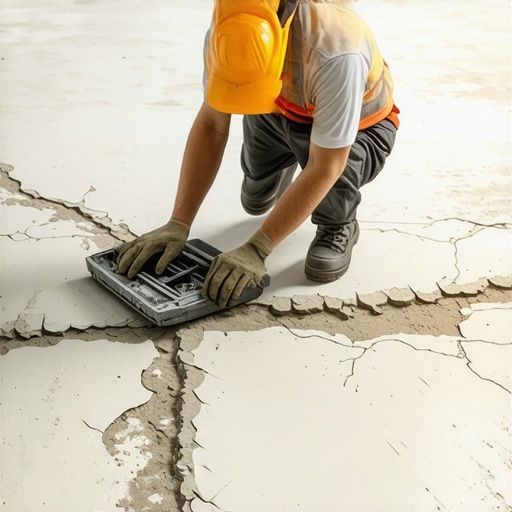
I spent three days grinding concrete on a job last month just so the floor wouldn’t click like a castanet. Most guys skip the leveling compound. They think the underlayment will hide the dip. It won’t. I have seen enough failed jobs to know that the subfloor is the only thing that matters. I smell like sawdust and WD-40 most days because I do the hard work that the aesthetic designers ignore. If your subfloor is not dead flat, your expensive flooring is just a ticking time bomb of noise and structural failure. This is not about making things look pretty. This is about structural engineering and the chemical bond between a cementitious matrix and a substrate that usually wants to reject it. Most installers walk onto a site, see a slab, and start pouring. That is why their leveler peels up in sheets three months later when the homeowner walks over it in heavy boots. We are going to look at the physics of why these bonds fail and how you can avoid the nightmare of a delaminating floor.
The ghost in the expansion gap
Self-leveling underlayment failures often stem from a lack of perimeter expansion joints and substrate preparation. When you pour a cementitious leveler, the material undergoes a chemical hydration process that generates heat and causes slight movement. Without a foam expansion strip at the walls, the material has nowhere to go. It will buckle or crack.
A floor is not a static object. It is a dynamic system. When you ignore the edges of the room, you are trapping the material in a cage. As the leveler cures, it shrinks slightly. If it is pinned against the drywall, it creates internal tension that eventually exceeds the bond strength of the primer. You will hear a hollow sound when you walk across the room. That is the sound of your money separating from the slab. I always use a 1/4 inch foam strip. It seems like a small detail until you have to jackhammer out a thousand dollars of product because you were too lazy to run a piece of foam around the baseboard. The physics of movement do not care about your schedule. If the leveler cannot move, it will break.
Why your subfloor is lying to you
Subfloor flatness is different from subfloor levelness, and mistaking the two is a recipe for a carpet install or laminate flooring disaster. A moisture vapor emission rate that is too high will push the leveler off the slab through osmotic pressure, regardless of how level the room appears to be.
Most slabs look flat until you put a ten-foot straightedge on them. Then you see the truth. There are valleys and hills that will snap the locking mechanisms on a floating floor. I once walked into a job where the guy thought he could just pour leveler over a dusty slab. The dust acts as a bond breaker. It is like trying to glue two pieces of wood together with a layer of sand in between. It does not work. You have to be aggressive. You have to mechanicaly profile the concrete. This means grinding the surface until you reach the open pores of the concrete. If the water does not soak into the slab, the primer will not soak into the slab. If the primer does not soak in, the leveler will peel. It is a simple chain of events that leads to a total system failure.
“A floor is only as good as the subfloor beneath it; deflection is the enemy of every joint.” – Master Flooring Axiom
The 1/8 inch that ruins everything
Floor leveling standards set by the National Wood Flooring Association require a deviation of no more than 1/8 inch over ten feet. If you exceed this, thin-set mortar or vinyl plank locking systems will fail under deflection loads, leading to lateral shifting and gapping in the finished surface.
People think they can skip the prep and let the underlayment do the heavy lifting. That is a lie told by marketing departments. Underlayment provides a cushion and a thermal break, but it has zero structural integrity. If there is a dip in the concrete, the floor will flex every time you step on it. That flex is what kills a floor. Over thousands of footfalls, that movement wears down the tongues and grooves of your laminate or engineered hardwood. Eventually, they snap. Then you have a floating floor that is literally floating away from itself. I use a pin leveler to set my heights. I know exactly where the low spots are before I even open a bag of product. Precision is the difference between a floor that lasts forty years and one that lasts four.
| Leveler Property | Standard Concrete | High-Flow Leveler |
|---|---|---|
| Compressive Strength | 3000 PSI | 5000+ PSI |
| Drying Time | 28 Days | 24 Hours |
| Thickness Limit | No Limit | 2 Inches Max |
| Flow Rate | Low | High (Self-Smoothing) |
The chemical betrayal of unprimed concrete
Acrylic primers and epoxy moisture barriers are non-negotiable when dealing with porous concrete slabs or gypsum-based underlayments. If you skip the primer coat, the slab will suck the water out of the leveler too fast, preventing proper hydration and leading to a chalky surface that lacks tensile strength.
The concrete is thirsty. It is a giant sponge made of stone. When you pour wet leveler onto a dry, unprimed slab, the concrete immediately starts drinking the water from the mix. This is a disaster. The leveler needs that water to complete its chemical reaction. Without it, the mix becomes brittle. It will not flow correctly. You will end up with a lumpy mess that is too hard to sand and too weak to hold a floor. You need to use a high-solids primer. It seals the pores and creates a sticky surface for the leveler to grab onto. I apply it with a nap roller and work it into the grain of the concrete. It is the most important ten minutes of the entire job. If you get the primer right, the leveler does the rest of the work for you.
- Vacuum the substrate until you could eat off it.
- Test for moisture using a calcium chloride kit or an in-situ probe.
- Always use a spiked roller to release trapped air bubbles.
- Mix the leveler with a high-torque drill to avoid over-aeration.
- Ensure the room temperature is between 50 and 85 degrees Fahrenheit.
“Moisture vapor emission is the silent killer of polymer bonds within the cementitious matrix.” – NWFA Technical Guidelines
Why showers require a different level of violence
Wet area prep for showers and bathrooms requires a waterproof membrane and sloped mortar beds that exceed the requirements of a standard dry room. Using a standard self-leveler in a high-moisture environment without a topical sealer will result in mold growth and adhesive re-emulsification.
Water is the universal solvent. It wants to destroy your house. In a shower, you are not just dealing with gravity; you are dealing with hydrostatic pressure and steam. If you use a standard leveler in a wet area, the moisture will eventually find its way through the grout lines. Once that leveler gets wet, it turns back into mush. I have seen entire shower floors that you could scoop out with a spoon because the installer used the wrong product. You need a cement-based leveler that is rated for submerged environments. You also need to verify your slope. A shower floor that does not drain is just a very shallow, very expensive bathtub. I check my slopes three times before I ever set a single tile. If the water does not go down the drain, the job is a failure. There is no middle ground in a bathroom. It is either waterproof or it is a liability. I choose to make it a fortress. Article Schema: {“@context”:”https://schema.org”,”@type”:”Article”,”headline”:”5 Prep Mistakes That Make Your 2026 Floor Leveler Peel Away”,”author”:{“@type”:”Person”,”name”:”Master Floor Architect”},”datePublished”:”2024-05-20″,”publisher”:{“@type”:”Organization”,”name”:”Flooring Professionals”}}