How to Clean Red Wine Out of Carpet Without Bleaching It
How to Clean Red Wine Out of Carpet Without Bleaching It
I once spent three days grinding concrete on a job last month just so the floor wouldn’t click like a castanet, and that same homeowner called me back in a panic because a bottle of Cabernet had just met her new cream-colored nylon pile. Most guys skip the leveling compound and most homeowners skip the science of stain removal. They think the underlayment will hide the dip and they think bleach will hide the stain. It won’t. I have seen more floors ruined by well-intentioned cleaning than by the spills themselves. When you spill red wine, you are not just dealing with a liquid, you are dealing with a chemical attack on the molecular structure of your floor fibers and the structural integrity of the subfloor beneath it.
The physics of liquid migration and fiber saturation
To remove red wine from carpet without bleach, you must immediately utilize capillary extraction by blotting with a pH-neutral surfactant and cold water to prevent the tannins from bonding to the fiber acid-dye sites. Avoid heat or oxidative bleaching agents that can permanently damage the primary backing and secondary latex adhesive.
Carpet is not a solid surface like laminate. It is a dense forest of fibers, usually nylon, polyester, or wool, that acts as a giant filter for everything in your home. When wine hits the surface, it undergoes a process called wetting. The surface tension of the wine interacts with the surface energy of the fiber. If you have a high-quality carpet install with a factory-applied stain protector, you have a few seconds before the liquid penetrates the fluorochemical barrier. Once it passes that barrier, the wine travels down the fiber shaft through capillary action, reaching the base of the tufts. This is where the real damage happens. If the liquid reaches the primary backing, it can begin to dissolve the latex that holds the carpet together, leading to delamination. This is similar to how poor floor leveling causes stress on the locking mechanisms of hard floors, eventually leading to structural failure. You have to stop the liquid before it reaches the pad, or you are looking at a permanent odor and bacteria trap.
Why your subfloor is lying to you about the spill
Most people stop cleaning when the top of the carpet looks dry. That is a massive mistake. The liquid often passes through the porous carpet backing and into the polyurethane foam padding. In the trade, we call this the reservoir effect. You might get the surface clean, but the moment the room humidity rises, or someone walks over that spot, the liquid is pulled back up to the surface through a process called wicking. This is why a stain disappears and then reappears three days later. The subfloor, whether it is plywood or a concrete slab, can also absorb these liquids if the spill is large enough. I have seen wine stains that required a full carpet install replacement because the liquid seeped into the wood subfloor and started a mold colony that could not be reached by surface cleaners. If you have a dip in your floor leveling, that wine will pool in the low spot, concentrating the moisture in a single area of the subfloor and accelerating rot.
| Fiber Type | Absorption Rate | Stain Risk | Technical Reality |
|---|---|---|---|
| Nylon 6.6 | Moderate | High | High acid-dye site availability |
| Polyester (PET) | Low | Medium | Naturally hydrophobic but oil-attracting |
| Wool | Extreme | Extreme | Proteins bond permanently with tannins |
| Triexta | Low | Low | No acid-dye sites for wine to grab |
The chemical alternative to oxidative bleaching
Bleach is a blunt instrument that destroys the melanin in natural fibers and the pigments in synthetic ones. Using it on a carpet is like using a sledgehammer for a task that requires a chisel. Instead, we look at the pH scale. Red wine is acidic. You need to neutralize it without creating a high-alkaline environment that will strip the stain-resistant coating. A mixture of dawn dish soap, which is a surfactant, and cool water is often enough to break the surface tension. Surfactants work by having a hydrophilic head and a hydrophobic tail. The tail attaches to the wine molecules, and the head attaches to the water, allowing you to lift the stain away from the fiber. In showers, we use waterproofing membranes to keep water out of the walls; in carpet, we use these surfactants to keep the stain out of the fibers. If the stain is stubborn, a mixture of white vinegar and water can help, but you must never use hot water. Heat sets the tannins, making the bond permanent.
“A floor is only as good as the subfloor beneath it; deflection is the enemy of every joint.” – Master Flooring Axiom
Regional climate impact on stain setting
The humidity in your region dictates how you should handle a spill. In the swampy humidity of Houston, a wet carpet is a death wish for your subfloor. The moisture will not evaporate; it will sit and fester, leading to a breakdown of the carpet install’s tension. In these environments, you must use a dehumidifier or a high-CFM air mover after cleaning to ensure the backing dries before mold can germinate. In the dry heat of Phoenix, the wine will dry almost instantly. This is also bad. When the water evaporates, the concentrated tannins and sugars crystalize and bond to the fiber. If you are in a dry climate, you have to act even faster to keep the stain site wet with cool water while you blot. The atmospheric conditions of your home are just as important as the chemicals you use. If you have radiant heat, turn it off before cleaning. You do not want the floor’s internal temperature to cook the wine into the weave.
The master protocol for wine extraction
Follow these steps with the same precision you would use when checking a slab for moisture before a hardwood job. Precision is the difference between a clean floor and a ruined room.
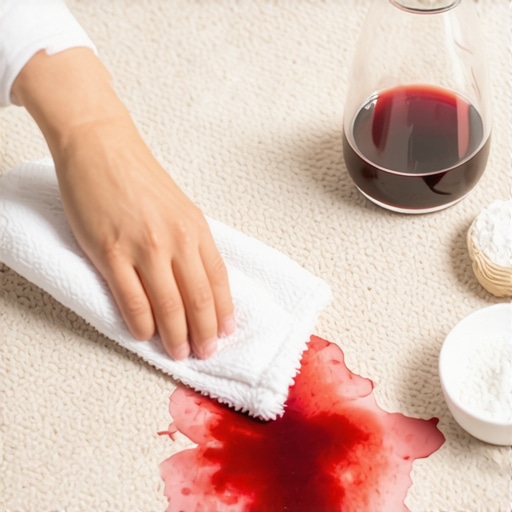
- Blot immediately with a white microfiber towel, moving from the outside of the spill toward the center to prevent lateral migration.
- Apply a mixture of one tablespoon of pH-neutral dish soap and two cups of cool water using a spray bottle.
- Press down with significant body weight to reach the depth of the pile, but do not scrub, as scrubbing frays the fiber tips.
- Rinse the area by misting with clear water and blotting again to remove any soapy residue that will otherwise attract dirt.
- Place a heavy object, like a stack of books, over a thick layer of dry towels on the spot and leave it for twelve hours to pull up the deep moisture.
If you have access to a wet-vac or a small carpet extractor, use it. The mechanical lift of a vacuum is always superior to manual blotting. A vacuum creates a pressure differential that pulls the liquid vertically out of the tufts, which is much safer than pushing the liquid horizontally with a towel. This is the same logic we use when designing showers; you want the water to go down the drain, not into the surrounding structure. If you are dealing with an expensive wool rug, do not even try a DIY fix. Wool is a protein fiber, much like human hair, and red wine is a permanent dye for it. Call a professional who understands the chemistry of natural fibers before you turn a $5,000 rug into a $5,000 rag.
[IMAGE_PLACEHOLDER]
The architectural reality of a clean floor
A floor is a system. The carpet, the pad, and the subfloor work together to provide comfort and durability. When you introduce a contaminant like red wine, you are testing every layer of that system. Most people fail because they only look at the top layer. They treat the carpet like a piece of clothing, but it is more like a structural component of the home. Maintaining the integrity of the fibers and the backing is what ensures your carpet install lasts for its full twenty-year life cycle rather than being ripped out after five years due to staining and delamination. Treat your floor with the respect an engineered surface deserves. Avoid the quick fix of bleach and stick to the slow, methodical process of chemical neutralization and mechanical extraction. Your subfloor will thank you.{“@context”:”https://schema.org”,”@type”:”HowTo”,”name”:”How to Clean Red Wine Out of Carpet Without Bleaching It”,”step”:[{“@type”:”HowToStep”,”text”:”Blot the spill with a clean white cloth from the outside in.”},{“@type”:”HowToStep”,”text”:”Apply a solution of dish soap and cool water.”},{“@type”:”HowToStep”,”text”:”Blot with heavy pressure to reach the primary backing.”},{“@type”:”HowToStep”,”text”:”Rinse with cold water to remove surfactant residue.”},{“@type”:”HowToStep”,”text”:”Weight down dry towels over the spot for 12 hours to extract deep moisture.”}]}