Why your kitchen floor feels sticky even after mopping
Why your kitchen floor feels sticky even after mopping
The smell of floor wax and the gritty feeling of sawdust under my fingernails are the hallmarks of twenty-five years in the trenches of residential flooring. I have spent thousands of hours on my knees with a moisture meter. I have seen every mistake a homeowner can make. One of the most common complaints I hear when I am called to inspect a buckling plank or a dull finish is a simple one. The homeowner says their floor feels like a glue trap despite daily cleaning. Most people think they are cleaning when they mop. In reality, they are often just performing a chemical ritual that builds a layer of sludge. This is not a cosmetic issue. This is a matter of surface chemistry and structural integrity. If you ignore the residue, you are essentially inviting microbial growth and finish degradation into your home. It will ruin the floor. I once walked into a house where a expensive wide-plank walnut floor was cupping so bad it looked like a potato chip because the owner used a steam mop every single day. They thought they were being extra clean. Instead, they were forcing moisture into the tongue and groove joints, expanding the wood fibers from the bottom up while the top was being choked by surfactant buildup.
The molecular trap of surfactant buildup
Sticky floors are almost always caused by an accumulation of cleaning agents that were never properly rinsed away from the surface. When you use a concentrated cleaner, the surfactants are designed to lift dirt. However, if the water evaporates before the cleaner is removed, those chemical bonds remain on the floor. Every subsequent mopping adds another layer of this microscopic film. Eventually, the floor becomes a magnet for dust and hair. You are not walking on your flooring material. You are walking on a dirty plasticized layer of old soap. This is especially prevalent on luxury vinyl plank and laminate because these surfaces are non-porous. The cleaner has nowhere to go but up. It sits on the wear layer and hardens into a tacky film that resists standard mopping. To break this bond, you need to understand the pH scale. Most household cleaners are alkaline. If you keep adding alkaline layers, the surface tension of the floor changes. It becomes grabby. You need a neutralizing agent, not more soap.
The ghost in the evaporation cycle
Evaporation is the hidden enemy of a clean floor in a busy kitchen environment where heat and airflow fluctuate. When you mop with a bucket of water, the liquid begins to evaporate the moment it touches the surface. If your solution is too strong, the water leaves first, leaving behind a concentrated chemical residue. This residue is what creates that hazy, sticky feeling under your socks. In high-traffic areas like the kitchen triangle, this process is accelerated by the warmth of the dishwasher and the oven. The heat causes the liquid to flash off too quickly. I have seen floors where the area in front of the refrigerator is twice as sticky as the rest of the room. This is because the compressor exhaust is blowing warm air right across the floorboards. It dries the soap before it can be wiped away. You are essentially painting your floor with a thin layer of sticky resin every time you pass the mop over those warm spots. You have to control the drying time or use significantly less product.
Why your subfloor is lying to you
Subfloor moisture can manifest as surface tackiness through a process called efflorescence or adhesive bleed through in certain installations. If your kitchen was built over a concrete slab without a proper vapor barrier, moisture vapor is constantly moving upward through the material. This vapor can carry minerals and salts from the concrete. When it reaches the underside of your LVP or laminate, it creates pressure. In some cases, if the installer used a pressure-sensitive adhesive that was not compatible with the slab moisture levels, that adhesive can emulsify. It turns back into a liquid state and migrates through the seams of the planks. You think you spilled syrup. In reality, your floor is bleeding glue from the bottom up because the installer skipped the moisture test. I have spent days grinding concrete just to prevent this. Most guys think the underlayment will hide the dip or the dampness. It won’t. The physics of hydrostatic pressure will always win.
“A floor is only as good as the subfloor beneath it; deflection is the enemy of every joint.” – Master Flooring Axiom
The hard truth about steam mops
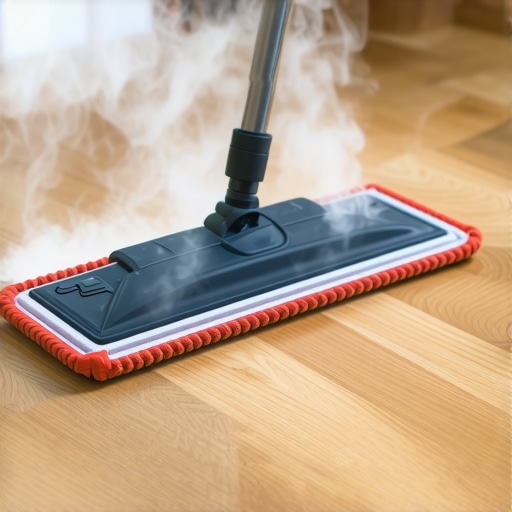
Steam mops are the fastest way to destroy the structural integrity of an engineered or laminate floor while creating a permanent sticky haze. The high-temperature vapor forced into the seams of the floor liquefies the factory finish and any residual cleaning chemicals. This creates a slurry that settles into the texture of the grain. Furthermore, the heat can cause the adhesive layers in engineered wood to delaminate. I have seen the edges of planks turn gray and soft within six months of steam mop use. The steam penetrates where liquid water cannot. It reaches the core material, which is often high-density fiberboard or plywood. Once that core swells, the floor is finished. It will never lay flat again. The stickiness you feel after steaming is often the actual resins of the wood or the plasticizers of the vinyl being pulled to the surface by the heat. Stop using steam on anything that is not solid porcelain tile.
Comparison of Floor Cleaning Methods and Residue Risk
| Method | Residue Level | Structural Risk | Recommended Frequency |
|---|---|---|---|
| Traditional Bucket/Mop | High | Moderate | Weekly |
| Spray Mop (Microfiber) | Low | Low | Daily |
| Steam Mop | Extreme | Very High | Never on wood/LVP |
| pH Neutral Rinse | Zero | Low | Monthly |
The 1/8 inch that ruins everything
Floor leveling is not an optional step in the installation process and its absence often contributes to uneven wear and cleaning difficulties. When a floor has dips or humps, your mop skips over the low spots. Dirt and cleaning solution pool in these depressions. Over time, these pools dry and create thick patches of sticky residue that are nearly impossible to remove with standard agitation. If your floor clicks or moves when you walk on it, that deflection is also cracking the micro-beveled edges of your planks. These cracks trap grease and soap. I tell my clients that if the subfloor is not flat within one-eighth of an inch over a ten-foot span, the floor will fail. It doesn’t matter how expensive the wood is. If the foundation is junk, the finish will suffer. The stickiness is just the first symptom of a larger mechanical failure occurring beneath your feet.
Checklist for restoring a sticky floor
- Strip the old residue using a 1:10 solution of white vinegar and distilled water.
- Use a microfiber pad rather than a string mop to increase agitation.
- Mop in small sections to prevent the solution from drying before it is wiped up.
- Perform a final rinse with plain distilled water to remove any loosened surfactants.
- Check the room humidity; it should remain between 35 and 55 percent.
- Inspect the transitions and baseboards for signs of moisture migration.
“The National Wood Flooring Association standards require that all subfloors be clean, dry, and flat to prevent finish failures.” – NWFA Professional Guidelines
Regional climate factors in floor maintenance
The swampy humidity of areas like Houston or Florida means that your cleaning solution will take much longer to dry, increasing the chance of it trapping airborne dust. In these regions, solid wood is a death wish for a kitchen. You need engineered cores. Conversely, in the dry heat of Phoenix, the air will suck the moisture out of your cleaning solution so fast that you almost certainly leave streaks of concentrated soap behind. You have to adapt your chemistry to your zip code. If you live in a high-humidity area, you should use even less cleaner than the bottle recommends. The moisture in the air keeps the surface tackier for longer. In a desert climate, you need to work in much smaller sections to ensure the floor stays wet enough to be wiped clean. Stickiness is often just a reflection of your local dew point interacting with your choice of soap.
The final word on floor chemistry
You cannot solve a chemical buildup with more chemicals. If your floor is sticky, the solution is subtraction, not addition. You must remove the layers of old product that have cross-linked with household grease and dust. This requires patience and mechanical action. A floor is a performance surface. It requires a balance of friction and cleanliness to function. When that balance is skewed by improper mopping techniques or subfloor issues, the floor ceases to be a structural asset and becomes a maintenance nightmare. Take care of the subfloor, watch your moisture levels, and stop over-medicating your floors with big-box store cleaners. It will save your finish. It will save your sanity.