How to fix a dip in the floor without removing the carpet
Most guys skip the leveling compound. They think the underlayment will hide the dip. It won’t. I spent three days grinding concrete on a job last month just so the floor wouldn’t click like a castanet. I have seen it a thousand times. You walk across a room and feel that sickening sinkhole beneath the fibers. It is a structural failure disguised as a minor annoyance. If you are trying to fix a dip without pulling back the carpet, you are fighting physics, but it can be done if you understand the anatomy of the joist and the subfloor. Most homeowners assume they have to tear everything out, but the solution often lies in the crawlspace or through a surgical injection. I once saw a $20,000 carpet install ruined because the installer ignored a 1/4 inch dip over a ten foot span. The constant flexing of the subfloor eventually sheared the tack strips right off the slab. We are going to look at the mechanics of the void and how to stabilize it from the inside out.
The ghost in the expansion gap
To fix a dip in the floor without removing the carpet, you must either access the subfloor from the crawlspace below to jack and shim the joists or use a specialized floor-leveling injection kit to fill the void through the carpet backing. These methods address the structural deficiency without disturbing the tension of the carpet install. Most dips are caused by a combination of high moisture content in the plywood and insufficient support from the floor joists. When the relative humidity in a crawlspace spikes, the wood fibers absorb water, causing the lignin to soften and the panel to sag under the weight of furniture or foot traffic. If you cannot pull the carpet, you have to treat the subfloor as a hollow cavity that needs structural reinforcement. This is not about aesthetics. It is about the deflection limit which is technically known as L over 360 in the building code. If your floor moves more than that, it is failing.
“A floor is only as good as the subfloor beneath it; deflection is the enemy of every joint.” – Master Flooring Axiom
Why your subfloor is lying to you
The plywood or OSB under your feet is a composite of wood strands and resins. Over time, the adhesive bond within the board can degrade if it was exposed to moisture during the construction phase. This is why a carpet install that felt solid five years ago might suddenly develop a soft spot. The wood is delaminating at a molecular level. When you step on that spot, the fibers compress and the air is pushed out of the void. You are not just feeling a dip; you are feeling the sound of structural fatigue. If you are dealing with a concrete slab, the dip is likely a result of poor finishing or a settling foundation. In these cases, the carpet hides a literal pit in the stone. Fixing this through the carpet requires a high-viscosity leveling compound that can be injected through a syringe. This compound must have a high compressive strength to withstand the thousands of pounds of pressure exerted by a human heel. I have seen guys try to use expanding foam from a hardware store. That is a mistake. Standard foam is flexible. You need a rigid, closed-cell structural resin that sets as hard as rock.
| Subfloor Material | Typical Thickness | Deflection Resistance | Moisture Sensitivity |
|---|---|---|---|
| CDX Plywood | 3/4 inch | High | Moderate |
| OSB (Oriented Strand Board) | 23/32 inch | Moderate | High |
| Concrete Slab | 4 to 6 inches | Extreme | Low |
| Particle Board | 5/8 inch | Low | Extreme |
The injection method for minor depressions
If the dip is less than 1/4 inch, you can sometimes use a surgical approach. This involves finding the exact center of the dip with a long straightedge. You then use a heavy-duty syringe and a hollow needle to penetrate the carpet and the padding. You are aiming for the subfloor. By injecting a low-viscosity, high-strength epoxy or structural resin, you can fill the gap between the subfloor and the floor joist or fill a low spot in the concrete. The resin flows into the depression and hardens, creating a custom-molded support pillar. You must be careful with the volume of fluid. Too much and you will create a hump that is harder to fix than the dip. This process requires patience because the resin needs time to cure without being disturbed. I always tell people to stay off that section of the floor for at least 24 hours. If you walk on it while it is tacky, you will just create a bigger mess under the carpet.
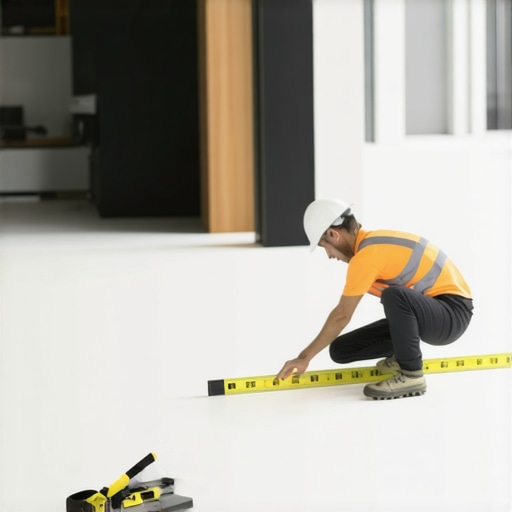
- Identify the lowest point using a 6-foot level or a laser line.
- Mark the perimeter of the dip with painter’s tape on top of the carpet.
- Check for floor joist locations using a high-density stud finder.
- Drill a tiny pilot hole through the carpet backing if using a thick resin.
- Inject the structural filler slowly to avoid air pockets.
- Weight the area around the injection site to ensure the floor stays flat.
- Allow for a full 24-hour cure time before removing the weights.
Reaching the void from the crawlspace
The most professional way to fix a dip without touching the carpet is to go underneath the house. This is where the real engineering happens. You are looking for the joists that support the area where the dip is located. Often, you will find a joist that has bowed or twisted. This is common in older homes where the lumber was not kiln-dried to modern standards. To fix this, you can use a 20-ton hydraulic jack and a 4×4 post. You slowly apply pressure to the joist until the floor above is level. Once the dip is gone, you sister the joist. This means you bolt a new, straight piece of lumber alongside the old one. This doubles the strength of the span and locks the floor in its new, level position. It is a dirty, cramped job, but it is the only way to ensure the dip never returns. You are essentially rebuilding the skeleton of the house from the bottom up. Do not over-jack the floor. If you go too high, you will crack the drywall on the walls or pop the seams in the ceiling. It is a game of millimeters.
“Deflection is not just a measurement of distance; it is a measurement of the structural integrity of the entire assembly.” – TCNA Technical Handbook
The 1/8 inch that ruins everything
In the world of professional flooring, we live and die by the 1/8 inch rule. The NWFA states that a floor should be flat within 1/8 of an inch over a 6-foot radius. While carpet is more forgiving than laminate or hardwood, a dip larger than this will still cause problems. It creates a trip hazard and causes the carpet fibers to wear unevenly. If the carpet is stretched over a dip, the tension is inconsistent. Over time, this leads to ripples and buckles. Many people think they can just throw a thicker underlayment down to hide the dip. That is a lie. While most people want the thickest underlayment, too much cushion actually causes the locking mechanisms on floors to snap and causes carpet to feel like walking on a sponge. A thick pad does not fill a hole. It just follows the contour of the hole. You need structural mass, not soft foam. Whether you are dealing with a shower transition or a hallway, the levelness of the substrate is the only thing that matters. If the subfloor is not right, the finish floor will never be right. You can buy the most expensive wool carpet in the world, but if it is sitting on a sagging piece of 5/8 inch particle board, it will feel cheap and broken within a year. Fix the structure first and the aesthetics will follow.