The reason your laminate smells like vinegar
The pungent reality of off gassing and moisture
Laminate flooring smells like vinegar because of acetic acid release from moisture reacting with urea-formaldehyde resins in the high-density fiberboard core. This chemical breakdown occurs when high humidity, subfloor moisture, or improper cleaning solutions penetrate the locking joints. Poor floor leveling often traps moisture in low spots, leading to microbial growth and pungent odors.
Homeowners always ask why their waterproof vinyl or laminate is buckling or smelling. Usually, it is because they locked it under a heavy kitchen island, killing the floor’s ability to breathe. I once saw a job where the entire kitchen smelled like a salad dressing factory. The culprit was not a spill. It was a failure to use a proper moisture barrier over a concrete slab that was still curing. The moisture rose, hit the phenolic backing of the laminate, and started a chemical party that nobody wanted to attend. I have spent 25 years on my knees with a moisture meter, and I can tell you that a floor is not a decoration. It is a structural engineering challenge that starts at the subfloor. If you ignore the physics of the slab, the chemistry of the adhesive will remind you of your mistake with a sharp, vinegary punch to the nostrils. When we talk about laminate, we are talking about a sandwich of melamine, wood fiber, and resins. When that sandwich gets wet, it does not just swell. It ferments. This odor is the sound of your investment rotting from the inside out. You cannot just spray some air freshener and hope for the best. You have to understand the molecular reality of what is happening under your feet.
The molecular breakdown in cheap resins
The sharp scent of vinegar is often the result of hydrolyzed resins in the HDF core of budget-grade laminate. These floors use urea-formaldehyde binders that release acetic acid when exposed to water vapor. Higher quality AC4 or AC5 rated floors use more stable phenolic resins that resist this chemical decomposition.
When you buy a floor for ninety nine cents a square foot, you are buying a product held together by hope and cheap glue. The high density fiberboard core is essentially compressed sawdust and resin. In a controlled environment, these resins stay stable. But your house is not a laboratory. It is a living, breathing ecosystem. If you just finished a carpet install in the adjacent room and moved to laminate without checking the humidity, you are asking for trouble. The resins used in cheap laminate are particularly susceptible to hydrolysis. This is a chemical reaction where water molecules break the bonds of the polymer chains. As these bonds break, they release volatile organic compounds. One of the byproducts of this degradation is acetic acid. That is literally the chemical name for vinegar. So, when you smell that scent, you are smelling the literal disintegration of the floor core. It is not just a smell. It is a structural failure. The wood fibers lose their grip on the resin, the tongue and groove joints become brittle, and the floor starts to sound like a bag of potato chips when you walk on it. I have seen guys try to save money by skipping the underlayment, thinking the subfloor was dry. It never is. Concrete is a sponge. It pulls moisture from the earth and feeds it directly into your floor core. This is why the NWFA has such strict rules about moisture testing. You are not just checking for puddles. You are checking for the invisible vapor that turns your floor into a chemical vat.
“A floor is only as good as the subfloor beneath it; deflection is the enemy of every joint.” – Master Flooring Axiom
The swamp under the planks
Trapped moisture beneath laminate creates an anaerobic environment where mold and bacteria thrive and produce acidic odors. This often happens near showers or exterior doors where water seeps into the expansion gap. Without proper floor leveling, water collects in subfloor dips, creating localized rot that smells like vinegar or sour milk.
I have walked into beautiful homes where the master bathroom transition looks perfect, but the smell tells a different story. Laminate near showers is a high risk game. Even if the product is marketed as waterproof, the joints are not always vapor tight. Water splashes out of the shower, sits on the edge of the transition, and then gravity does its job. It pulls that water into the expansion gap. Once it is under the floor, it has nowhere to go. The plastic vapor barrier you put down to protect the floor now works against you. It traps the water against the HDF core. This creates a tiny, dark, warm swamp. Bacteria and fungi start to feed on the wood fibers and the organic resins. This biological activity produces gases. Some of these gases are sulfur based, but many are acidic. This is why the vinegar smell can sometimes have a funky, earthy undertone. It is a biological cocktail. This is also why floor leveling is so critical. If your subfloor has a dip of even an eighth of an inch, water will find it and sit there. It will not evaporate. It will just sit and cook. I spent three days grinding concrete on a job last month just so the floor would not click or trap moisture. Most installers skip this because it is dusty, hard work. But if you do not level that floor, you are just building a shelf for mold to grow on. You need a flat surface to ensure that the locking mechanisms stay tight and do not allow moisture to migrate downward.
Why floor leveling ruins or saves your project
Subfloor flatness is the most overlooked factor in floor longevity and odor prevention. A subfloor that is out of spec causes the locking joints to flex, opening microscopic gaps that allow cleaning liquids and humidity to enter the core. Proper floor leveling with a high quality compound prevents the mechanical stress that leads to core failure.
If you think a thick underlayment will hide a bad subfloor, you are wrong. In fact, too much cushion actually causes the locking mechanisms on laminate and LVP to snap under pressure. When those joints snap, they leave the core exposed. Now, every time you mop the floor, you are injecting water directly into the heart of the HDF. This is where the vinegar smell starts for many people. They use a wet mop, the water gets into the broken joints, and the chemical reaction begins. You need to follow the 3/16 inch in 10 feet rule. If you do not, the floor will bounce. Every time you step on a bouncy floor, you are acting like a bellows, sucking air and moisture in and out of the joints. This air exchange can bring in humid air that condenses under the floor. This is why I am a stickler for a level surface. I use a straight edge and a bag of self leveler on almost every job. It is the difference between a floor that lasts thirty years and one that smells like a pickle factory in three. You have to look at the chemistry of the leveler too. Use a high strength, calcium aluminate based compound. It dries faster and has less shrinkage than the cheap stuff. This ensures a rock solid base that prevents the mechanical flexing that ruins the laminate seal.
| Feature | Budget Laminate | Premium Laminate | Waterproof LVP |
|---|---|---|---|
| Core Material | Low-density HDF | High-density HDF / Waxed joints | Stone Polymer Composite (SPC) |
| Resin Type | Urea-Formaldehyde | Melamine / Phenolic | None (PVC Based) |
| Moisture Resistance | Low | Medium to High | Very High |
| Odor Risk | High (Vinegar scent) | Low | Very Low (VOC only) |
| Thickness | 6mm – 8mm | 10mm – 12mm | 5mm – 8mm |
The catastrophic failure of the vapor barrier
A missing or improperly taped moisture barrier allows ground vapor to saturate the laminate core from below. This constant upward pressure of humidity triggers the release of acetic acid from the wood resins. In regions with high soil moisture, a 6 mil polyethylene film is the minimum requirement for odor prevention.
I have seen guys lay laminate over a concrete slab without a vapor barrier because the slab felt dry to the touch. That is a rookie mistake. Concrete is never truly dry. It is a porous material that breathes moisture from the soil. If you do not put down a 6 mil poly film and tape the seams with moisture resistant tape, you are asking for a disaster. The moisture rises, hits the bottom of the laminate, and has nowhere to go. It saturates the backing. The backing is often just a thin layer of paper or melamine. Once that is breached, the water hits the HDF. This is when the vinegar smell becomes unbearable. It is a constant, slow motion chemical spill. And if you are in a humid climate like Houston or Florida, this process happens twice as fast. The heat and humidity accelerate the chemical breakdown. You need to treat the vapor barrier like the hull of a ship. Any hole, any untaped seam, is a leak that will eventually sink your floor. I always overlap my seams by at least six inches and use a high quality seam tape. I do not trust the adhesive strips that come on some underlayments. They are usually garbage. I want a continuous, unbroken shield between the earth and the wood. This is the only way to ensure that the acetic acid stays locked in the molecular structure of the resin instead of filling your living room.
“Laminate flooring shall be installed in environments where the relative humidity is maintained between 35 percent and 55 percent.” – NWFA Technical Guidelines
Why white vinegar is the enemy of your wear layer
Cleaning laminate with a vinegar and water solution can actually cause the very odor you are trying to eliminate. The acid in the vinegar can break down the protective aluminum oxide wear layer and seep into the core through the joints. Once the vinegar reaches the HDF core, it reacts with the internal resins and causes permanent damage.
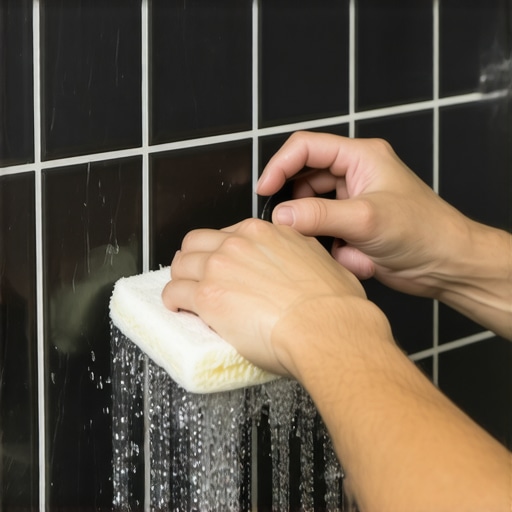
There is this old wives tale that vinegar is the best cleaner for everything. In the flooring world, that is a lie. Vinegar is an acid. Laminate floors have a wear layer made of aluminum oxide. While it is tough against scratches, it does not like acidic environments. When you mop with vinegar, you are slowly etching that surface. But the real problem is the liquid that gets into the joints. If you are using a soaking wet mop with a vinegar solution, that acidic water is sitting in the tongue and groove. It starts to eat away at the wax coating that some manufacturers put on the joints for water resistance. Once that wax is gone, the vinegar water enters the core. Now you have added more acetic acid to a core that might already be trying to off gas. You are literally fueling the fire. I tell my clients to use a pH neutral cleaner and a microfiber mop that is barely damp. If you can see streaks of water on the floor after you pass, it is too wet. You are not washing a car. You are cleaning a precision engineered surface. If you treat it like a sidewalk, it will respond by smelling like a dumpster. This is especially true after a carpet install where the subfloor might be extra dusty. People want to deep clean the new floor, but they end up destroying it with too much liquid and the wrong chemicals.
The link between showers and laminate decay
Installing laminate in or near bathrooms without a perimeter silicone seal is a recipe for chemical odors. Water from showers migrates under the baseboards and saturates the expansion gap, which is the most vulnerable part of the floor. Without a 100 percent silicone sealant in these areas, the vinegar smell is inevitable.
Laminate in a bathroom is a controversial choice for a reason. Even the best waterproof laminate has a weakness, the expansion gap. You need that gap so the floor can move as the temperature changes. But in a bathroom, that gap is an open door for water. Every time someone steps out of the shower, water hits that gap. If you do not have a bead of silicone under the baseboard and around the toilet flange, you are asking for the vinegar smell. I have pulled up floors in bathrooms that were only two years old and found the underside covered in black mold and the core so soft you could poke a finger through it. It smelled like a vat of sour grapes. The issue is that the water gets trapped between the laminate and the underlayment. It cannot evaporate. The only way to fix it is to rip it out. You cannot dry it out with a fan. Once the core has absorbed that much water and started the chemical breakdown, the structural integrity is gone. This is why I often recommend LVP for bathrooms instead of laminate. But if you must use laminate, you have to be obsessive about the sealing process. Every perimeter edge must be caulked with a high quality silicone. It is the only way to keep the water on top of the floor where it can be wiped up.
Master Checklist for Odor Prevention
- Conduct a Calcium Chloride moisture test on the concrete slab before installation.
- Ensure the subfloor is flat within 3/16 inch over a 10 foot radius using a straight edge.
- Apply a 6 mil polyethylene vapor barrier with all seams overlapped and taped.
- Acclimate the laminate planks in the room for at least 48 hours to stabilize the core.
- Leave a 3/8 inch expansion gap around the entire perimeter to prevent buckling.
- Seal expansion gaps near showers and exterior doors with 100 percent silicone caulk.
- Use only pH neutral cleaners and avoid all vinegar based solutions.
- Maintain indoor relative humidity between 35 and 55 percent year round.
The final word on subfloor integrity
At the end of the day, a floor is a system. It is not just the pretty planks you see on top. It is the slab, the leveler, the moisture barrier, the underlayment, and then the laminate. If any one of those components fails, the whole system fails. The vinegar smell is just a symptom. It is a warning sign that something is wrong with the chemistry or the physics of your installation. Do not ignore it. If you smell it, you need to find the source of the moisture. Is it a leak from a shower? Is it ground vapor? Is it a subfloor dip holding water? Once you find the source, you have to be honest about the damage. Laminate is not a resilient material like tile. Once the core has started to off gas acetic acid, it is usually too late to save those planks. You are better off pulling up the affected area, fixing the subfloor, and starting fresh. It is a hard lesson to learn, but it is one I have seen played out on countless job sites. Do it right the first time. Level the floor. Use a barrier. Keep it dry. Your nose and your wallet will thank you. The smell of victory in this business is not vinegar. It is the smell of a dry, stable, and silent floor that stays where you put it for thirty years.