Why Your Kitchen Laminate is Buckling Near the Fridge
I once spent four hours on my knees in a humid Houston kitchen just to prove a point to a homeowner who swore up and down that their waterproof laminate was defective. The floor was peaking so high near the refrigerator that the crisper drawer wouldn’t even open. It looked like a miniature mountain range. They blamed the manufacturer. I pulled my moisture meter and a 6-foot level out of my truck and found the real culprit. The refrigerator was leaking a slow drip from the ice maker line, and because they had installed the kitchen island directly on top of the floating floor, the laminate had nowhere to go. It was trapped. It was buckled. It was a $4,000 mistake that could have been avoided with a simple expansion gap and a better understanding of subfloor physics. People treat flooring like a rug. It is not a rug. It is a structural component that breathes and moves and reacts to the atmospheric pressure of your home.
The heavy appliance anchor effect
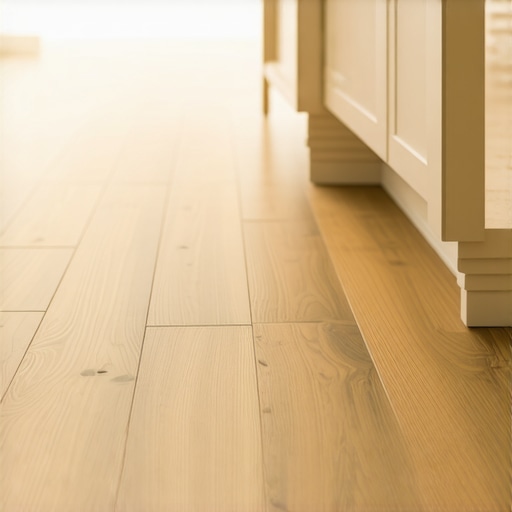
Kitchen laminate buckles near the fridge because the weight of the appliance creates a friction lock that prevents the floating floor from expanding or contracting. When a refrigerator weighing several hundred pounds sits on a floating floor, it pins the boards to the subfloor. As humidity changes, the rest of the floor tries to move toward the walls, but it is anchored by the fridge. This tension causes the interlocking joints to peak or buckle at the point of least resistance, usually right in front of the appliance feet.
You have to understand the molecular reality of a laminate core. Most laminate is made from High-Density Fiberboard or HDF. These are wood fibers compressed with resin. Even though the surface is a wear layer of aluminum oxide or melamine, the core is still organic. It is hygroscopic. This means it absorbs water from the air. In a place like Houston or Miami, the relative humidity inside a home can swing 20 percent in a single day. Those wood fibers swell. If you have a massive Sub-Zero fridge sitting on one end and a heavy kitchen island on the other, you have created a vice. The floor wants to grow by 1/8 of an inch, but it cannot move outward. It must move upward. That is why your floor looks like a wave.
Microscopic water migration under the crisper drawer
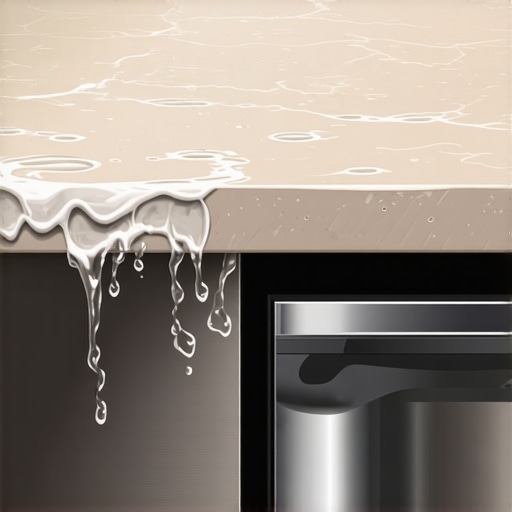
Slow leaks from water lines or condensation pans introduce liquid moisture that travels through capillary action under the laminate planks. This moisture is often invisible until the core of the laminate has already absorbed enough water to double in thickness. Once the HDF core saturates, the structural integrity of the click-lock mechanism fails, leading to permanent buckling that cannot be fixed by simply drying the floor. You must address the source of the water before attempting any repairs.
I have seen guys try to use a hair dryer to fix a buckle. That is like trying to put a forest fire out with a squirt gun. Once the urea-formaldehyde resins in the core board start to break down from water exposure, the bond is gone. The fibers delaminate. You can tell if it is a moisture issue or a weight issue by looking at the seams. If the seams are swollen and soft, you have a leak. If the seams are tight but the floor is lifting off the subfloor, you have a tension problem caused by a lack of expansion gaps or heavy furniture. Most kitchen leaks happen at the plastic compression fitting behind the fridge. A tiny spray, no bigger than a needle, can dump five gallons of water under your floor in a week without you ever seeing a puddle on the surface.
“A floor is only as good as the subfloor beneath it; deflection is the enemy of every joint.” – Master Flooring Axiom
The subfloor leveling reality check
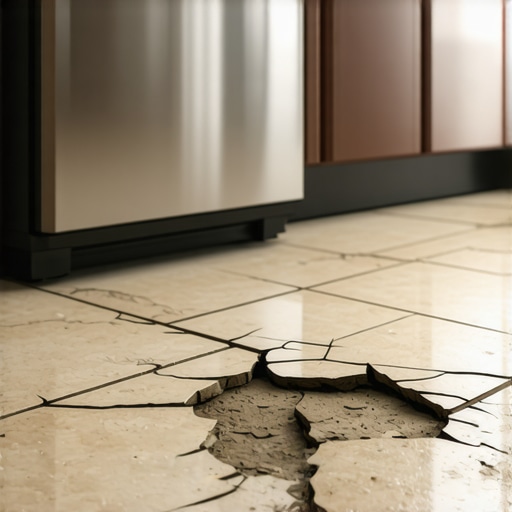
If your subfloor has a dip or a high spot greater than 3/16 of an inch over a 10-foot span, your laminate floor will eventually fail near heavy appliances. Subfloor leveling is the most skipped step in residential construction because it is messy and expensive. However, a refrigerator sitting on a high spot will act as a pivot point, causing the surrounding planks to bounce and eventually snap their locking tongues as people walk past the fridge area.
I spend more time with a grinder and self-leveling compound than I do actually laying planks. If you are installing over concrete, you need to check for hydrostatic pressure. Concrete is a sponge. It pulls moisture from the earth and pushes it upward. If you do not have a 6-mil poly vapor barrier, that moisture hits the bottom of your laminate and stays there. The fridge makes it worse because the compressor generates heat. That heat creates a micro-climate under the fridge that accelerates the evaporation of moisture from the slab into your flooring core. It is a literal pressure cooker for your floor joints.
| Material Property | HDF Laminate | Rigid Core LVP | Solid Hardwood |
|---|---|---|---|
| Expansion Rate | High | Low | Very High |
| Moisture Resistance | Moderate | High | Low |
| Acclimation Time | 48-72 Hours | 0-24 Hours | 7-14 Days |
| Janka Hardness | N/A (Wear Layer) | N/A | 1200 to 4000 |
The 1/8 inch that ruins everything
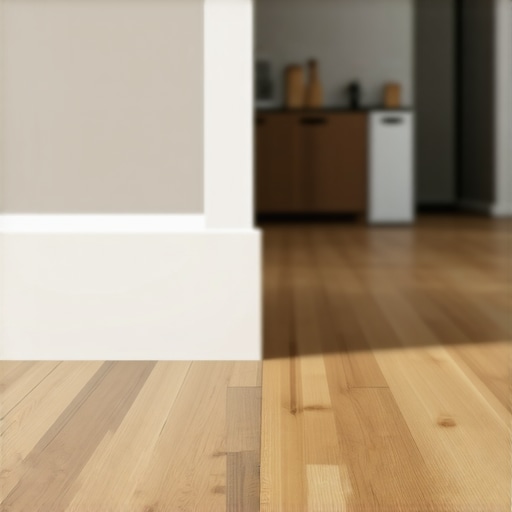
Expansion gaps are not optional suggestions; they are engineering requirements for any floating floor system. A standard kitchen requires at least a 1/4 inch to 3/8 inch gap around the entire perimeter, including where the floor meets the cabinets and the refrigerator alcove. If the floor is tight against a wall or a cabinet base, the internal pressure generated by humidity will force the planks to buckle at the weakest point, which is usually the joint nearest the heavy appliance.
I see installers cut the floor right up to the dishwasher or the fridge. They think it looks cleaner. It is a death sentence for the installation. You have to hide those gaps under the baseboard or the quarter round. If you are doing a shower remodel or a kitchen upgrade, never run the laminate under the cabinetry. Install the cabinets first, then the floor. This allows the floor to move freely. If you already have a buckled floor, you might be able to save it by removing the baseboard and cutting a wider expansion gap with a toe-kick saw. If the planks have not yet delaminated, they might lay back down once the pressure is released. But if they have been peaked for months, the locking system is likely trashed.
- Check the subfloor for levelness within 1/8 inch over 6 feet.
- Install a 6-mil vapor barrier over all concrete surfaces.
- Ensure a minimum 3/8 inch expansion gap at all vertical obstructions.
- Acclimated the flooring in the kitchen for at least 48 hours.
- Use a moisture meter to verify the subfloor is below 12 percent moisture content.
- Never install heavy kitchen islands on top of a floating floor.
The chemistry of core boards and moisture
The technical failure of laminate near refrigerators often involves the breakdown of the resin-to-fiber bond when exposed to pH-neutral water. Most people assume the laminate is a solid piece of plastic. It is actually a complex sandwich. The top is a photographic layer protected by a resin-impregnated wear layer. The middle is the HDF. The bottom is a balancing layer. When water gets into the click joint, it bypasses the waterproof top and hits the raw HDF. The fibers swell at the edges first. This is called edge-flaring. You can feel it with your thumb. If the edges are raised, the core has been compromised by liquid moisture.
In high-humidity regions like the South, the air itself carries enough moisture to cause this. If you do not run your air conditioning, the floor will swell. If you then turn the AC on high, the floor shrinks. This constant tug-of-war eventually wears down the locking tongues. In a kitchen, the fridge is the variable that breaks the math. It is a constant weight in an environment of changing dimensions. If you want a floor that lasts, you have to treat it like a machine. It needs clearance to operate. If you take away that clearance, the machine breaks. There is no such thing as a maintenance-free floor. There are only floors that haven’t failed yet because they were installed by someone who understood the physics of the subfloor.