Why Your New Carpet Has Visible Rows of Tiny Holes
Why Your New Carpet Has Visible Rows of Tiny Holes
I have spent twenty-five years on my knees with a moisture meter in one hand and a knee kicker in the other. I have smelled enough floor wax and oak dust to fill a cathedral. When a homeowner calls me out to look at their brand new carpet install and points at visible rows of tiny holes, I know exactly what I am going to find. It is usually not a defect in the fiber itself. It is a failure of subfloor preparation, a misunderstanding of tufting mechanics, or a total disregard for National Wood Flooring Association standards that often bleed over into general flooring wisdom. A floor is not a rug you just throw down. It is a performance surface. If the primary backing or the secondary backing is compromised by poor installation tools like a power stretcher, you see the skeleton of the product.
Most guys skip the leveling compound. They think the underlayment will hide the dip. It won’t. I spent three days grinding concrete on a job last month just so the floor wouldn’t click like a castanet. That same logic applies to carpet. If your concrete slab is not level, the carpet backing stretches unevenly over the high spots. This tension opens up the gauge lines where the tufting needles punched through the polypropylene during manufacturing. You are literally seeing the pores of the carpet because the installer was too lazy to pull out a straight edge.
The phantom of the primary backing
Primary backing and secondary backing are the two structural layers that hold your carpet fibers in place. When you see rows of tiny holes, you are likely observing rowing or needle tracking. This occurs when the tufting machine needles are slightly misaligned or when the stretch-in process is too aggressive for the face weight of the material.
At a molecular level, the Styrene-Butadiene Rubber (SBR) latex adhesive is what bonds these layers. If the manufacturer used too much calcium carbonate filler in the latex mix, the bond becomes brittle. When I hook my power stretcher to the wall and put 400 pounds of tension on that carpet install, a brittle backing will crack. Those tiny cracks look like rows of holes from a distance. It is a sign that the chemical bond is failing. This is similar to how a shower pan fails when the waterproof membrane is stretched too thin over a corner. The physics of tension and compression do not care about your budget. They only care about structural integrity.
Why your subfloor is lying to you
Subfloor levelness and moisture vapor transmission are the two most ignored factors in any carpet install. If the subfloor has a dip or a crown, the carpet cannot sit flat. This creates void spaces under the backing. When you walk over these areas, the carpet flexes. This constant vertical deflection causes the yarn bundles to pull apart, exposing the primary backing holes.
“A floor is only as good as the subfloor beneath it; deflection is the enemy of every joint.” – Master Flooring Axiom
If you are installing over a concrete slab, you must check for alkalinity and moisture. High PH levels in the concrete will literally eat the latex adhesive that holds the carpet together. I have seen laminate floors buckle and vinyl planks peak because someone ignored a 5 pound calcium chloride test result. Carpet is no different. If the moisture is high, the secondary backing delaminates. Those tiny holes you see are the first warning signs of a total floor failure. You need floor leveling and a moisture barrier before the first tack strip is even nailed down.
The physics of the power stretcher
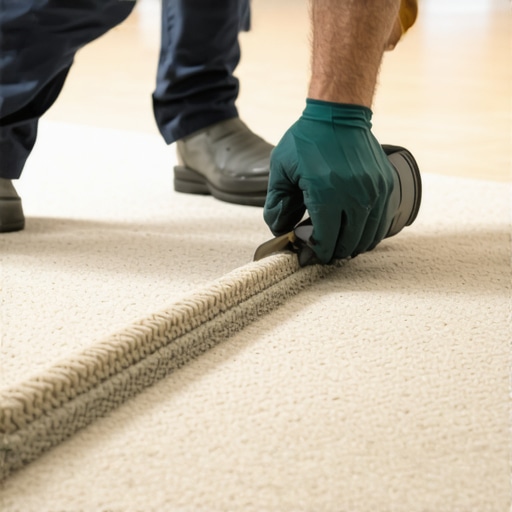
Power stretchers are required by the CRI 104 and CRI 105 installation standards, yet I see guys using knee kickers for whole rooms every single day. A knee kicker is for positioning. A power stretcher is for structural tensioning. If you do not stretch the carpet correctly, it will develop ripples and wrinkles within six months. However, if you over-stretch a low-quality builder-grade carpet, you will tear the backing pores open.
The gauge of the carpet refers to the distance between the tufting needles. A 1/10 gauge means there are ten needles per inch. If an installer uses a row-finder tool and isn’t careful, they can create permanent gaps between these rows. These look like tiny holes or bald spots. It is mechanical damage, plain and simple. You can’t fix it with a steam iron. You have to replace the breadth of the carpet roll. I always tell my apprentices that a carpet install is a game of millimeters. If you are off by a fraction, the light refraction across the yarn will highlight every single perforation in the backing.
When moisture meets the latex bond
SBR latex is the glue of the flooring world, but it has a weakness. It is hydrophilic in certain formulations. When humidity in a home spikes, the latex softens. This is why carpets feel “loose” on a humid day. In Houston or Miami, if you don’t run the HVAC during acclimation, you are asking for delamination. The tiny holes are the spaces where the tufts are no longer held tightly by the adhesive matrix.
Think about a laminate floor. If it gets wet, the HDF core swells. Carpet doesn’t swell, it relaxes. When it relaxes, the tension from the tack strips pulls the backing apart. Those rows of holes are the warp and weft of the polypropylene failing to hold the yarn. I’ve seen homeowners try to steam clean their way out of this. That is the worst thing you can do. Adding heat and moisture to a failing latex bond is like throwing gasoline on a fire. You are melting the structural glue of your floor.
Comparing Carpet Technical Specifications
| Feature | Low End (Builder Grade) | High End (Architectural) |
|---|---|---|
| Face Weight | 25 oz – 30 oz | 60 oz – 100 oz |
| Primary Backing | Single Layer Poly | Reinforced Multi-Layer |
| Latex Quality | High Filler Content | Pure SBR or Urethane |
| Stitch Rate | 7 per inch | 12+ per inch |
| Durability Rating | 2.0 – 2.5 | 4.0 – 5.0 |
The 1/8 inch that ruins everything
Subfloor tolerances for carpet are often overlooked because people think the padding will soak up the imperfections. This is a lie. Most carpet manufacturers require the subfloor to be level within 3/16 of an inch over 10 feet. If you have a dip that is deeper than that, the carpet backing will bridge the gap. Every time you step on that bridge, the backing stretches. Over time, the yarn pulls away from the latex, and you see the backing holes.
“Deflection in the subfloor is the primary cause of premature wear in textile floor coverings; a stable base is non-negotiable.” – TCNA Technical Bulletin (Adapted)
I have spent days using self-leveling underlayment on plywood subfloors just to get them ready for a carpet install. It sounds like overkill until you see a high-end wool carpet ruined because of a low spot in the joist system. If your installer doesn’t own a straight edge or a laser level, he isn’t an installer. He is a laborer. There is a big difference. One understands the physics of flooring, the other just wants to get paid and get out.
Carpet Install Inspection Checklist
- Verify the subfloor moisture content with a pin-less meter before laying tack strips.
- Ensure floor leveling compound is used on any concrete dip exceeding 1/8 inch.
- Check that power stretchers were used on all four walls to achieve 1 percent stretch.
- Inspect seams for edge sealer application to prevent fraying and visible holes.
- Confirm acclimation of the carpet for 48 hours in a temperature-controlled environment.
- Look for needle tracking or rowing along the tufting lines in natural light.
The ghost in the expansion gap
Expansion gaps are not just for hardwood and laminate. Carpet needs perimeter space for the tack strips to function. If the tack strip is placed too far from the baseboard, the carpet edge will “tuck” poorly. This creates a shadow line that looks like a row of holes at the edge of the room. It is a visual illusion caused by poor trimming and tucking.
Proper floor leveling ensures that the tack strip sits on a flat plane. If the strip is tilted, the pins will poke through the face fiber rather than catching the backing. Those silver pins poking through the yarn are often mistaken for holes. It is a safety hazard and a mechanical failure. I have had to rip out entire rooms because the tack strips were the wrong architectural grade for the carpet thickness. Using a C-grade strip on a heavy plush carpet is like using duct tape to hold a Ferrari engine together.
Final thoughts on structural flooring
If you see rows of tiny holes in your new carpet install, do not let the salesperson tell you it will “walk out.” It won’t. You are seeing the structural anatomy of a failed installation or a defective backing. Check your subfloor. Check the moisture. Demand a power stretcher. Anything less is just dressing up a disaster. Flooring is an engineering challenge. Treat it like one and your carpets will last twenty years. Ignore the physics and you will be back in the flooring showroom in twenty months, smelling the floor wax and wondering where it all went wrong.