
Why Your New Carpet Has Visible Lines Through It
I spent three days grinding concrete on a job last month just so the floor would not click like a castanet. Most guys skip the leveling compound. They think the underlayment will hide the dip. It will not. I have seen it a thousand times in the carpet world too. You spend five thousand dollars on a plush saxony and two weeks later you see a ridge running right through the center of the master bedroom. It looks like a scar on the face of your home. You call the shop. They say it is just a seam. They are wrong. It is a failure of geometry and tension. I have sawdust under my nails and the smell of WD-40 on my shirt because I do things the right way. Most installers today want to get in and out in four hours. They kick the carpet in with a knee kicker and leave. They do not realize that carpet is a structural membrane that requires precision engineering at the molecular level to look right. If you see lines, you are looking at the ghost of a bad installation.
The phantom of the seam
Visible lines in new carpet are typically caused by seam peaking where the tension of the power stretcher pulls the carpet edges upward at the join. This happens when the installer does not properly seal the edges or uses the wrong type of seam tape for the backing material. Carpet is not just a rug. It is a composite of synthetic fibers, a primary backing, and a secondary backing held together by SBR latex. When you join two pieces, you are creating a bridge. If that bridge is not perfectly flat, the light will hit the raised edge and cast a shadow. This shadow is what you see as a line. It is an optical illusion created by bad physics. The industry calls this peaking. It happens because the stretch is pulling against the seam rather than through it. If the subfloor has a slight crown where the seam sits, the line will be even more pronounced. You cannot just vacuum this away. You have to understand that the thermoplastic adhesive in the seam tape has a specific melting point and if the iron was too hot or too cold, the bond will be brittle or weak.
When the subfloor tells a lie
A subfloor that is not perfectly level will telegraph every imperfection through the carpet and padding once the material settles into the troughs. I have walked onto jobs where the builder-grade plywood was so warped it looked like a frozen lake in a storm. If there is a 1/8 inch gap between sheets of OSB, that gap will eventually show up as a dark line in your carpet. The fibers will literally sink into the crevice over time. This is why floor leveling is not optional. I use a straight edge to find every dip. If I find a low spot, I fill it with a high-strength portland cement patch. If I find a high spot, I grind it down. Most installers think carpet is thick enough to hide these sins. It is not. Carpet is flexible. It follows the contour of the earth. If the earth is crooked, your floor is crooked. You have to treat the subfloor like the foundation of a skyscraper. If the base is off by a fraction of an inch, the top will be off by a mile.
“A floor is only as good as the subfloor beneath it; deflection is the enemy of every joint.” – Master Flooring Axiom
The physics of the power stretcher
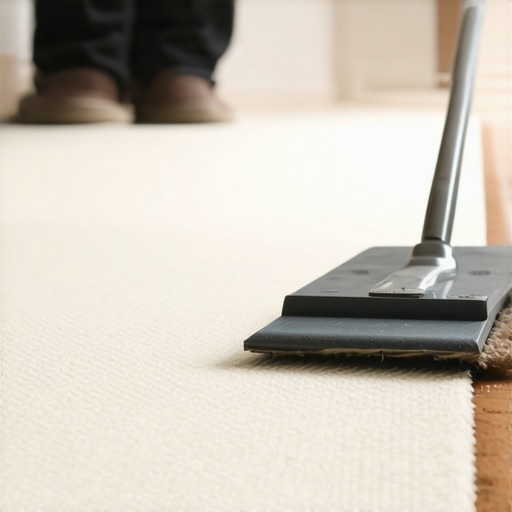
Power stretching is a mechanical requirement for modern carpet installation to prevent ripples and ensure that the latex backing remains under constant tension across the room. A knee kicker is for positioning, not for stretching. If your installer showed up with only a small tool that he hits with his quad, he did not install your carpet correctly. He just laid it down. A power stretcher uses a long pole and a head with teeth that bite into the carpet to pull it with hundreds of pounds of force. This tension is what makes the carpet stay flat for twenty years. Without it, the carpet will relax and develop those ugly waves. When these waves happen near a seam, they manifest as lines. The tension must be equalized across the entire room. If one side is tighter than the other, the seam will twist. This torque ruins the alignment of the pile. When the pile is not aligned, the light reflects differently off each side, creating a visible color shift.
Why padding density changes everything
While most people want the thickest underlayment, too much cushion actually causes the locking mechanisms on LVP to snap and causes carpet seams to fail under foot traffic. A pad that is too soft allows the carpet to flex too much. When you walk over a seam on a soft pad, the carpet sinks, then springs back. This constant vertical movement breaks down the seam sealer. Eventually, the two pieces of carpet begin to rub against each other. This creates friction that can melt the synthetic fibers or cause them to fray. I prefer a high-density 8-pound rebond pad or a synthetic fiber pad for high-traffic areas. It provides a firm base that supports the seam. Think of it like a bridge. You do not want a bridge built on a swamp. You want it built on solid rock. The pad is your rock. If the pad is too thick, the tack strip cannot properly grab the backing, leading to a loss of tension.
The factory edge versus the field cut
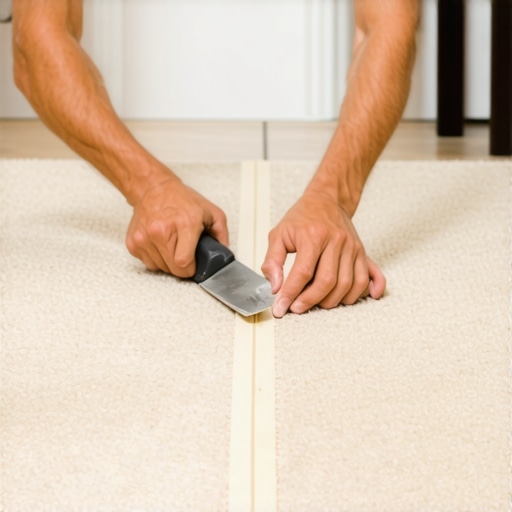
The cleanest seams come from installers who row-cut the carpet from the top down rather than relying on factory edges which are often damaged during transit. When carpet comes off the roll, the edges are often slightly crushed or dirty. If you just butt those two edges together, you will see a line. I take my row-finder and separate the fibers, then I use a sharp blade to cut exactly between the rows. This ensures that when the two pieces meet, the pile perfectly interlocks. It is like a zipper. If you miss one tooth, the whole thing is ruined. I also use a seam sealer on every edge. This is a liquid plastic that bonds the fibers to the backing. Without it, the edges will eventually unravel. This is called delamination. It is the number one cause of seams becoming visible after six months of wear. Most guys skip the sealer because it takes an extra ten minutes to dry. I do not. I want your floor to last longer than your mortgage.
| Metric | Builder Grade | Architectural Grade | Industrial Grade |
|---|---|---|---|
| Yarn Twist | 3.5 per inch | 5.5 per inch | 7.0 per inch |
| Density Rating | 1800 | 3200 | 5000 |
| Seam Tape Width | 2.5 inch | 3.5 inch | 4.0 inch |
| Latex Content | Low | Medium | High |
Lighting and the optical illusion of peaking
Light reflecting off the carpet pile at an angle can make even a perfectly flat seam appear visible due to the way synthetic fibers like nylon and polyester catch the sun. This is especially true in rooms with large floor-to-ceiling windows. If the light is parallel to the seam, it will be invisible. If the light is perpendicular, it will highlight every microscopic elevation. This is why we try to run seams toward the primary light source whenever possible. It is a strategy of camouflage. You also have to consider the pile direction. Every carpet has a nap. If you turn one piece of carpet 180 degrees, the two sides will look like different colors. This is called a reverse nap. It is a rookie mistake that causes a massive, permanent line that no amount of cleaning can fix. You have to check the arrows on the back of the carpet before you ever make the first cut.
“Standard practice requires that seams be constructed such that the carpet pile runs in the same direction and the edges are sealed with a thermoplastic or solvent-based adhesive.” – CRI 105 Standard
The acclimation and the molecular shift
Carpet is a textile that reacts to the humidity and temperature of its environment by expanding or contracting before it is permanently fastened. If I bring a cold roll of carpet from my van in the middle of winter and install it immediately in a heated house, it is going to move. The synthetic fibers will relax as they warm up. This change in dimension can cause the tension to drop, leading to ripples and seam visibility. I require the carpet to sit in the house for at least twenty-four hours before I start stretching. This is even more vital for laminate or hardwood, but carpet guys ignore it. They think because it is soft, it does not matter. They are wrong. Everything on a job site is subject to the laws of thermodynamics. If you ignore those laws, the floor will punish you. I have seen seams open up by a quarter of an inch because the carpet shrunk after being installed in a humid room that later dried out.
- Verify the subfloor is within 1/8 inch of level over a 10 foot radius.
- Apply seam sealer to both edges of the carpet before joining.
- Use a 4-inch wide premium seam tape for all high-traffic areas.
- Set the seam iron to the specific temperature recommended by the tape manufacturer.
- Check the pile direction three times before cutting the first roll.
- Maintain indoor climate control for 48 hours prior to installation.
The final word on floor integrity
Visible lines in your carpet are not a mystery. They are the result of a chain of events that started long before the first tack was driven. It starts with a subfloor that was not prepped. It continues with an installer who used a knee kicker instead of a power stretcher. It ends with a homeowner who was told that seams are always visible. They are not. A master installer can make a seam that you cannot find even if you are on your hands and knees with a flashlight. It takes time. It takes the right chemistry in the adhesives. It takes a deep understanding of how light interacts with the pile height. If you see lines, do not accept the excuse that it will walk out. It will not walk out. It will only get worse as the latex ages and the tension fails. demand a redo if the installer skipped the sealer or the stretcher. Your house deserves a floor that is a single, unified surface, not a collection of parts held together by hope. Follow the standards. Respect the physics. Get the floor right the first time or do not do it at all. That is how we do it in my shop. Anything less is just a rug covering a problem.