Why Your New Shower Feels Gritty Under Your Feet
That annoying sand under your soles after a renovation is not just a cleaning problem. It is a symptom of structural or chemical failure during the installation process. Most of the time, that grit is grout haze, efflorescence, or a deteriorating subfloor material that was never properly sealed. You expected a spa, but you got a construction site that refuses to go away. I have spent twenty five years fixing these mistakes. I have seen the same shortcuts taken from high-end penthouses to suburban basements. When a shower feels gritty, it means the installer skipped the final chemical wash or, worse, the thin-set is leaching minerals through the grout joints because the waterproofing was botched. I do not care how much you paid for the tile. If the chemistry is wrong, the floor is failing.
The residue of a rushed installation
Grout haze and efflorescence are the primary reasons why a new shower floor feels gritty under your feet. These issues occur when the installer fails to remove the polymer film from the tile surface or when moisture trapped beneath the tile pulls minerals to the surface. It is a chemical reality that many contractors ignore to save time. Most guys skip the leveling compound. They think the underlayment will hide the dip. It won’t. I spent three days grinding concrete on a job last month just so the floor wouldn’t click like a castanet. That job taught me that if you do not control the substrate, the substrate will control you. When we talk about grit in a shower, we are often talking about the microscopic breakdown of the bonding agents. If the water cannot drain because the slope is off by a mere eighth of an inch, it sits in the pores of the grout. That standing water dissolves the salts in the cement. As the water evaporates, it leaves behind a white, sandy crust called efflorescence. You can scrub it a hundred times, but it will keep coming back until the moisture source is managed. Then there is the issue of grout haze. Modern grouts are packed with polymers and resins to make them stain-resistant. If the installer does not use a specific acidic cleaner to break down those resins within twenty four hours, they harden into a transparent, sandpaper-like film. This film traps dirt and skin cells, making the floor feel perpetually dirty regardless of how many times you mop it.
“A floor is only as good as the subfloor beneath it; deflection is the enemy of every joint.” – Master Flooring Axiom
The ghost in the expansion gap
Laminate and vinyl floors require a precise expansion gap at the perimeter to prevent the planks from peaking or buckling. When these floors feel gritty or crunch when you walk on them, it is usually because debris is trapped in the locking mechanisms or the subfloor was not cleaned. You might think the grit is on top, but it is actually underneath. If a contractor does not use a HEPA vacuum before laying the underlayment, every speck of sawdust and every drywall screw left on the slab will create a pressure point. When you walk across the floor, the plank flexes over that debris. That is the clicking sound you hear. Over time, that tiny bit of grit acts like a diamond saw. It grinds away at the underside of your laminate until the locking tongue snaps. I have seen thousand dollar floors ruined by ten cents worth of sawdust. This is why floor leveling is not an optional step. If the subfloor has a dip of more than three sixteenths of an inch over a ten foot span, the floor will bounce. Every bounce pulls more air and dust from the wall cavities and deposits it right under your feet. It is a mechanical pump for filth. You feel it as grit because the floor is literally breathing through the seams.
The physics of subfloor deflection and thin-set failure
Structural deflection occurs when the joists or the subfloor material flexes beyond the limits allowed by the Tile Council of North America standards. This movement breaks the bond of the thin-set, turning your mortar into a layer of loose, gritty sand underneath the tile. If your shower floor feels crunchy, you are likely feeling the pulverized remains of your setting bed. Most residential joists are spaced sixteen inches on center. If you are using large format tile or a heavy stone, that standard spacing might not be enough. You need a L over 360 rating for ceramic and L over 720 for natural stone. If the floor bends, the tile stays rigid. Something has to give. Usually, it is the bond. Once that bond is broken, the moisture from your shower enters the mortar bed and stays there. This creates a bacterial soup that eventually works its way up through the grout lines as a gritty, foul-smelling residue. I have walked into bathrooms where the homeowner thought they just needed better soap. In reality, they needed a new subfloor. We had to rip out the entire pan because the original builder used OSB (oriented strand board) instead of a proper cement board or a waterproof membrane system. OSB in a wet environment is a ticking time bomb. It swells, it rots, and it turns your expensive tile into a jigsaw puzzle of loose grit.
| Material Type | Janka Hardness Rating | Acclimation Period | Moisture Tolerance |
|---|---|---|---|
| Solid White Oak | 1360 | 7 to 14 Days | Very Low |
| Engineered Maple | 1450 | 3 to 5 Days | Moderate |
| Luxury Vinyl Plank | N/A | 48 Hours | High |
| Laminate HDF Core | N/A | 48 Hours | Low |
Why your carpet install is hiding a dusty secret
Carpet padding acts like a giant filter that traps construction dust and subfloor particulates over many years. If the subfloor was not sealed or vacuumed before the carpet install, those particles migrate to the surface every time you step down on the fibers. This is the grit that no vacuum can ever fully reach. Most people blame the carpet fibers for the dust in their home, but the real culprit is the slab beneath. If you have a concrete subfloor that is chalking, it means the top layer of the concrete is weak. This often happens in new builds where the slab dried too fast. The installer rolls out the pad, kicks in the carpet, and leaves. Now, every time you walk, the pad rubs against that chalky concrete. It creates a fine powder that rises through the weave of the carpet. To prevent this, a Master Flooring Architect will always use a primer on the concrete. This binds the loose particles and creates a dust-free environment. Without that primer, you are living on a giant sandpaper block. This is especially true with cheap, builder-grade carpet that has a loose primary backing. The grit moves through it like water through a sieve.
“The integrity of the assembly is defined by its weakest interface; moisture is the universal solvent that seeks that weakness.” – Master Flooring Axiom
The 1/8 inch that ruins everything
Precision in floor leveling is the difference between a floor that lasts fifty years and one that fails in five. A deviation of just one eighth of an inch can cause liquid to pool in a shower or a laminate joint to fail. We use self-leveling underlayments for a reason. They are engineered with high flow polymers that find the low spots that the human eye cannot see. When I see a shower floor with grit in the corners, I know the pitch was not handled correctly. The water is not moving toward the drain fast enough. It lingers. As it lingers, it reacts with the minerals in the grout. This is basic chemistry. If you want a floor that feels smooth and clean, you have to start with a surface that is perfectly flat. This does not mean level in the sense of a pool table, but flat in terms of plane. In a shower, that plane must be a consistent slope. Any dip becomes a collection point for minerals and soap scum. That is the grit you feel. It is a microscopic mountain range of calcium and magnesium deposits.
- Check subfloor moisture levels with a pinless meter before any installation.
- Vacuum the substrate with a HEPA rated machine to remove all construction debris.
- Use a high quality primer to seal the subfloor and prevent chalking.
- Ensure the grout is mixed with the exact ratio of water specified by the manufacturer.
- Apply a penetrating sealer to grout joints after the full twenty eight day cure cycle.
- Verify that the expansion gaps for floating floors are not blocked by baseboard nails.
The chemistry of a clean finish
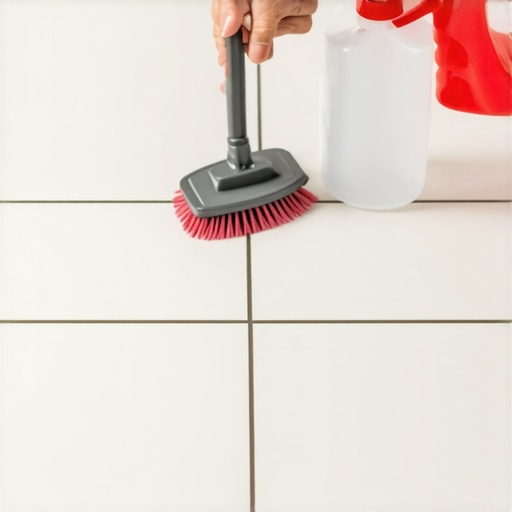
Maintaining a shower floor requires an understanding of pH balanced cleaners rather than harsh abrasives. Using the wrong chemicals can actually create more grit by eroding the grout and the stone surface over time. Many homeowners reach for bleach or vinegar when they feel that gritty residue. This is a mistake. Vinegar is an acid that eats away at the lime in cement-based grout. You are literally dissolving your floor to clean it. This creates more loose sand and more grit. Instead, you need a neutral cleaner that suspends the dirt so it can be wiped away. If you are dealing with a new install, you must ensure the contractor performed a post-construction cleaning. This involves using a specialized grout haze remover that is matched to the type of grout used. Epoxy grouts require a different solvent than cementitious ones. If you use the wrong one, you leave a sticky residue that feels like sandpaper once it catches a little bit of dust. It is a cycle of filth that only ends when the chemical balance is restored. This is the structural reality of flooring. It is not about the color. It is about the science of the surface. If you ignore the physics of the subfloor or the chemistry of the adhesive, you are just walking on a failure waiting to happen. The grit under your feet is the floor trying to tell you that something is wrong underneath. Listen to it. Investigate the slope, the moisture, and the bond. Only then will you have a surface that performs as well as it looks. Stop looking at the tile and start looking at the microscopic world beneath it. That is where the real quality lives. It lives in the prep work. It lives in the three days I spent grinding concrete. It lives in the moisture meter readings. If you want a floor that feels like silk, you have to treat the subfloor like a diamond. No shortcuts. No excuses. Just engineering. “