How to Stretch Carpet Yourself Without a Knee Kicker
Most installers skip the hard part. They think the underlayment hides the dip. It won’t. I spent three days grinding concrete on a job last month just so the floor wouldn’t click like a castanet. That job was supposed to be a simple carpet install, but the slab was a mountain range. If you don’t level the base, your carpet will never sit right. It will ripple. It will bunch. I have seen fifteen thousand dollar wide plank walnut floors cup like potato chips because of humidity, but carpet is a different animal. It is a structural textile that requires massive tension to stay stable. Stretching carpet without a knee kicker is a matter of mechanical leverage. You must understand the physics of the backing and the grip of the tack strip. It is not about brute force. It is about steady pressure.
A knee kicker is a common tool, but it is often the wrong tool for a full room. It is designed for small adjustments and setting the carpet onto the teeth of the strip. For a real stretch, you need a power stretcher. If you have neither, you are looking at manual tensioning methods that rely on the carpet’s own elasticity and friction. This is a structural engineering challenge. You are trying to overcome the internal resistance of the latex and jute backing. If you fail, the carpet will walk. It will move every time someone steps on it. This creates friction against the pad. That friction turns into heat and wear. Your carpet will die in five years instead of twenty. It will buckle.
The mechanics of tension in a loose textile
Carpet stretching without a knee kicker requires a power stretcher or a carpet spreader to achieve tensile strength across the primary backing. Professionals use mechanical leverage to ensure the synthetic fibers are pulled taut over tack strips. This prevents delamination and rippling caused by ambient humidity or foot traffic.
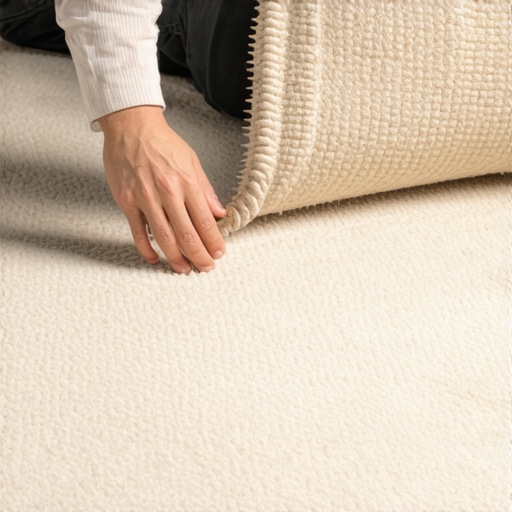
When you look at a carpet, you see the pile. I see the weave. Most residential carpets use a dual-layer backing system. The primary backing holds the yarn in place. The secondary backing, usually made of a woven polypropylene or jute, provides the dimensional stability. When a carpet is manufactured, it is rolled tight. It has a memory. To get a flat finish, you have to break that memory. You have to stretch the material about one to one and a half percent in both directions. In a twenty foot room, that is three inches of extra material you are pulling. If you do not have a knee kicker, you are essentially trying to manually winch a heavy fabric across a rough surface. The friction is immense. You have to work with the temperature of the room. A cold carpet is a stiff carpet. If the house is sixty degrees, that backing is brittle. It will resist you. I always tell homeowners to crank the heat to seventy five the day before. This lowers the glass transition temperature of the synthetic materials. It makes the carpet more pliable. It lets the fibers stretch without snapping. You are managing the molecular state of the plastic. This is the difference between a floor that lasts and one that fails. It is all in the physics.
“A floor is only as good as the subfloor beneath it; deflection is the enemy of every joint.” – Master Flooring Axiom
Why your subfloor is lying to you
Floor leveling is the foundation of any carpet install because subfloor irregularities manifest as surface ripples. A leveling compound or concrete grinding must be used to eliminate high spots. This ensures the carpet pad and tack strips sit flush against the structural slab or plywood deck.
You might think a soft carpet hides a bad floor. You are wrong. If there is a dip in the subfloor, the carpet will bridge it. This creates a hollow pocket. Every time someone walks over that pocket, the carpet flexes. That flex pulls on the tack strips. Over time, the nails in those strips will pull out of the wood or the concrete. Then the whole floor loses tension. I have walked into jobs where the carpet felt like walking on a trampoline. That is a failure of the installer to address the subfloor. Before you even think about stretching, you take a six foot level to the floor. If you see a gap larger than an eighth of an inch, you fix it. You grind the concrete. You pour self leveler. You do not ignore it. This is why I hate builder grade work. They skip the prep. They throw the carpet down and kick it once. Six months later, the homeowner has a wave in the middle of the room. It is lazy. It is a crime against the trade. If you are doing this yourself, do it right. Check the perimeter. Ensure the tack strips are a quarter inch away from the baseboard. This gap is where you will tuck the carpet. If the gap is too wide, the carpet will pop out. If it is too narrow, you will never get it tucked. It is a game of precision.
The mechanical advantage of the power stretcher
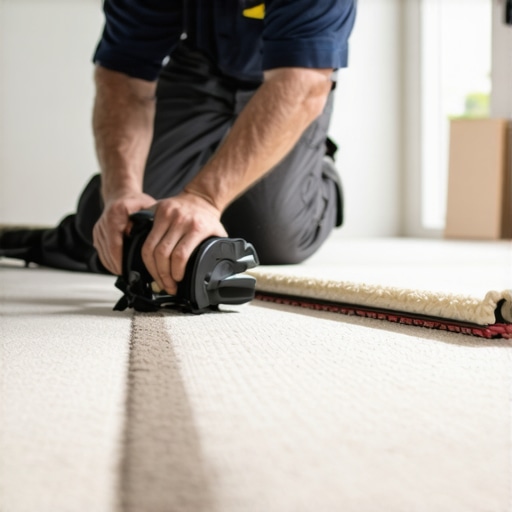
Power stretchers provide heavy duty leverage using a telescoping pole system to push against opposite walls. This tool is superior to a knee kicker because it applies uniform pressure across the carpet width. It eliminates the physical strain on the installer’s joints and ensures long term stability of the installation.
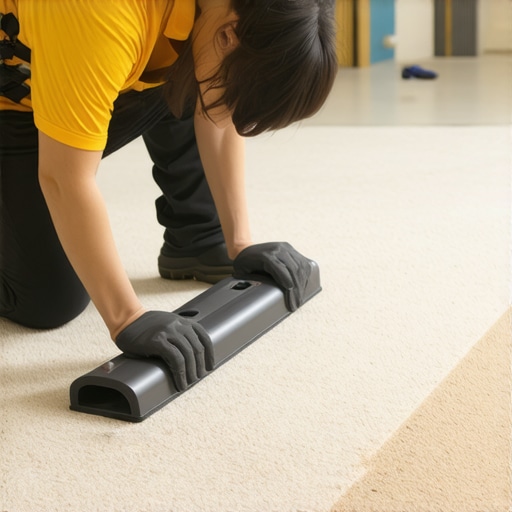
If you don’t have a knee kicker, you should be using a power stretcher anyway. A knee kicker is for the edges. A power stretcher is for the room. It works like a car jack. You set one end against a wall board and the other end near the carpet you are pulling. You pump the handle. The mechanical advantage is massive. You can pull thousands of pounds of tension with one hand. This is the only way to get a professional result in a large space. Without this tool, you are left with manual methods like a carpet spreader or using a 2×4 and a pry bar. I have seen guys try to use a pry bar against the baseboard to pull the carpet. It is dangerous. You will snap the baseboard. You will damage the drywall. You will probably rip the carpet backing. A power stretcher distributes the force. It uses a head with dozens of sharp teeth that bite into the carpet pile. It pulls from the bottom. This is how you ensure the carpet is tight enough to bounce a nickel. If you can’t rent one, you are in for a long day of manual labor. You have to understand that the carpet wants to shrink back. It is fighting you. You have to win that fight.
| Tool Type | Tension Method | Best For | Risk Level |
|---|---|---|---|
| Knee Kicker | Impact Force | Small Rooms/Edges | High Knee Strain | Power Stretcher | Leverage/Pole System | Large Rooms | Low Risk | Carpet Spreader | Manual Push | Tucking/Stairs | Moderate | Pry Bar Method | Manual Leverage | Emergency Only | High Damage Risk |
The 1/8 inch that ruins everything
Expansion gaps and tack strip placement must be calculated to within one eighth of an inch to prevent carpet pullout. The tucking process requires the carpet edge to be folded into the gully between the strip and the wall. This creates a friction lock that complements the mechanical grip of the tack strip nails.
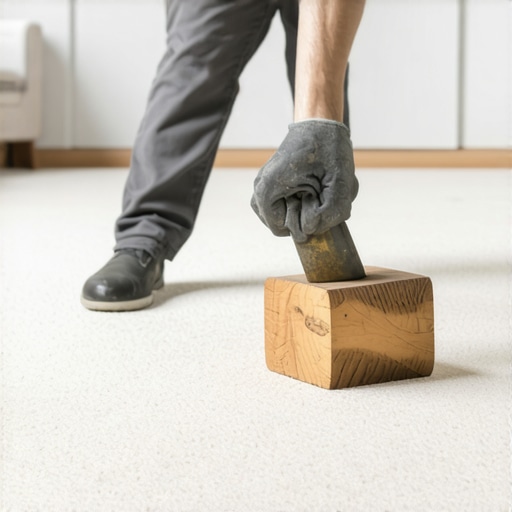
People treat carpet like it is just a rug. It is not. It is a system. When you are stretching without a kicker, you have to be perfect with your tuck. The tuck is what holds the tension. Imagine you have pulled the carpet tight. Now you have to lock it. You use a stair tool or a wide wood chisel. You drive the carpet down into that tiny gap between the strip and the wall. The teeth on the strip are angled toward the wall. When the carpet tries to pull back toward the center of the room, it gets caught on those teeth. The harder it pulls, the deeper the teeth bite. If your gap is too big, the carpet has room to move. It will slide off the teeth. If your carpet is too thick, like a high pile shag, you need a wider gap. If it is a thin commercial grade, you need it tighter. You also have to consider the transition to other floors. If you are moving from carpet to laminate or to tile in showers, you need a solid transition strip. You cannot just leave it raw. A floor is a series of interconnected systems. If one part is weak, the whole thing fails. I always use a heavy hammer to set the carpet into the teeth. You listen for the click. That is the sound of the teeth engaging the secondary backing. If you don’t hear it, you don’t have a floor. You have a trip hazard.
“Deflection is the silent killer of every flooring installation; if it moves, it fails.” – Master Flooring Axiom
Strategic steps for manual carpet tensioning
- Clear the room entirely and verify the subfloor is level and free of debris.
- Install tack strips around the perimeter with the teeth facing the wall.
- Lay the carpet and allow it to acclimate to the room temperature for 24 hours.
- Secure one corner and one long wall first to create an anchor point.
- Use a power stretcher or carpet spreader to pull the material toward the opposite walls.
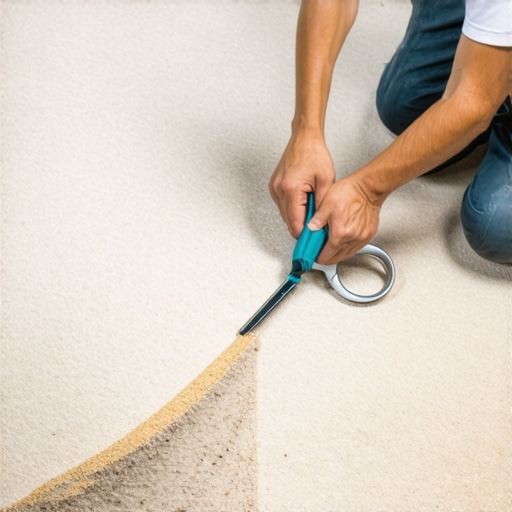
- Trim the excess carpet leaving roughly half an inch for the tuck.
- Use a stair tool to force the carpet into the gully for a permanent friction lock.
- Verify tension by attempting to lift the carpet in the center of the room.
The biggest mistake people make is thinking they can do this in an hour. It takes time. You have to work in a specific pattern. You start at one corner. You work your way down the wall. Then you move to the center. You are essentially ironing the carpet onto the floor with tension. If you find a bubble, you have to pull it all the way to the edge. You cannot just push it down. It is like a bubble under a screen protector. It has to go somewhere. If you are transitioning to laminate flooring, remember that the laminate needs an expansion gap while the carpet needs to be tight. This is where most DIY jobs fail. They don’t leave enough room for the T-molding. They end up with a gap that collects dirt and eventually causes the laminate to buckle. You have to think three steps ahead. You have to be an architect. You have to see the forces at play. Carpet stretching is about controlling those forces. It is about making a piece of plastic and fabric behave like a solid surface. It is a battle of wills. And if you don’t have the right tools, you have to have the right technique. There is no middle ground. You either do it right, or you do it twice. And I don’t like doing things twice. It smells like wasted time and sawdust. Do it right the first time. Level your floor. Warm your carpet. Use a stretcher. Lock it in.