Why Your Shower Drain Grate Is Pitting and Discoloring
I spent three days grinding concrete on a job last month just so the floor wouldn’t click like a castanet. Most guys skip the leveling compound. They think the underlayment will hide the dip. It won’t. I have seen it a thousand times where a contractor thinks he can cheat the physics of a flat surface. This same mindset of cutting corners leads exactly to the disaster happening in your shower. You see a pitted, ugly drain grate and think it is just a bad part. I see a failure of chemistry and structural planning. I have been on my knees for twenty five years with a moisture meter and a level, and I can tell you that metal does not just give up for no reason. It is being murdered by your environment.
The chemistry of a dying drain grate
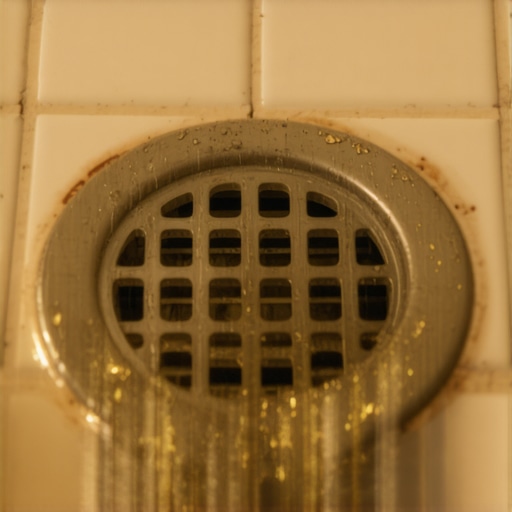
Shower drain pitting and discoloration are caused by the breakdown of the chromium oxide passive layer on stainless steel due to harsh chemical exposure, high chloride levels in water, or galvanic corrosion. When this microscopic protective shield is stripped away, the raw iron in the steel lattice reacts with oxygen to form iron oxide, or rust. This process is accelerated in the humid, high-temperature environment of a shower where stagnant water sits against the metal surface for extended periods. Most homeowners assume that stainless means it is invincible. It is not. It is a specific alloy that requires a precise chemical balance to remain stable. When you introduce acidic cleaners or allow mineral salts to concentrate on the surface, you are effectively initiating a slow motion chemical burn. The metal starts to look like the surface of the moon because the atoms are literally being pulled out of the material by an electrochemical reaction.
Galvanic corrosion and the metal war
Galvanic corrosion occurs when two dissimilar metals come into contact in the presence of an electrolyte like water, causing the less noble metal to corrode at an accelerated rate. If your installer used a brass or copper fitting and paired it with a cheaper 304 grade stainless steel grate without a proper dielectric barrier, you have created a battery. The water from your shower acts as the bridge that allows electrons to flow from one metal to the other. In this scenario, the grate usually loses. I have walked onto jobs where the grate looks like it was dipped in acid because someone used the wrong screws to hold it down. You cannot mix metals in a wet environment. It is a fundamental law of metallurgy that many flooring guys ignore because they are too busy trying to finish the job and get paid. If the screw is more noble than the grate, the grate will pit around the screw holes first. This is not a manufacturing defect. This is a failure of the installation architect to understand the periodic table.
“A floor is only as good as the subfloor beneath it; deflection is the enemy of every joint.” – Master Flooring Axiom
The hidden chemistry of thinset leaching
Thinset leaching happens when moisture moves through the mortar bed and carries dissolved minerals and alkalis to the surface where they react with the metal grate. If the shower pan was not sloped correctly or if the weep holes in the drain assembly are clogged with debris, the water sits in the mud bed. This is like a toxic soup. This water becomes highly alkaline as it sits against the cementitious products. When this water eventually reaches the metal grate, it carries a heavy load of minerals that can cause severe discoloration and dark spotting. I have seen this in high-end stone installs where they didn’t use a proper sealer or waterproofing membrane. The moisture wicks up through the grout lines and sits on the underside of the grate. It eats the metal from the bottom up. By the time you see the pitting on the top, the underside is usually covered in a crust of calcified minerals and rust.
Why your cleaning habits are a death sentence
Harsh cleaning agents containing bleach, chlorides, or strong acids strip the protective layer from metal grates and initiate rapid pitting. People love to spray their showers with industrial strength cleaners and let them sit. That is the worst thing you can do. If you do not rinse that grate thoroughly within minutes, the chemicals will begin to dwell in the micro-scratches of the metal. I tell people that if you wouldn’t put it on your skin, you should be very careful putting it on your metal finishes. Bleach is particularly nasty for stainless steel. It causes a reaction called stress corrosion cracking. You think you are disinfecting your shower, but you are actually destroying the molecular bond of your hardware. Even some of the natural cleaners with high citrus acid content can be aggressive enough to cause staining if they are not neutralized with fresh water immediately after application.
| Metal Grade | Pitting Resistance | Common Usage | Chemical Sensitivity |
|---|---|---|---|
| 304 Stainless | Moderate | Standard Residential | High to Chlorides |
| 316 Stainless | High | Coastal/Commercial | Low |
| Brass/Chrome | Low | Vintage/Budget | Extreme to Acids |
| PVD Coated | High | Luxury Finishes | Moderate to Abrasives |
The physical failure of the weep holes
Clogged weep holes in the drain flange prevent the sub-surface water from draining, leading to a permanent state of dampness that corrodes the metal from below. Most installers treat a shower floor like they are doing a carpet install or a quick laminate click-lock. They don’t think about what happens an inch below the tile. The weep holes are designed to let the water that gets through the grout escape into the pipe. If those holes are plugged with thin-set or sand, the water stays trapped. This stagnant water becomes a breeding ground for sulfur-reducing bacteria. These bacteria produce hydrogen sulfide gas, which is highly corrosive to metal. If your drain smells like rotten eggs and the grate is turning black, you don’t have a metal problem. You have a drainage problem. The subfloor is essentially a swamp that is off-gassing into your bathroom.
Why your subfloor preparation ruins the finish
Improper subfloor leveling causes water to pool around the drain rather than flowing into it, leading to localized mineral buildup and metal degradation. I have seen guys try to fix a bad slope by piling up more mortar around the drain. It never works. If the floor is not dead-on with its pitch, you get standing water. This standing water evaporates and leaves behind every mineral that was in your tap water. These minerals concentrate. Over time, the concentration becomes so high that it creates a localized salt bath. This is what causes those white, crusty rings around the edge of the grate. That crust is acidic and it will eat through the finish of even the most expensive designer grates. I spend time grinding the concrete and checking my levels because if the water doesn’t move, the floor dies. It is that simple.
- Check your water hardness levels to prevent mineral buildup on metal.
- Never use steel wool or abrasive pads to clean a finished metal grate.
- Ensure the installer used 100% silicone rather than plumbers putty if specified.
- Rinse the grate with clear water after every shower to remove soap scum.
- Inspect weep holes during any maintenance to ensure they are clear of debris.
The ghost in the expansion gap
A lack of proper expansion gaps at the perimeter of the shower floor causes pressure to build against the drain assembly, potentially cracking the seal and allowing corrosive moisture to seep into the metal housing. Flooring is a living thing. It expands and contracts with temperature changes. If the tile is jammed tight against the drain grate frame, something has to give. Usually, the grout cracks. Once that grout cracks, you have a direct path for soapy, chemically-laden water to get under the grate and sit there forever. I treat every shower floor as a structural engineering challenge. You have to account for the movement. If you don’t, the metal will be the first thing to show the stress. It isn’t just about the look. It is about the physics of the assembly. If the subfloor moves and the tile stays still, the metal grate becomes the sacrificial lamb in that mechanical conflict. Use a high-quality sealant at the transitions and keep the water where it belongs. On top of the grate, not under it.