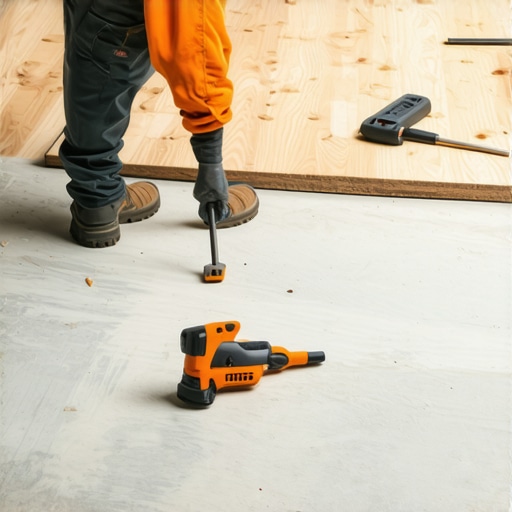
I spent three days grinding concrete on a job last month just so the floor wouldn’t click like a castanet. Most guys skip the leveling compound. They think the underlayment will hide the dip. It won’t. I walked into a site where the homeowner had just spent four grand on a high end laminate and the middle of the room was rising up like a mountain ridge. They called it tenting. I called it a failure to respect the subfloor. My hands were covered in gray dust and my knees were aching from the kneepads, but that slab had to be flat within three sixteenths of an inch over ten feet. If you ignore the substrate, the locking mechanisms will eventually snap. This is not about aesthetics. This is about structural engineering at the ground level. I smell like WD-40 and oak dust most days because I fix what the fast-talkers break. Laminate is a floating system. It needs to move. If it gets caught on a hump or sinks into a valley, the tension has to go somewhere. That somewhere is up.
The physics of the floating floor failure
Laminate tenting occurs when boards bridge over a low spot or are pinched against a wall with zero expansion gap. The locking joints act as a lever under pressure. When the subfloor is not flat, the weight of furniture or foot traffic forces the boards into a position they cannot maintain. Most people assume the floor is defective. The floor is fine. The ground underneath it is the liar. You have to understand the difference between level and flat. A floor can be slanted like a mountain path and still work if it is flat. If it has dips and crowns, you are looking at a disaster. The National Wood Flooring Association is very clear about these tolerances. Moisture also plays a role. If your concrete is sweating, that laminate core will swell. It is basically high density fiberboard. It is a sponge with a pretty face. You need to verify the moisture content of the slab using a calcium chloride test or an in-situ probe before you even think about opening a box of planks.
“A floor is only as good as the subfloor beneath it; deflection is the enemy of every joint.” – Master Flooring Axiom
The 1/8 inch that ruins everything
Tolerance levels for modern laminate installations require a subfloor to be flat within 1/8 inch over a six foot radius or 3/16 inch over a ten foot radius. Exceeding these limits creates a trampoline effect that stresses the tongue and groove connections until they fatigue and fail. I have seen installers try to double up on underlayment to hide a hole. That is a crime. Too much cushion is actually worse than no cushion. It creates a soft spot that allows the joint to flex too far. Think of it like a paperclip. You bend it back and forth enough times and it snaps. That is exactly what happens to your laminate click system. You want a high density underlayment with a high compression strength. I prefer anything with a high IIC rating for sound, but it must be firm. If you can squeeze it like a kitchen sponge, it does not belong under a floating floor. You need to check the subfloor with a long straightedge. I use a ten foot aluminum box beam. If I see daylight under that beam, I know I have work to do.
Concrete grinding and the dust of truth
Fixing high spots on a concrete slab requires a diamond cup wheel grinder and a high quality HEPA vacuum system to manage the silica dust. Grinding is the most effective way to remove crowns in the masonry that would otherwise cause the laminate to pivot and tent. This is the grittiest part of the job. You have to mark the high spots with a wax crayon. Then you go to work. The dust is a health hazard, so do not skimp on the vacuum. We are talking about microscopic particles that will stay in your house for years if you are messy. The goal is to feather the edge of the hump so the floor has a smooth transition. I once spent a whole Saturday in a basement in the middle of July just grinding down a ridge that a builder left behind. It was brutal. But when that laminate went down, it felt solid. No hollow sounds. No bouncing. You can feel the quality under your boots when the subfloor is right. It sounds like a solid wood floor because there is no air gap between the plank and the slab.
Self leveling underlayment and the gravity cure
Low spots are corrected using a high strength polymer modified self leveling underlayment that flows into the depressions to create a perfectly flat surface. This chemical solution is the standard for deep dips where grinding is not an option or when the slab is structurally sound but wavy. You cannot just pour it and walk away. You have to use a primer. If you do not prime the concrete, the slab will suck the moisture out of the leveler too fast and it will crack. It is a chemical bond. I use a spiked roller to get the air bubbles out. It looks like something out of a horror movie, but it works. The chemistry of these products has come a long way. Some of them can be walked on in four hours. But you should wait at least twenty four hours before putting laminate over it. You want that moisture to be gone. I always check it with a meter. If the leveler is still wet, you are just trapping water under your vapor barrier. That leads to mold and a floor that smells like a damp basement.
| Method | Primary Use | Drying Time | Difficulty Level |
|---|---|---|---|
| Concrete Grinding | Removing high spots | Instant | Expert |
| Self-Leveling Compound | Filling deep low spots | 4 to 24 hours | Advanced |
| Asphalt Shingles | Minor low spots in wood | Instant | Intermediate |
| Patching Compound | Small cracks and pits | 2 hours | Beginner |
Shimming the hollows with asphalt shingles
For wood subfloors, using felt paper or thin asphalt shingles is a time tested method to shim out minor low spots before installing the final underlayment. This technique allows for a gradual build up of the surface height without the moisture risks of wet leveling compounds on plywood. It sounds old school, but it works. You layer the shingles starting with the thickest part in the center of the dip and feathering out with felt paper. You avoid the mess of liquid levelers. Wood subfloors move. They breathe. Putting a rigid cement product on top of a flexible wood joist system can lead to cracking. The shingles stay in place and provide a firm base. You just have to make sure they are flat. No overlaps that create new bumps. I have used this trick in old Victorian houses where the floors looked like the rolling hills of Kentucky. It takes patience. You spend a lot of time on your knees with a straightedge and a stapler. But the result is a floor that doesn’t groan when you walk across it at night.
“Deflection is the enemy of every joint. If the subfloor moves, the floor will fail.” – TCNA Handbook Principle
The expansion gap and the ghost of humidity
Every floating floor requires a minimum gap of 3/8 inch to 1/2 inch around the entire perimeter to allow for natural expansion and contraction. Tenting is often the result of the floor hitting a wall or a heavy kitchen island and having nowhere to expand. I see this all the time. An installer runs the floor tight to the baseboard. Then summer hits. The humidity goes up. The floor grows. It hits the wall and starts to bow. It is basic physics. You cannot stop the wood from moving. You can only give it space to do so. This includes heavy objects. If you put a heavy kitchen island on top of a floating floor, you have effectively pinned it. It can no longer move. The floor will pull apart at the seams or tent in the middle. You must install the floor around the island, or use a specialized transition strip. Do not lock your floor down. It needs to breathe. It needs to live.
- Check subfloor flatness with a 10 foot straightedge
- Test concrete moisture using ASTM F2170 standards
- Apply a high quality primer before using leveling compounds
- Maintain a consistent 1/2 inch expansion gap around all vertical obstructions
- Remove all baseboards before installation to ensure proper spacing
- Vacuum the subfloor three times to remove all grit and debris
The chemical bond of modified thin set
When you are working with transitions to showers or wet areas, the subfloor preparation must be even more rigorous to prevent water migration. Using a modified thin set for patching ensures that the bond is permanent and resistant to the micro movements of the home. If you are transitioning from a laminate hallway into a tiled bathroom, that threshold is a weak point. I have seen laminate swell at the bathroom door because the installer didn’t seal the edge. You should use a 100 percent silicone sealant in the expansion gap near wet areas. This keeps the spills from getting under the floor. It is about layers of protection. You have the wear layer on top. You have the HDF core. You have the underlayment. And you have the vapor barrier. If any one of those fails, the whole system is compromised. I treat every floor like a waterproofing project. Even if it is just a bedroom. You never know when a pipe will leak or a window will be left open. A flat, well prepared subfloor handles stress better than a sloppy one. It is the difference between a floor that lasts thirty years and one that lasts three. Take the time to do the prep. Your knees will thank you later when you aren’t coming back to rip it all out.