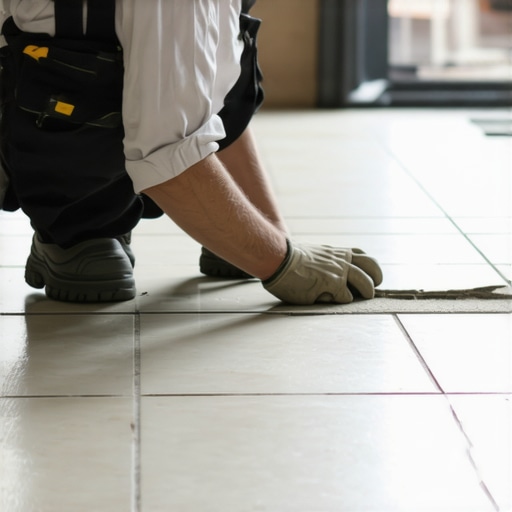
Why your grout is cracking after only a week
Most guys skip the leveling compound. They think the underlayment will hide the dip. It won’t. I spent three days grinding concrete on a job last month just so the floor wouldn’t click like a castanet. When you see grout lines spiderwebbing across a shower floor or a kitchen entryway after seven days, you aren’t looking at a bad grout mix. You are looking at a structural failure. Grout has zero structural integrity. It is a brittle filler. If the tile moves even a fraction of a millimeter, the grout snaps. I have seen fifteen thousand dollar wide-plank walnut floors cup like potato chips and I have seen marble tile shatter because the installer did not understand the physics of deflection. Grout is the canary in the coal mine. It tells you that the bones of your floor are weak. We need to talk about the mechanics of the subfloor and the chemical reality of Portland cement before you try to patch those cracks.
The structural failure of the subfloor
Cracking grout occurs when the subfloor exhibits excessive vertical movement known as deflection which exceeds the rigid capacity of the tile and bond coat. Most residential joist systems are designed to a standard of L over 360, which means the floor can bend up to its length divided by 360 without the house falling down. However, ceramic and porcelain tile require a much stiffer environment. If you are installing natural stone, that requirement doubles to L over 720. When you walk across a floor that is too bouncy, the tile stays rigid while the plywood underneath bows. This shear force tears the grout right out of the joints. You cannot fix this with a new bag of grout. You fix it by sistering joists or adding a second layer of exterior grade plywood to reduce the flex. [image_placeholder_1]
The chemistry of the improper mix
Grout is a precise chemical compound that requires a specific ratio of water to cementitious material to achieve its rated compressive strength. Many installers treat grout like pancake batter, adding water until it looks right. This is a disaster. If you add too much water, you are diluting the polymer additives and creating microscopic voids in the grout structure as the excess water evaporates. These voids are essentially air bubbles that make the grout brittle and porous. Once the water leaves the mix, the grout shrinks. This shrinkage pulls the grout away from the edge of the tile, leading to those hairline cracks you see within the first few days. You must use a graduated cylinder or a measuring cup. Guessing is for amateurs who do not mind coming back for warranty repairs. You also have to respect the slake time. You mix the grout, let it sit for ten minutes to allow the chemicals to fully hydrate, and then mix it again without adding more water. If you skip the slake, the grout will not reach its full strength.
“A floor is only as good as the subfloor beneath it; deflection is the enemy of every joint.” – Master Flooring Axiom
The physics of expansion and contraction
Everything in a house moves. Wood expands with humidity. Concrete shrinks as it cures. Metal expands with heat. Tile is relatively stable, but the house around it is a living thing. If you push your tile tight against the walls without a perimeter expansion gap, the floor has nowhere to go when the seasons change. The pressure builds up until the weakest point gives way. Usually, that is the grout. The Tile Council of North America specifies that you must have movement joints every 20 to 25 feet in each direction for interior installations. If you have a large open concept space and you have not installed a soft joint, a color matched sealant, then the grout will crack. It is a mathematical certainty. You cannot fight thermodynamics with a bag of sanded grout.
| Substrate Type | Required Deflection Limit | Recommended Underlayment |
|---|---|---|
| Ceramic Tile | L/360 | 1/4 inch Cement Board |
| Porcelain Tile | L/360 | Uncoupling Membrane |
| Natural Stone | L/720 | Double Layer Plywood |
| Large Format Tile | L/480 | Self-Leveling Underlayment |
The 1/8 inch that ruins everything
Flatness is not the same thing as levelness. A floor can be slanted like a mountain and still be flat enough for tile, but a floor with a 1/8 inch dip over ten feet will cause grout failure. When a tile spans a low spot, it creates a bridge. When you step on that bridge, the tile bends. Porcelain tile is incredibly strong in compression but weak in tension. That tiny bend puts massive stress on the grout joint. Within a week, the bond between the grout and the tile edge breaks. I always use a ten foot straight edge before I even open a box of tile. If I find a dip, I fill it with a high quality self-leveling compound. If I find a hump, I grind it down. This is the difference between a floor that lasts fifty years and one that fails in seven days. People hate the dust from grinding, but they hate cracked grout even more.
- Check subfloor for L/360 deflection using a joist calculator.
- Verify the moisture content of the wood subfloor is within 2 percent of the tile substrate.
- Ensure the thin-set coverage is at least 80 percent for dry areas and 95 percent for wet areas.
- Use a perimeter expansion gap of at least 1/4 inch at all vertical obstructions.
- Allow grout to cure for at least 72 hours before heavy foot traffic or cleaning.
The ghost in the expansion gap
Movement joints must be placed at the perimeter of every room and at transitions between different flooring materials to prevent stress fractures. Many installers make the mistake of grouting the joint where the tile meets the bathtub or the baseboard. This is a rookie move. Those joints must be filled with 100 percent silicone or a color matched caulk. Houses settle. Tubs flex when they are filled with water. If that joint is hard grout, it will crack almost immediately. By using a flexible sealant, you allow the different components of the house to move independently without destroying the aesthetic of the tile work. This is especially true in regions like Houston where humidity swings are massive or Phoenix where the dry heat causes wood framing to shrink rapidly. The climate determines how much your house will breathe, and your grout joints must be prepared for that movement.
“Standard cementitious grout is not a structural component; it is a decorative finish that requires a stable substrate.” – TCNA Handbook Principles
The molecular bond of the thin-set also plays a role. If you use a cheap, unmodified thin-set on a substrate that requires a polymer-modified bond, the tile will eventually delaminate. Even a microscopic loss of bond will result in grout failure. The grout is held in place by the mechanical lock between the edges of the tile. If the tile is loose, even if you cannot feel it move yet, the grout will turn to powder. I always look for the C2 rating on my mortar bags. That tells me it has the high bond strength needed for modern porcelain tiles which have an absorption rate of less than 0.5 percent. If the tile cannot absorb the moisture from the mortar, it needs a chemical bond to stay put. When you ignore these details, you are not just making a mistake. You are building a floor that is destined to fail. Do the prep work. Respect the chemistry. Stop blaming the grout for a problem that started at the joists.