The ‘Sealant Bead’ Trick for Stopping IBR Roof Leaks in Midrand
The ‘Sealant Bead’ Trick for Stopping IBR Roof Leaks in Midrand
As a specialist in Building Diagnostics and Quality Management for the Building Envelope, I have spent decades investigating why structures fail. In the Gauteng province – specifically the high-intensity corridor of Midrand and Pretoria – the most common culprit for commercial and residential frustration is the Inverted Box Rib (IBR) roof. While IBR is a marvel of structural efficiency, offering high strength-to-weight ratios and excellent water-shedding capabilities on paper, the reality on the ground often involves persistent, “untraceable” leaks that reappear every summer.
Standard repair methods usually involve “slapping on” some bitumen and a bit of membrane. In my professional capacity, I’ve seen these “patch jobs” fail within six months. Why? Because they ignore the fundamental physics of the “Gauteng Shift.” To solve these leaks permanently, we use what I call the ‘Sealant Bead’ Trick. This isn’t just a quick fix; it’s a remedial strategy based on high-modulus elasticity and thermal management. If you’ve found that a leaky roof is starting to affect your interior finishes, you might also want to read about The ‘Drip Test’ for Sealing High-Porosity Subfloors, as moisture ingress rarely stays confined to the ceiling.
Why IBR Roofs Leak: The Science of the “Gauteng Shift”
To understand the ‘Sealant Bead’ trick, one must first understand why IBR roof waterproofing fails in Midrand. The Highveld climate is brutal on metal. During a typical January day in Midrand, an IBR sheet can reach surface temperatures of 70°C. When a sudden afternoon thundershower hits – dropping 20mm of rain in 15 minutes – the metal temperature plummets to 10°C in a matter of seconds.
This rapid cooling causes the metal to contract violently. In the industry, we call this “sheet creep.” Because metal has a high coefficient of thermal expansion, a 20-meter run of IBR sheeting can move several millimeters in a single hour. This movement puts immense shear stress on fasteners and lap joints. Most roof repairs Midrand contractors perform fail because they use rigid materials. When the sheet moves, the rigid repair cracks. The water doesn’t just leak; it is literally “sucked” into the building through capillary action between the overlapping sheets.
This is why corrugated iron roof waterproofing requires a solution that moves with the building, not against it. If your building’s movement is causing more than just roof issues, such as internal drainage problems, you should investigate How to Level a Floor That Slopes Toward Your Exterior Walls to ensure water isn’t pooling where it shouldn’t.
The ‘Sealant Bead’ Trick: The Professional Secret
The “trick” is a move away from external bridging toward internal gasketing. Traditional waterproofing attempts to bridge the gap from the outside. The ‘Sealant Bead’ trick involves creating a flexible, internal gasket within the lap joint itself. This is a technique inspired by the heavy-duty engineering found in high-traffic infrastructure like OR Tambo International expansion joints.
Instead of applying a thick layer of acrylic over the seam, we inject a high-modulus polyurethane or EPDM (Ethylene Propylene Diene Monomer) compatible sealant bead directly into the “under-lap.” Why does this work? Because a bead of sealant has a much higher “elongation at break” than a thin film of paint. By placing the bead between the sheets, you create a pressurized seal that remains intact even when the sheets expand and contract. It acts as a shock absorber for the roof.
The choice of material is critical. We use high-performance sealants that offer UV resistance and chemical stability. In my diagnostic audits, I often find that DIYers use silicone, which lacks the necessary adhesion to galvanized steel over the long term. A professional-grade bead ensures that even when the “Gauteng Shift” occurs, the seal remains hermetic.
Step-by-Step: Implementing the Sealant Bead Method
Implementing this method requires precision. It is a remedial strategy that demands the same level of care as finishing a high-end interior. Just as you would use The ‘Painter’s Tape’ Trick for Perfectly Even Grout Lines in Showers to ensure a clean finish, the preparation of an IBR roof determines the longevity of the seal.
Step 1: Surface Preparation and Rust Conversion
You cannot seal over oxidation. In the humid summers of the East Rand, rust is inevitable on older IBR. We start by mechanically removing surface rust. Once the bulk is gone, we apply a phosphoric acid-based rust converter. This turns the iron oxide into a stable, paintable surface (iron phosphate). Without this step, the sealant will eventually delaminate as the rust continues to “grow” underneath it.
Step 2: Priming with Airless Spray Systems
Once the surface is stable, we apply a specialized corrugated primer. For large-scale industrial roofs in areas like Silverton or Hatfield, we utilize airless spray systems. This ensures the primer penetrates the microscopic pores of the metal and the tightest corners of the IBR profile, providing the “anchor” for our sealant bead.
Step 3: Applying the High-Modulus Bead
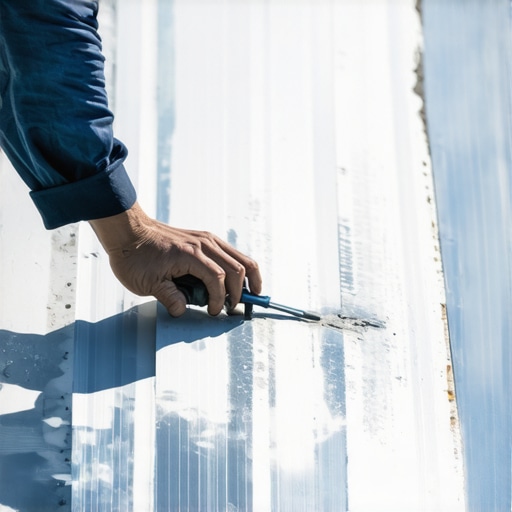
This is the core of the trick. We lift the overlapping IBR rib slightly and run a continuous 6mm bead of sealant along the entire length of the under-lap. We also apply a “donut” of sealant around every fastener. When the fasteners are re-tightened (or replaced with oversized “stitcher” screws), the sealant is compressed, creating a gasket that is physically impossible for water to bypass, even under hydrostatic pressure during a Midrand cloudburst.
Step 4: The 3-Coat Liquid Rubber Reinforcement
While the bead does the heavy lifting, we add a secondary layer of protection. We apply a 3-coat liquid rubber system, reinforced with a fiber flex membrane, over the seams and fasteners. This protects the internal bead from direct UV exposure and provides an extra “skin” of IBR roof waterproofing. This multi-layered approach is why our waterproofing contractors East Rand are often called in to fix the failed attempts of others.
Beyond the Sheets: Ridges and Parapets
While the IBR sheets are the primary surface area, the most common failure points are actually the “terminations” – the places where the roof ends. This includes roof ridge waterproofing and parapet wall flashing. In residential hubs like Lynnwood and commercial zones in waterproofing Centurion, we see a recurring theme: the roof is fine, but the ridge capping is loose.
The ‘Sealant Bead’ trick applies here too. Instead of just screwing the ridge cap down, we apply the bead to the closure strips (the foam inserts that match the IBR profile). This prevents wind-driven rain from being blown up and under the ridge. If your roof terminates into a brick wall, the flashing must be “chased” into the masonry. Simply sticking a membrane to the wall will fail because the brick and the metal have different thermal expansion rates. We use a counter-flashing technique that allows the roof to slide independently of the wall.
Failure to address these termination points is often Why Your Walk-In Shower Is Making the Hallway Walls Damp – it’s not always a plumbing leak; sometimes it’s water traveling down the cavity of a parapet wall from a poorly sealed roof ridge. For comprehensive solutions, many waterproofing companies Johannesburg trust, diagnostic accuracy is the first priority.
Comparing Solutions: Why the Bead Beats the Torch
Many property owners ask me, “Why not just use torch-on waterproofing?” My answer is always the same: Torch-on is for concrete; the ‘Sealant Bead’ is for metal. While logilinewaterproofing.co.za offers world-class torch-on services for flat roofs, applying it to IBR is a mistake.
The heat from the torch can damage the protective zinc coating of the IBR, leading to accelerated corrosion. Furthermore, torch-on bitumen is heavy and relatively inelastic compared to polyurethane. On a metal roof that is constantly shifting, the torch-on membrane eventually “de-bonds” from the high ribs of the IBR, creating hollow pockets where condensation forms. This hidden moisture causes the roof to rust from the inside out. For metal, you need the lightweight, high-elongation properties of the sealant bead and liquid rubber systems. This technical distinction is why we are the preferred waterproofing contractors East Rand for complex industrial projects.
Whether you are dealing with a standard warehouse or specialized structures, the principles remain the same. We apply similar high-stakes logic to logilinewaterproofing.co.za concrete projects and even logilinewaterproofing.co.za reservoir seals. It is all about understanding the substrate and the environmental stressors.
The Diagnostic Audit: Before the Rain Starts
The best time to fix a leak is when it’s not raining. In Midrand, the “window of opportunity” is the dry winter months. By the time the first spring rains hit, the thermal expansion cycles have already begun to stress your roof’s existing seals.
Before you commit to a full roof replacement, I recommend a diagnostic audit. We look for:
- Fastener Fatigue: Are the rubber washers (neoprene) perished?
- Lap Separation: Is there a gap between the sheets where you can see daylight?
- Capillary Tracks: Are there water stains on the purlins that don’t align with the fasteners?
If you suspect your roof is failing, don’t wait for the ceiling to collapse. A simple test, similar to The ‘Garden Hose’ Test for Verifying Shower Pan Integrity, can be conducted on your roof to identify the exact entry points of water ingress.
Conclusion
The ‘Sealant Bead’ trick is more than a “hack” – it is a professional remedial standard that respects the laws of physics. By creating an internal, flexible gasket, we address the root cause of IBR failure: thermal movement. Whether you are in Hatfield, Silverton, or the heart of Midrand, your building envelope deserves a solution that is as resilient as the Gauteng sun.
Stop chasing leaks with temporary patches. Contact a specialist who understands building diagnostics and quality management. Let’s secure your IBR roof with a system designed for the Highveld’s unique challenges. Don’t let another storm season pass with buckets in your boardroom.
About the Author:
Lloyd O. is a specialist in Building Diagnostics, Remedial Strategies, and Quality Management for the Building Envelope. With extensive experience in roofing, waterproofing, and building consultancy, Lloyd provides technical solutions for complex structural challenges across Gauteng.