The ‘Coin Drop’ Test for Finding Hollow Hardwood Planks
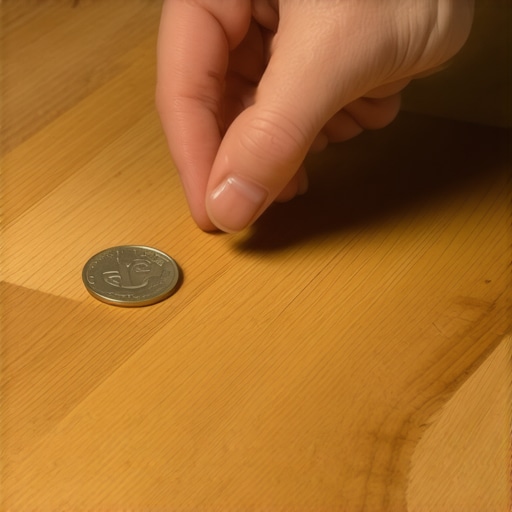
A quarter is a technical instrument when you know how to listen to it. Most homeowners see a floor as a visual choice, a color, or a grain pattern. To me, a floor is an acoustic and structural assembly. When I walk onto a job site, I do not look at the finish first. I listen to the footfalls. If a floor sounds like a drum, it is failing. The ‘Coin Drop’ test is the simplest way to identify where the bond between your hardwood and the subfloor has failed. You take a heavy coin, usually a quarter or a half-dollar, and you drop it from waist height across the surface. A solid bond produces a sharp, high-frequency ‘clink’ because the energy of the impact is transferred directly into the mass of the subfloor. A hollow spot produces a low-frequency ‘thud’ or a rattling vibration. That sound is the air gap. It is the sound of a floor that will eventually crack, squeak, or fail under the weight of your furniture.
The physics of the acoustic void
A hollow sound in a hardwood floor indicates a lack of mechanical or chemical connection between the flooring material and the substrate. This gap creates an echo chamber where sound waves reflect off the bottom of the plank and the top of the subfloor instead of being absorbed. In a glue-down installation, this usually points to poor adhesive transfer or a subfloor that was not properly leveled before the planks were laid. In a floating floor, it often signifies a subfloor dip that exceeds the tolerance of the underlayment. The physics is simple. If there is air, there is movement. If there is movement, there is friction. Friction leads to the eventual destruction of the tongue and groove locking mechanisms. This is why floor leveling is not a suggestion, it is a structural requirement for any successful installation.
The subfloor secret that installers ignore
Most guys skip the leveling compound. They think the underlayment will hide the dip. It won’t. I spent three days grinding concrete on a job last month just so the floor wouldn’t click like a castanet. The client had bought a high-end engineered oak, but the slab was like a topographical map of the Swiss Alps. If I had laid that wood over those humps and valleys, the coin drop test would have sounded like a percussion section in a high school band. I had to use a 7-inch diamond cup wheel on a handheld grinder and a full-size floor maintainer with 30-grit diamonds to bring that slab within the 1/8 inch over 10 feet tolerance required by the NWFA. It was dusty, back-breaking work that smelled like scorched stone and old lime, but it was the only way to ensure that the floor would remain silent for thirty years.
“A floor is only as good as the subfloor beneath it; deflection is the enemy of every joint.” – Master Flooring Axiom
The molecular reality of adhesive failure
Adhesives are not just glue. They are complex polymers designed to create a molecular bridge. When you use a moisture-cure urethane adhesive, it reacts with the humidity in the air and the moisture in the wood to form a rigid yet flexible bond. If the installer uses the wrong trowel size, they do not achieve enough ‘muddiness’ or transfer to the back of the plank. This leaves ‘starved’ areas. When the coin hits a starved area, you hear the hollow thud. This is especially dangerous in areas near showers or kitchens where moisture fluctuations are high. If a plank is not fully bonded, it cannot resist the natural expansion and contraction of the wood fibers. The wood will cup or crown, and because it isn’t anchored, it will eventually pull away entirely, leaving you with a floor that feels like walking on a trampoline.
Comparing material stability and sound transmission
Not all floors react to the coin drop test the same way. A solid hardwood plank has a different density and resonance than a laminate or a luxury vinyl plank. Below is a breakdown of how different materials handle the structural challenge of subfloor imperfections.
| Material Type | Typical Density (kg/m3) | Subfloor Tolerance | Acoustic Profile |
|---|---|---|---|
| Solid White Oak | 750 | 1/8″ per 10′ | High Resonance / Sharp Clink |
| Engineered Wood | 650 to 800 | 1/8″ per 10′ | Medium Resonance / Solid |
| Laminate | 800 to 900 | 3/16″ per 10′ | High Resonance / Hollow Click |
| Luxury Vinyl (SPC) | 1900 to 2100 | 3/16″ per 10′ | Low Resonance / Dense Thud |
The ghost in the expansion gap
Many hollow sounds are not in the field of the floor but at the perimeter. If an installer doesn’t leave the proper expansion gap, the floor can ‘bind’ against the wall. This causes the entire floor to lift slightly off the subfloor in a phenomenon called ‘buckling.’ When you drop a coin on a buckled floor, the hollow sound is massive. It sounds like the floor is floating an inch off the ground. In high-humidity regions like the Southeast, wood can expand by a significant margin. Without that 1/2 inch gap hidden under the baseboard, the wood has nowhere to go but up. I have seen floors lift so much they actually pop the transitions off at the doorways. This is why acclimation is the first law of flooring. You cannot take wood from a dry warehouse, install it in a humid house, and expect it to stay flat.
Regional climate and the structural bond
If you are in a dry climate like Phoenix, your subfloor is likely bone dry, which can suck the moisture out of water-based adhesives too quickly, causing a brittle bond. In a swampy climate like New Orleans, the concrete slab is a constant source of vapor. If you don’t use a vapor barrier or a moisture-mitigating adhesive, the bond will fail from the bottom up. The coin drop test will reveal this failure long before the wood starts to visibly rot. You will hear the bond ‘crunching’ as the adhesive loses its grip on the minerals in the concrete. This is why a calcium chloride test or a pinless moisture meter is a non-negotiable part of the pre-installation ritual. You are not just laying a floor. You are managing a chemical reaction between the earth and the interior environment.
Checklist for a silent installation
- Verify subfloor flatness within 1/8 inch over a 10-foot radius using a professional straightedge.
- Perform moisture tests on both the subfloor and the flooring material to ensure they are within 2% to 4% of each other.
- Select the correct trowel notch size to ensure 95% adhesive transfer to the back of the plank.
- Ensure the room has reached a consistent ‘lived-in’ temperature and humidity for at least 72 hours before opening the boxes.
- Leave a minimum 1/2 inch expansion gap around all vertical obstructions.
- Clean the subfloor of all drywall mud, wax, and oils that could act as a bond-breaker.
“Wood is a hygroscopic material; it never stops moving, and your installation must account for that eternal heartbeat.” – NWFA Technical Guidelines
Fixing the hollow spots without a total tear out
If the coin drop test reveals a few isolated hollow spots, you might not need to rip the whole floor up. We use a specialized injection system. We drill a tiny hole, often in the grain of the wood or at a knot, and inject a low-viscosity epoxy or an architectural-grade adhesive resin. This resin flows into the void and fills the air gap. We then weigh the plank down with 50-pound sandbags until the adhesive cures. This essentially ‘re-anchors’ the floor to the subfloor. It is a surgical procedure for a flooring system. However, if more than 20% of the floor sounds hollow, you have a systemic failure. At that point, you are better off pulling it up and doing the subfloor leveling right. A floor that clicks or thuds is a floor that is dying. You can’t ignore the physics of the acoustic void forever.
Final thoughts on structural integrity
The next time you walk across a hardwood floor, pay attention to the sound. Don’t just look at the stain or the shine. The sound is the truth. A well-installed floor feels like part of the earth. It is silent, solid, and immovable. If you find a hollow spot, address it early. Whether it is a carpet install where the tack strips are loose or a laminate floor that was laid over a carpet pad (which you should never do), the sound will always tell you what the installer tried to hide. Use the coin drop test. Listen to the vibrations. If the floor speaks back to you with a hollow echo, it is telling you that the foundation is lying. Fix the subfloor, and the floor will take care of itself for a lifetime.