Why You Should Never Use a Steam Mop on Your Laminate Floors
I once walked into a house where a expensive wide-plank walnut floor was cupping so bad it looked like a potato chip because the installer did not check the crawlspace humidity. The homeowner was crying because the floor was only two months old. But the worst part was that she had been trying to fix the look of it by using a steam mop. She thought the heat would somehow flatten the wood. Instead, she was injecting high-pressure vapor directly into the cellular structure of the wood. It was a total loss. I had to rip it all out, right down to the joists. That experience stuck with me. It taught me that most people do not understand the physics of what they are walking on. They see a hard surface and think it is indestructible. They treat it like the ceramic tile in their showers. But laminate is a different beast entirely. It is a high-tech sandwich of paper, resin, and wood fiber. When you introduce a steam mop to that equation, you are essentially starting a chemical and physical countdown to floor failure. My name is Jim, and I have spent twenty-five years with sawdust under my nails and a moisture meter in my pocket. I am here to tell you why that steam mop is the most dangerous tool in your cleaning closet.
The microscopic death of a fiberboard core
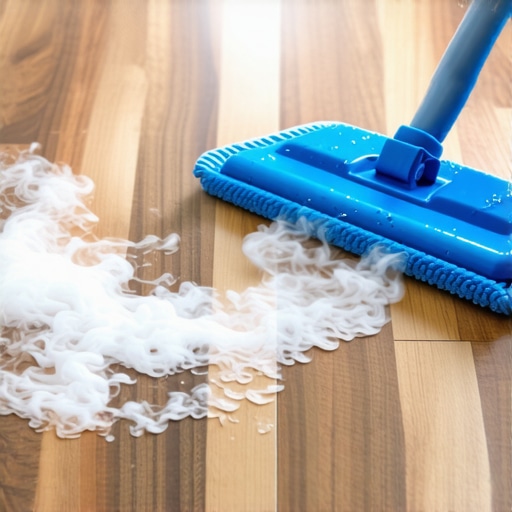
Steam mops use pressurized water vapor to clean surfaces, but on laminate floors, this vapor penetrates the micro-cracks in the wear layer and reaches the High-Density Fiberboard (HDF) core. This core is made of compressed wood fibers and resins. When steam hits these fibers, they undergo a process called hygroscopic expansion. This expansion is permanent because the heat breaks down the internal resin bonds that keep the board stable. Once those bonds are gone, the floor will never return to its original flat state. I have seen hundreds of floors ruined this way. People think they are being hygienic. They want to kill bacteria. What they are actually doing is delaminating their investment from the inside out. The HDF core is designed to be water-resistant, not waterproof. There is a massive difference between a spill you wipe up in five minutes and a jet of two-hundred-degree steam being forced into the joints under pressure.
“Moisture is the primary cause of flooring failure, representing over 90 percent of all claims in the industry.” – Master Flooring Axiom
The pressure trap inside your click joints
The locking mechanisms of laminate flooring, often called click joints, are the most vulnerable point of the entire installation because they lack the protective aluminum oxide wear layer found on the surface. When you run a steam mop over these joints, the vapor moves through the path of least resistance. It travels into the tongue and groove system. Since the vapor is in a gaseous state, it occupies more volume than liquid water and moves with more kinetic energy. This allows it to bypass the tight tolerances of the floor. Once the steam cools, it turns back into liquid water. It gets trapped. There is no airflow inside a click joint to dry it out. This trapped moisture causes the edges of the planks to swell. This is called peaking. You will feel it under your socks first. Those little ridges at the edges of the boards are the sign that your floor is already failing. No amount of floor leveling or expensive underlayment can fix a board that has peaked due to steam damage.
What happens when vapor meets resin
The chemical resins used to bind wood fibers in laminate floors are heat-sensitive and can soften when exposed to the extreme temperatures of a steam cleaner. Most laminate uses melamine-formaldehyde or urea-formaldehyde resins. These are incredibly strong under normal living conditions. However, when you hit them with a blast of steam, you are inducing a localized thermal shock. This can cause the decorative paper layer, the part that looks like wood, to peel away from the core. This is delamination. It starts as a small bubble. You might think it is just a manufacturing defect. It is not. It is the result of the adhesive bond failing. I have seen people try to glue these bubbles back down. It never works. Once the internal structure of the HDF is compromised, it becomes soft and spongy. If you recently moved from a house with a carpet install to one with laminate, you might be tempted to use deep cleaning tools. Resist that urge. Your laminate requires a dry-to-damp approach only.
The 1/8 inch that ruins everything
Successful laminate performance depends on a subfloor that is flat to within 1/8 inch over a ten foot radius, as any deviation causes the planks to flex and creates gaps where steam can enter easily. If your subfloor has dips, the floor will bounce. Every time you walk on a bouncing floor, the joints open slightly. If you are steam mopping at the same time, you are literally pumping steam into those opening and closing gaps. It is like a piston. I spend more time on floor leveling than I do on the actual installation. If the subfloor is not right, the floor is doomed before the first plank is laid. Many installers skip the grinding and the self-leveling compound. They think the foam underlayment will hide the sins of the concrete. It will not. A floor that is not flat will always fail at the joints, and steam just accelerates that failure by a factor of ten.
| Feature | Laminate Floor | Luxury Vinyl (LVP) | Solid Hardwood |
|---|---|---|---|
| Core Material | HDF Fiberboard | Stone Polymer (SPC) | Natural Timber |
| Steam Resistance | Zero / Fatal | Low / Risky | Zero / Fatal |
| Repairability | Low | Medium | High |
| Acclimation Time | 48-72 Hours | 0-24 Hours | 7-14 Days |
Why your subfloor is lying to you
Subfloors often hold hidden moisture that migrates upward through the flooring, and adding steam from the top creates a moisture sandwich that rots the laminate core from both sides simultaneously. Even if you have a moisture barrier, it is not a vault. Concrete is a sponge. It is constantly breathing. If you live in a humid climate like Houston or Miami, your subfloor is always under pressure from ground moisture. When you use a steam mop, you increase the humidity of the room and the temperature of the floor surface. This can pull moisture up from the slab through capillary action. I have pulled up floors where the underside was covered in black mold even though the top looked clean. The homeowner thought they were being healthy by steaming. In reality, they were creating a greenhouse for fungus under their feet. Always use a moisture meter before you install any hard surface. If the slab is over 3 percent moisture, you have work to do before any planks go down.
The ghost in the expansion gap
Laminate floors are floating systems that must expand and contract freely, but moisture from steam cleaning causes the planks to grow beyond their planned expansion gaps. Every room needs a gap of at least 1/4 to 3/8 of an inch around the entire perimeter. This gap is hidden by baseboards or shoe molding. If you use steam, the planks swell. They expand until they hit the wall. Once they have no more room to move, the floor will buckle. It will lift off the subfloor and create a hump in the middle of the room. I call this the ghost in the floor because it seems to happen overnight. You go to bed with a flat floor and wake up with a mountain in your hallway. The reason is the cumulative effect of steam. Each cleaning adds a bit more moisture until the wood fibers reach their breaking point. No amount of weight will push that hump back down. You have to cut the floor back to restore the gap, but the damage to the joints is usually permanent by then.
“A floor is only as good as the subfloor beneath it; deflection is the enemy of every joint.” – Master Flooring Axiom
Better ways to clean a performance surface
Maintaining a laminate floor requires a microfiber mop and a dedicated pH-neutral cleaner that evaporates quickly without leaving a residue or penetrating the joints. You should never use a soaking wet mop. You should never use vinegar. Vinegar is an acid. Over time, it will eat through the wear layer of your laminate, leaving it dull and susceptible to staining. The best method is a misting bottle. You spray a small area and wipe it immediately. If the floor stays wet for more than thirty seconds, you are using too much liquid. For those who are obsessed with sanitation, look for laminate with antimicrobial coatings integrated into the wear layer during manufacturing. This is a much safer way to handle germs than using a high-pressure steam device. Here is a checklist for proper care:
- Vacuum with a hard-floor attachment to remove grit that scratches the wear layer.
- Use felt protectors on every piece of furniture, no exceptions.
- Keep pet nails trimmed to prevent micro-punctures in the surface.
- Maintain indoor humidity between 35 and 55 percent year-round.
- Wipe up spills immediately, especially near transitions and baseboards.
The myth of the waterproof click
Marketing terms like waterproof laminate are often misleading because they usually only refer to the surface’s ability to resist standing water for a limited time, not its resistance to steam vapor. Manufacturers test their floors by putting a pool of water on the surface for 24 or 72 hours. This is great for a spilled glass of water. But steam is a different physical state. Steam is not water; it is a gas. It behaves according to the laws of thermodynamics, moving from areas of high pressure to low pressure. A waterproof warranty will almost always be voided the second you use a steam mop. Read the fine print. The manufacturers know that steam destroys their product. They use the word waterproof to compete with vinyl, but the wood-based core is still the Achilles heel. If you truly want a floor you can steam, you need to go with a full-body porcelain tile and a high-quality modified thin-set. Even then, you have to be careful with the grout. For laminate, steam is the end of the road. Treat your floor with respect, keep the moisture low, and it will last you twenty years. Use a steam mop, and I will be seeing you in six months to give you a quote for a full replacement.