The Best Cleaner for Laminate Floors That Don’t Leave a Streak
Professional Grade Solutions for Streak Free Laminate Flooring Maintenance
I smell like WD-40 and oak dust most days, and I have spent the better part of three decades on my knees with a moisture meter. I have seen it all. I once walked into a house where a expensive wide-plank floor was cupping so bad it looked like a potato chip because the installer didn’t check the crawlspace humidity, but the most common heartbreak I see is simpler. It is the homeowner who spends thousands on a high-end laminate only to ruin it with a bucket of soapy water and a string mop. They want that glass-like finish, but they end up with a hazy, sticky mess that shows every footprint. Most guys skip the leveling compound. They think the underlayment will hide the dip. It won’t. I spent three days grinding concrete on a job last month just so the floor wouldn’t click like a castanet, and that same level of precision applies to how you clean the surface. If your subfloor is not flat, your cleaning solution will pool in the low spots, leaving streaks that no amount of buffing can remove. You are not just cleaning a floor; you are maintaining a multilayered structural system designed for performance.
The science of surface residue on laminate boards
Laminate floor streaks occur when cleaning solutions with high surfactant concentrations or excessive water volumes evaporate, leaving behind mineral deposits or soap film. The aluminum oxide wear layer on high-quality laminate has a non-porous surface that rejects liquid absorption, causing detergents to pool and dry unevenly on the surface. When you look at your floor under a microscope, the wear layer is a hard, sacrificial barrier of aluminum oxide particles. These particles are meant to resist scratches, not absorb liquids. When you use a heavy-duty cleaner, the surfactants, which are chemicals designed to lift dirt, have nowhere to go. They sit on top of the non-porous surface. As the water carrier evaporates, these chemicals crystallize into a film. This film is what catches the light and creates that cloudy look. It is a chemical bond that requires a specific pH balance to break. If you are coming from a home where you had a carpet install, you might be used to the idea of deep cleaning with steam or heavy liquids. That mindset will destroy a laminate floor in months. Carpet holds dirt in fibers; laminate holds it on a microscopic plane where any residue becomes an optical distortion. You need a solution that flashes off the surface almost instantly, leaving nothing behind but the clear wear layer.
“A floor is only as good as the subfloor beneath it; deflection is the enemy of every joint.” – Master Flooring Axiom
Why water is the natural enemy of your laminate core
Water damage in laminate flooring starts at the joints where liquid penetrates the High-Density Fiberboard or HDF core through capillary action. This moisture causes the wood fibers to swell, leading to edge-peaking and irreversible structural failure that no cleaning product or surface treatment can fix once it begins. Many people buy into the marketing of waterproof laminate. They think they can treat it like the tile in their showers. They are wrong. While the top surface is waterproof, the joints are the Achilles heel. When you use a soaking wet mop, water sits in the micro-bevels of the planks. Through a process called capillary action, that water is sucked down into the HDF core. This core is essentially compressed sawdust and resin. Once it gets wet, it expands. It does not shrink back down when it dries. This is why you see the edges of planks sticking up. If you have a floor that was not prepared with proper floor leveling, the problem is worse. The planks flex as you walk on them, which creates a pumping action that pulls even more moisture into the joints. To avoid streaks and structural failure, you must use a damp-mop technique, never a wet-mop technique. The goal is to have the floor dry within thirty seconds of the cleaning pass.
The chemical failure of commercial floor waxes
Commercial floor waxes and oil-based soaps create a secondary layer on laminate that traps dirt and creates a permanent haze over the factory finish. These products are designed for porous wood or linoleum and are chemically incompatible with the inert resins used in modern laminate wear layers. I have had homeowners ask me to sand and finish their laminate floors. You cannot do that. You are working with a photograph under a layer of plastic and minerals. When you apply an oil-based soap like Murphy’s, the oil cannot penetrate the surface. It sits there and turns into a sticky magnet for dust. Over time, you build up layers of this gunk. This is the primary cause of those stubborn streaks that appear even after you think you have cleaned the floor. The only way to fix this is to strip the floor back to its original state using a mixture of white vinegar and water or a specialized residue remover. You have to be careful, though. Too much vinegar is acidic and can eventually dull the finish if used every day. You want a neutral pH, around 7.0, to ensure you are not etching the wear layer while you remove the buildup.
| Cleaning Agent | pH Level | Residue Risk | Evaporation Rate |
|---|---|---|---|
| Distilled Water | 7.0 | Zero | Moderate |
| Isopropyl Alcohol | 7.0 | Zero | Very High |
| White Vinegar | 2.4 | Low | High |
| Oil Soaps | 10.0+ | Extreme | Very Low |
| Dish Detergent | 8.0-9.0 | High | Low |
Choosing the right pH balanced solution
The most effective streak-free cleaner for laminate is a mixture of distilled water and 70 percent isopropyl alcohol which lowers the surface tension of the liquid for rapid evaporation. This combination ensures that no minerals from tap water are left behind and that the cleaning agent disappears before it can penetrate the joints. If you live in an area with hard water, using tap water is your first mistake. The calcium and magnesium in your water will leave white spots as the water dries. Distilled water is a few bucks a gallon and it is the secret weapon for a pro finish. By adding a small amount of alcohol, you increase the flash rate. This means the liquid turns to vapor faster. It also helps to cut through any oils left behind by bare feet or pets. I tell my clients to stay away from anything that smells like lemons or pine. Those scents are often carried by oils that will streak your floor. If you want a scent, light a candle. Do not put it in your floor cleaner. You need to think like a laboratory technician, not a housekeeper. The chemistry of the bond between the dirt and the floor is what we are breaking, and we want to do it without leaving a footprint of our own chemicals behind.
“Moisture content in a concrete slab must be below 3 lbs per 1,000 square feet per 24 hours for a safe installation.” – NWFA Standard
The 1/8 inch that ruins everything
Floor leveling is a structural necessity that directly impacts the visual success of your cleaning routine because uneven subfloors create pockets where cleaning fluid collects. A subfloor that deviates more than 1/8 inch over a 6 foot radius causes the laminate locking mechanisms to strain, allowing moisture to seep into the core during cleaning. I spend half my life with a 10-foot straightedge checking for dips. If your floor has a hollow spot, you will feel it when you walk. It feels soft. Every time you step on that spot, the air and moisture are pushed out of the joint. When you lift your foot, it acts like a vacuum, sucking in whatever is on the surface. If you just sprayed a bunch of cleaner there, you are literally injecting the cleaner into the heart of your floor. This is why a flat floor stays cleaner. There are no pockets for dirt to hide in and no mechanical movement to draw in liquids. If you skipped the leveling compound during the install, you are fighting an uphill battle. You have to be even more careful with how much liquid you use because your floor is essentially breathing in the cleaner every time you walk across the room.
From carpet install to laminate conversion
Transitioning from a carpet install to a laminate surface requires a complete change in environmental maintenance because laminate lacks the air filtration properties of soft flooring. Dust and allergens that were once trapped in carpet fibers now sit on top of the laminate surface, making frequent dry-mopping more important than wet cleaning. People love laminate because it is cleaner than carpet. Carpet is a giant filter that holds onto skin cells, pet dander, and dust mites. When you rip that out and put in a hard surface, all that debris has nowhere to go. It floats around until it lands on your floor. If you try to wet-mop a floor that has a layer of dust on it, you are just making mud. That mud gets pushed into the textures of the laminate and creates streaks. The first step to a streak-free floor is not the cleaner, it is the vacuum. You need a vacuum with a hard-floor setting that turns off the beater bar. If that bar is spinning, it can scratch the wear layer with the very grit it is trying to pick up. You must remove 100 percent of the dry debris before a drop of liquid touches the floor.
Microfiber density and mechanical cleaning action
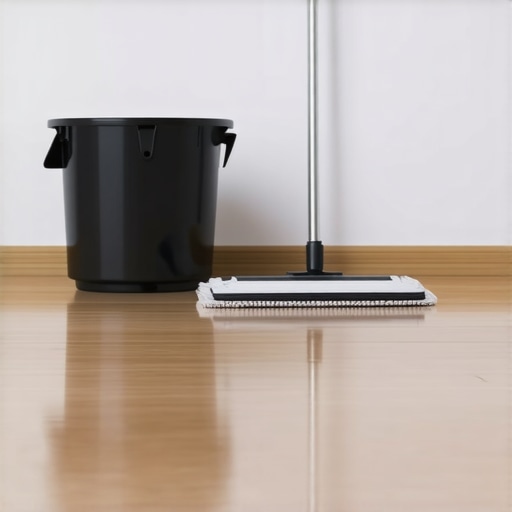
Microfiber mops are the superior tool for streak-free laminate because the star-shaped synthetic fibers have a higher surface area than cotton, allowing them to lift and trap particles rather than pushing them around. A high-density microfiber pad with a GSM of at least 300 provides the mechanical agitation needed to break the surface tension of oils without scratching the aluminum oxide finish. Not all microfiber is the same. The cheap stuff you get at the grocery store is mostly polyester and does not absorb well. You want a blend that is at least 20 percent polyamide. Polyamide is the absorbent part. When you use these pads, you should have a dozen of them. As soon as a pad gets dirty, toss it in the laundry and grab a fresh one. If you clean your whole house with one pad, you are just relocating the dirt from the kitchen to the bedroom. This is how you get that gray, hazy look. You are spreading a thin layer of diluted filth across the entire surface. I wash my microfiber pads with unscented detergent and never, ever use fabric softener. Softener is basically oil, and it will coat the fibers, making them useless for cleaning and guaranteed to leave streaks on your next job.
The professional checklist for streak free floors
- Vacuum the entire surface using a soft-brush attachment to remove all abrasive grit and loose dust.
- Mix a solution of 1 part distilled water, 1 part 70 percent isopropyl alcohol, and a teaspoon of white vinegar in a fine-mist spray bottle.
- Mop in the direction of the grain or the long side of the planks to avoid crossing the joints perpendicularly which can trap moisture.
- Work in small 4×4 foot sections to ensure the solution does not dry on the surface before you can buff it off.
- Use a clean, dry microfiber cloth to buff each section immediately after damp mopping to remove any remaining micro-droplets.
- Ensure the room has proper ventilation to allow the alcohol-based solution to flash off within seconds of application.
- Replace the microfiber pad as soon as it shows visible discoloration to prevent cross-contamination of dirt.
The final word on floor health
While most people want the thickest underlayment, too much cushion actually causes the locking mechanisms on laminate to shear off under load. This same principle of precision applies to your cleaning. You do not need power or heavy chemicals. You need the right physics. A floor is a massive investment. It is the foundation of your home’s aesthetic, but it is also a structural component that reacts to the environment. The dry heat of Phoenix will shrink your boards, while the humidity from showers in a small apartment will swell them. You have to adapt. If you follow the science of the wear layer and respect the vulnerability of the HDF core, your floors will look as good in ten years as they did the day I finished the install. Stop thinking about cleaning as a chore and start thinking about it as surface engineering. Keep your subfloor flat, your cleaner pH neutral, and your microfiber clean. That is how you win the war against streaks and keep your laminate looking like a professional architectural feature instead of a builder-grade afterthought.