Why Your Laminate Flooring Feels Sticky Even After You Mop It
Most guys skip the leveling compound. They think the underlayment will hide the dip. It won’t. I spent three days grinding concrete on a job last month just so the floor wouldn’t click like a castanet. When that floor is not flat, every time you walk on it, the planks flex. That flex creates a vacuum that sucks up dust and traps it in the joints. But the real nightmare starts when the homeowner tries to clean those dips. They pour on the soap, the soap pools in the low spots, and suddenly you have a floor that feels like you are walking on a giant piece of flypaper. I have been in this game for twenty-five years and I can tell you that a sticky floor is rarely about the dirt. It is about the chemistry of the residue and the structural failures of the subfloor that nobody wants to talk about. Smelling like oak dust and WD-40 is part of the job, and my job today is telling you why your cleaning routine is actually ruining your expensive laminate planks.
The chemical reality of surfactant buildup
Laminate floors feel sticky primarily due to the buildup of soapy residue from concentrated cleaners, the use of too much water, or the reaction between hard water minerals and surfactants. This film traps dirt at a microscopic level, creating a tacky texture that worsens with every traditional mopping cycle. When you use a store-bought cleaner, you are often applying a complex cocktail of anionic surfactants and polymers. These chemicals are designed to lift dirt, but on a non-porous surface like the melamine resin of a laminate plank, they have nowhere to go. They do not soak in. They sit on top. If the concentration is too high or the water does not evaporate fast enough, these molecules bond to the wear layer. You are not cleaning the floor anymore. You are just adding another layer of microscopic sludge. Most people think more soap means more clean. In reality, more soap means more friction. That friction is what you feel under your feet as stickiness.
“A floor is only as good as the subfloor beneath it; deflection is the enemy of every joint.” – Master Flooring Axiom
The ghost in the expansion gap
An expansion gap is the empty space around the perimeter of a room that allows laminate planks to expand and contract without buckling or peaking. If this gap is blocked by improper trim installation or if it is filled with cleaning slurry, the floor loses its ability to move, causing the joints to compress and squeeze out trapped residues. I have seen countless DIY jobs where the homeowner caulk-sealed the baseboards right down to the plank. That is a crime against physics. When the humidity changes, the floor tries to grow. If it cannot grow outward, it grows upward at the seams. Those raised seams are the first place your mop hits. They act like little scrapers, stripping the soap off your mop and banking it right in the joint. Over time, those seams become dark, sticky lines that look like a failed grease job on a tractor. You need that 1/4 inch gap. Without it, the structural integrity of the floor is compromised and your cleaning efforts are doomed to fail.
Why your subfloor is lying to you
Subfloor flatness is measured by a maximum deviation of 3/16 of an inch over a 10 foot radius, and any dip beyond this creates a reservoir for cleaning fluids. When you mop over a dip, the microfiber pad loses contact with the surface, leaving a puddle of diluted chemical behind. As the water evaporates, the chemical concentration in that dip triples. You end up with a high-density polymer film in the low spots of your room. I always tell my clients that if I can see a shadow under my 6 foot level, they are going to have a sticky floor. It is not just about the feel. It is about the physics of fluid dynamics on a non-level plane. If the subfloor is not ground down or filled with a high-quality Portland-based leveler, the floor will always have a localized residue problem. No amount of fancy mopping will fix a hole in the concrete underneath your planks.
The 1/8 inch that ruins everything
A deviation of just 1/8 inch in your subfloor can cause the locking mechanisms of laminate planks to rub together, creating static electricity that attracts fine dust particles to the surface film. This static charge acts like a magnet for pet dander and skin cells, which then bind to any soap residue present on the wear layer. It is a vicious cycle of structural movement and chemical attraction. Most homeowners ignore the subfloor because it is hidden. They want to talk about colors and textures. I want to talk about the moisture vapor transmission rate of the slab. If your slab is pushing moisture up through the planks, it is emulsifying the adhesive in the core or the wax on the joints, leading to a permanent tacky feel that no mop can ever remove. You have to understand the microscopic reality of the materials you are living on.
| Cleaner Type | pH Level | Residue Risk | Recommended Frequency |
|---|---|---|---|
| White Vinegar and Water | 2.5 | Low | Once a month |
| Commercial Gloss Enhancer | 9.5 | Extreme | Never |
| 99% Isopropyl Alcohol | 7.0 | Zero | Spot cleaning only |
| Distilled Water | 7.0 | Zero | Weekly |
The breakdown of the melamine wear layer
The wear layer of a laminate floor is made of aluminum oxide and melamine resin. This is a high-performance thermosetting plastic. It is incredibly hard, but it is also hydrophobic. When you use a cleaner with a high oil content or a high pH, the surface tension of the liquid prevents it from actually wetting the surface. Instead, it beads up and dries in place. I have seen people use oil soaps on laminate because they want it to smell like a forest. That is a death sentence for the finish. The oil never dries. It just sits there, collecting every hair and bit of grit that enters the house. If you want a floor that feels clean, you have to stop treating it like wood. It is not wood. It is a high-tech plastic composite. Treat it with the same respect you would give the windshield of a car. You would not put oil soap on your windshield, so keep it off your floor.
- Strip the old wax with a 1:4 ratio of white vinegar and distilled water.
- Use only microfiber pads that are damp to the touch, never dripping wet.
- Check the subfloor for any deflection using a straight edge.
- Avoid any cleaner that promises a shine or a glow.
- Ensure the room humidity is kept between 35 and 55 percent to prevent joint movement.
Removing the ghost of cleaners past
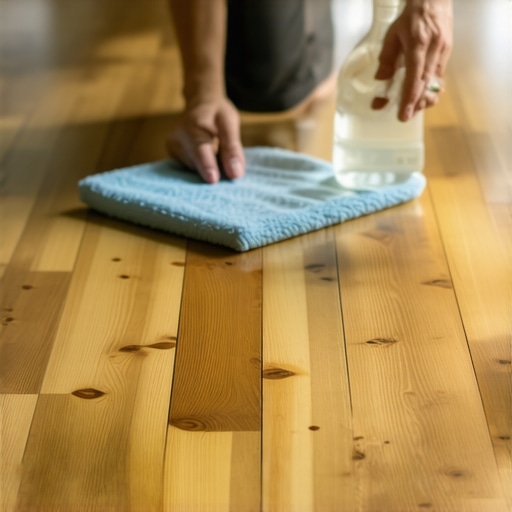
Stripping the residue from a laminate floor requires a non-reactive solvent like isopropyl alcohol or a mild acetic acid solution to break the ionic bonds of the built-up surfactants. You cannot just mop more. You have to de-layer. I usually tell people to get down on their hands and knees with a spray bottle and a stack of clean, dry microfiber cloths. Spray a small area, let it sit for thirty seconds to emulsify the gunk, and then wipe it dry immediately. If the cloth comes up grey or brown, that is the years of “cleaner” you are finally removing. It is a slow, grueling process, but it is the only way to get back to the original factory finish. Once you get that gunk off, throw away the string mop and the bucket. They are relics of a bygone era. A floor this precise requires a precise cleaning method. No shortcuts. No magic sprays. Just physics and a little bit of elbow grease. That is how we did it twenty years ago, and that is how the best in the business still do it today. It is about the structural integrity of the surface and the chemical purity of the maintenance. Anything else is just a cover-up for a bad install or a lazy routine.